


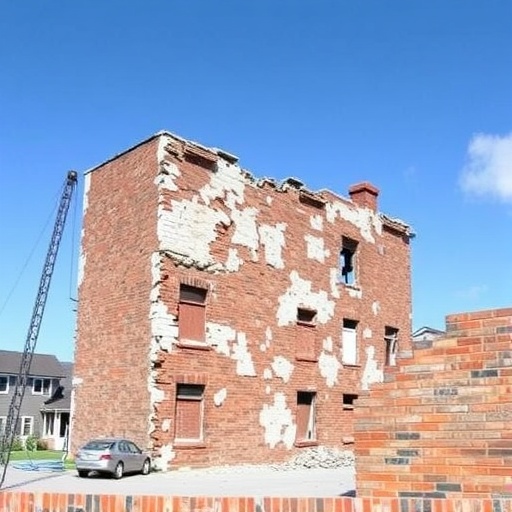
Masonry buildings are among the most vulnerable structures on Earth when the ground begins to shake, and a new study published in the Bulletin of Earthquake Engineering has now delivered one of the most comprehensive assessments yet of how these multistory structures fail when confronted with different kinds of earthquake ground motion. The research, conducted by Si-Qi Li and Peng-Chi Chen of the School of Civil Engineering at Heilongjiang University in Harbin, China, introduces a multivariate framework for measuring seismic intensity and predicting the fragility of multistory masonry buildings under both near-field and far-field earthquake sequences, including the distinctive pulse-like ground motions that emerge close to active faults.
The central insight of the work is that not all earthquakes shake buildings in the same way, and that the metrics engineers traditionally use to quantify shaking may mask crucial differences between ground motions recorded close to a fault and those recorded far away. Near-field ground motions, particularly those containing long-period velocity pulses generated by the direct rupture propagation of the fault, impart sudden, impulsive demands on structures that can be dramatically more damaging than the more slowly oscillating motions typical of distant events. Far-field motions, by contrast, tend to distribute their energy across longer durations and a broader range of frequencies, producing a different pattern of cumulative damage in masonry walls. The study set out to quantify these differences rigorously, and then to embed that understanding into predictive models of structural failure.
To accomplish this, the researchers assembled an unusually rich evidence base. They compared thirteen seismic intensity measures derived from ground acceleration, velocity, displacement, and shaking duration, evaluating which of these quantities best capture the destructive potential of pulse-like and non-pulse-like ground motions. The calibration data came from the monitoring records of two major seismic events: the 2008 Wenchuan earthquake in China and the 2024 Kyushu earthquake in Japan. Together, these records comprised 3,286,056 individual earthquake acceleration values captured by 32 seismic stations, providing a statistically powerful sample spanning both near-field and far-field conditions. The team analyzed these records against both the Chinese macrointensity standard and the Modified Mercalli Intensity scale, the two most widely used frameworks for describing the severity of shaking as experienced on the ground.
The vulnerability side of the study drew on an equally valuable resource: field survey samples of 978 multistory masonry structures that had been affected by the 2017 Jiuzhaigou earthquake in China, a magnitude 7.0 event that struck a mountainous region of Sichuan Province with dense clusters of masonry construction. From these surveys, the researchers constructed an actual failure probability matrix for the multistory masonry building cluster, capturing how frequently buildings at different damage states actually failed under known levels of shaking. This empirical grounding is what distinguishes the new framework from purely theoretical fragility models, which must often rely on simulated damage states rather than observed structural outcomes.
Building on this empirical matrix, the team developed a novel structural seismic fragility prediction model that explicitly accounts for regional seismic design acceleration, the parameter that encodes how strongly a given region’s building code requires structures to resist earthquakes. This is a critical addition, because masonry buildings in regions with higher design accelerations are theoretically built to tougher standards, and any fragility model that ignores this regional variation risks systematically misestimating vulnerability across a national building stock. The model effectively learns from the observed damage database how the interplay between design level and actual ground motion intensity translates into failure probability.
Perhaps the most technically distinctive contribution is the researchers’ relative cumulative failure assessment index model, designed to analyze the accumulated damage level of multistory masonry structures. Masonry is a brittle, quasi-brittle material: it does not yield and dissipate energy the way ductile steel or properly detailed reinforced concrete does. Instead, each cycle of strong shaking progressively degrades the material’s integrity, cracking mortar joints, separating wall elements, and weakening the load paths that hold a building together. A single intensity measure such as peak ground acceleration captures only the maximum instantaneous demand, not the total history of degradation a building endures. By proposing a cumulative index that tracks the progressive accumulation of relative failure across a ground motion sequence, the framework addresses one of the persistent blind spots in regional seismic risk assessment, particularly for mainshock-aftershock sequences where a structure damaged by the first event faces markedly higher risk from subsequent shaking.
The researchers complemented these models with a parameter estimation model for estimating the seismic failure level of a multistory masonry structure cluster, effectively creating a complete analytical pipeline: from raw ground motion records, through optimized intensity measures, to predicted probabilities of structural failure at regional scale. The entire methodology was then validated against the established structural seismic damage dataset from the Jiuzhaigou field surveys. The analytical results, the authors report, are consistent with the actual field reconnaissance, a critical benchmark demonstrating that the model’s predictions track real-world observed damage rather than diverging into mathematical abstraction.
The implications of this work extend well beyond the academic literature. Multistory masonry buildings house millions of people across China, the Mediterranean region, the Middle East, South Asia, and Latin America, often in dense urban districts where building stocks date from eras before modern seismic codes. Recent earthquake sequences, from the 2023 Kahramanmaras earthquakes in Türkiye to the 2025 Mandalay earthquake in Myanmar, have underscored how devastatingly these structures can fail. Regional risk models that can accurately distinguish the threat posed by near-field, pulse-like motions from that of far-field, long-duration sequences give emergency planners, engineers, and policymakers a far more precise tool for prioritizing retrofitting programs, designing emergency response strategies, and estimating potential losses before disaster strikes.
The technical machinery underlying the framework reflects broader trends in earthquake engineering. The comparison of thirteen intensity measures speaks to a long-standing debate in the field over which scalar or vector quantities of ground motion are most “sufficient” and “efficient” for predicting structural demand. Peak ground acceleration is easy to obtain from networks of strong-motion instruments but correlates poorly with the response of flexible structures. Spectral accelerations at a building’s fundamental period offer better correlation but require knowledge of structural dynamics that varies building by building. Velocity- and displacement-based measures, and composite measures incorporating duration, capture aspects of the damage process that acceleration alone misses, particularly for the stiffness-degrading, brittle behavior of masonry. By systematically benchmarking these alternatives against macroseismic intensity scales and observed damage, the study provides practical guidance on which measures should feed into regional fragility models for masonry construction.
The distinction between pulse-like and non-pulse-like near-fault motions also carries direct engineering consequences. Velocity pulses arise when the rupture front of an earthquake propagates toward a site at nearly the shear wave velocity of the crust, stacking the energy of the seismic waves into a single, coherent, long-period pulse. Structures with fundamental periods matching the pulse period experience a sharp amplification of demand, and masonry buildings, typically stiff with short fundamental periods, can still be caught out by the high spectral content and the abrupt onset of such motions. Incorporating pulse-like behavior into fragility prediction means that communities close to active faults, where a significant fraction of the world’s masonry building stock is located, can be assessed with models that reflect the physical reality of their exposure rather than an averaged, fault-agnostic hazard.
The study also demonstrates the value of integrating multiple independent data streams: instrumental ground motion records from dense seismic networks, macroseismic intensity scales that translate instrument readings into human-experienced severity, and systematic post-earthquake field surveys documenting actual building-by-building damage. The authors acknowledge the Institute of Engineering Mechanics of the China Earthquake Administration, whose seismic field inspection database supplied the masonry damage data, as well as Japan’s National Research Institute for Earth Science and Disaster Resilience, which provided the Kyushu earthquake records. The work was supported by funding from the National Natural Science Foundation of China and several provincial and institutional research programs, and was carried out with computational support from China’s National Facility for Earthquake Engineering Simulation in Tianjin.
For a field that has often treated fragility as a static property of building typologies, this research pushes the discipline toward a more dynamic, context-sensitive view: fragility as a function of the specific character of the ground motion, the regional design environment, and the cumulative history of damage. As seismic monitoring networks expand and post-earthquake surveys become more systematic, empirical frameworks of this kind are likely to grow ever more accurate, offering a path toward protecting the vast, aging masonry building stocks that remain among the world’s greatest seismic liabilities. The study, published on 11 August 2026, offers what the authors describe as an effective reference for estimating failure modes of multistory masonry structures under pulse-like and non-pulse-like conditions in both the near field and the far field, and it arrives at a moment when the global need for such tools has never been clearer.
Cite Scienmag News
Violet Maxwell. (September 10, 2026). Seismic vulnerability framework links intensity measures to masonry building damage. Scienmag. https://scienmag.com/seismic-vulnerability-framework-links-intensity-measures-to-masonry-building-damage/
Violet Maxwell. "Seismic vulnerability framework links intensity measures to masonry building damage." Scienmag, 10 September 2026, https://scienmag.com/seismic-vulnerability-framework-links-intensity-measures-to-masonry-building-damage/. Accessed 10 September 2026.
Violet Maxwell. "Seismic vulnerability framework links intensity measures to masonry building damage." Scienmag. September 10, 2026. https://scienmag.com/seismic-vulnerability-framework-links-intensity-measures-to-masonry-building-damage/


