


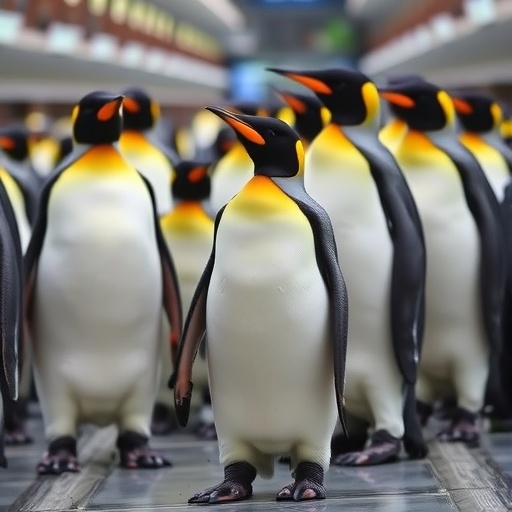
In a finding that is already making waves among conservation geneticists and penguin enthusiasts alike, researchers in Japan have decoded the immune-system genes of one of the world’s most carefully managed captive king penguin colonies, revealing 72 brand-new gene variants and a genetic family tree that stretches across five generations inside a single Japanese aquarium park. The study, published in the journal Immunogenetics, offers both a striking window into the evolutionary biology of penguins and a practical blueprint for keeping zoo populations healthy for decades to come.
King penguins, Aptenodytes patagonicus, are the second-largest penguin species on Earth, famous for their upright posture, shimmering golden-orange ear patches, and the extraordinary breeding biology that allows them to inhabit windswept sub-Antarctic islands. In the wild, they face mounting pressures from climate change, with catastrophic breeding failures linked to shifting ocean conditions already documented at major colonies. Meanwhile, in captivity, only a handful of institutions worldwide maintain breeding groups, and each animal is precious. Adventure World in Wakayama, Japan, houses one of the largest captive colonies anywhere: 99 living king penguins, drawn from 123 individuals whose records reach back more than three decades. It was here that a team led by Reona Dei, Yukie Miyazawa, and senior author Takashi Shiina of Tokai University School of Medicine turned its attention to one of the most famously complex regions of the vertebrate genome.
The target of the investigation was the major histocompatibility complex, or MHC, and specifically its class II beta-chain genes, designated Appa-CIIB in the king penguin. The MHC is a cluster of genes that encodes proteins responsible for presenting fragments of pathogens to immune cells, effectively teaching the adaptive immune system what to attack. Class II molecules handle extracellular threats such as bacteria and fungi by displaying peptide fragments to helper T cells. What makes MHC genes scientifically special is their extraordinary polymorphism: within a population, dozens or even hundreds of alternative versions, or alleles, can coexist, and the diversity is concentrated in the peptide-binding region, the molecular groove that physically cradles pathogen fragments. This pattern is widely interpreted as the signature of long-term balancing selection, an evolutionary force favoring hosts that can recognize a broad repertoire of invaders. In birds, MHC genes also influence mating preferences and disease resistance, making them powerful markers for conservation.
Studying these genes in penguins, however, has historically been technically difficult. Individual animals can carry multiple class IIB loci, sometimes with copy number differences between birds, and conventional genotyping struggles to separate true allelic variation from paralogous gene copies that look similar. To overcome this, the Japanese team developed a next-generation sequencing genotyping method tailored to the king penguin. High-throughput sequencing of amplified MHC class IIB regions allowed the researchers to resolve individual gene copies with far greater precision than older Sanger-based approaches, distinguishing alleles at multiple loci and identifying structural variation in the number of gene copies each bird carries.
The results were remarkable. From the 99 living penguins, the team identified 72 novel Appa-CIIB alleles, each encoding a distinct amino acid sequence, meaning that a colony of fewer than one hundred birds carries a wealth of previously unrecorded immune gene diversity. Phylogenetic analysis sorted these alleles into two major lineages and one minor lineage, and statistical tests applied to the peptide-binding regions of the main lineages detected clear signatures of positive selection, the classic fingerprint of host-pathogen arms races acting on the molecule’s functional surface. The researchers also inferred 34 Appa-CIIB haplotypes, the linked combinations of alleles inherited together on a chromosome, each haplotype comprising between one and three class IIB loci. That variable locus number points directly to an evolutionary history of gene duplication and recombination within the region, echoing findings from other bird species such as quail, where MHC structure is famously fluid compared with the compact, minimal MHC of chickens.
Perhaps the most striking aspect of the study is how the genetic data interwove with the colony’s living history. Using individual management records, the researchers reconstructed a pedigree showing that 114 of the 123 individuals in the dataset belonged to a single extended family spanning up to five generations, with the founding animals representing the first generation. In managed breeding programs, such deep pedigree knowledge is invaluable, because it allows coordinators to pair animals in ways that minimize inbreeding, which can depress fertility, hatchability, chick survival, and disease resistance. Yet a pedigree alone can be incomplete or inaccurate, especially in colonies where parentage is uncertain. The MHC haplotypes identified here now serve as genetic anchors for those records, allowing managers to verify relationships and to select breeding pairs that preserve the maximum amount of functional immune diversity.
The population genetic analyses delivered an encouraging headline for the aquarium: despite more than 30 years of captive maintenance, a period during which small populations typically lose genetic diversity through drift and founder effects, the Adventure World colony has retained high genetic diversity. That outcome reflects careful historical management, but it also highlights what is at stake. Loss of MHC diversity can leave populations vulnerable to epidemics, and captive penguins face real disease threats, including aspergillosis, a fungal respiratory infection that has caused significant mortality in penguin colonies worldwide. Maintaining a broad arsenal of MHC variants is therefore not an academic luxury but a concrete safeguard for animal welfare.
The study also fits into a broader scientific conversation about penguin immunogenetics. Earlier work by some of the same Japanese researchers traced MHC class II variation across penguin species, described trans-species polymorphism in banded penguins, and documented low MHC variation in the endangered Galapagos penguin, a species that survived historical bottlenecks. The new king penguin data add a third dimension to that picture: not just which variants exist, but how they are organized into haplotypes and multiple loci within a genome. Multiple class IIB loci with copy number variation suggest that the Appa-CIIB region has been repeatedly expanded and reshuffled over evolutionary time, generating the raw material for the remarkable allele diversity observed today.
There are implications beyond king penguins. As zoos and aquariums worldwide coordinate breeding programs under frameworks such as those promoted by regional zoo associations, genetic markers that capture functional immune diversity are increasingly recognized as essential complements to neutral markers like microsatellites. MHC genotyping of the kind developed in this study could be adapted for other threatened species maintained in captivity, from endangered penguins to cryptic birds where pedigree information is thin. The authors explicitly frame their work as a practical framework for managing king penguin gene diversity in captivity, supporting future breeding programs that minimize inbreeding depression and maintain healthy populations. In other words, the 72 novel alleles are not just a catalog; they are a toolkit.
For the general reader, the takeaway is a heartening one. A colony of charismatic birds waddling through a Japanese marine park turns out to be a living genetic library, safeguarding immune variation that evolved over millions of years in the Southern Ocean. With rigorous sequencing, careful record-keeping, and a bit of molecular detective work, scientists have now read a substantial portion of that library and equipped future caretakers with the knowledge to keep it intact. As wild king penguin colonies confront a rapidly changing climate, ensuring that well-managed captive populations remain genetically robust is more than a zookeeping goal; it is a small but meaningful piece of the global conservation puzzle, written in the language of duplicated genes and positively selected peptide-binding grooves, one generation at a time.
Cite Scienmag News
Juliet Wilcox. (September 10, 2026). MHC class II beta genes analyzed in captive king penguin colony. Scienmag. https://scienmag.com/mhc-class-ii-beta-genes-analyzed-in-captive-king-penguin-colony/
Juliet Wilcox. "MHC class II beta genes analyzed in captive king penguin colony." Scienmag, 10 September 2026, https://scienmag.com/mhc-class-ii-beta-genes-analyzed-in-captive-king-penguin-colony/. Accessed 10 September 2026.
Juliet Wilcox. "MHC class II beta genes analyzed in captive king penguin colony." Scienmag. September 10, 2026. https://scienmag.com/mhc-class-ii-beta-genes-analyzed-in-captive-king-penguin-colony/


