


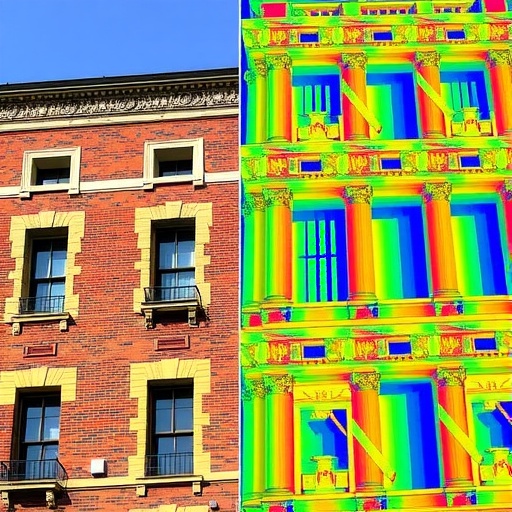
In a groundbreaking development that could revolutionize the field of earthquake engineering and structural assessment, a team of researchers has introduced an innovative approach for evaluating the seismic vulnerability of unreinforced masonry façades using photographic imagery combined with advanced macroelement-based modeling. This cutting-edge technique promises to significantly enhance both the speed and accuracy of structural assessments, particularly in urban environments where traditional inspection methods can be prohibitively time-consuming, costly, or even hazardous.
Unreinforced masonry (URM) façades, characterized by their reliance solely on masonry materials without internal reinforcement, pose a serious risk during seismic events due to their inherent brittleness and vulnerability to cracking or collapse. Historically, the seismic performance of these structures has been difficult to assess, especially in rapidly urbanizing areas or post-disaster scenarios where quick evaluations are crucial. The research spearheaded by Ariss, Pantoja-Rosero, Duarte, and colleagues leverages the latest advances in image processing and computational modeling to circumvent these challenges, enabling a non-invasive yet thorough structural evaluation from simple photographic inputs.
At the heart of this novel methodology lies a sophisticated macroelement-based computational framework, which models masonry façades as assemblies of discrete yet interacting structural elements. Unlike traditional finite element models, which often require extensive parametrization and computational resources, macroelement models strike an optimal balance between accuracy and efficiency by capturing the essential mechanical behavior of masonry panels and their failure modes. By integrating this model with high-resolution images, the researchers can reconstruct the geometry, element arrangement, and potential damage indicators without physical sampling or intrusive testing.
One of the critical breakthroughs demonstrated in the study is the algorithmic extraction of pertinent structural information directly from two-dimensional imagery. Through advanced computer vision techniques, including edge detection, texture analysis, and pattern recognition, the system identifies masonry boundaries, cracks, joints, and deformation markers with unprecedented precision. This data forms the basis for calibrating the macroelement model parameters, which then simulate seismic responses under diverse loading scenarios to predict potential failure mechanisms and displacement demands.
The implications for post-earthquake damage assessment are profound. Traditionally, engineers must conduct on-site inspections that are not only labor-intensive but expose personnel to safety risks in unstable environments. The image-based macroelement modeling technique enables remote sensing capabilities, allowing structural health monitoring teams to assess damage quickly and identify critical vulnerabilities without entering dangerous buildings. Moreover, this approach supports rapid decision-making for emergency response and prioritization of repair resources, ultimately saving lives and reducing economic losses.
Furthermore, the model’s adaptability to varying masonry typologies and construction details enhances its applicability worldwide. Masonry façades vary widely in terms of material composition, workmanship quality, and design practices, all of which influence seismic resilience. The researchers have rigorously validated their approach against a variety of masonry configurations, demonstrating robust performance in predicting failure modes such as diagonal shear cracking, out-of-plane overturning, and in-plane rocking. This versatility makes the technology attractive for global adoption in seismic-prone regions.
From a technical standpoint, the macroelement modeling encapsulates nonlinear material behavior, interface debonding, and damage evolution to simulate degradation under cyclic seismic loads realistically. The team implemented constitutive relationships that model cracking and crushing phenomena within masonry units and mortar joints, calibrated through experimental data and existing literature. By capturing these complex interactions, the model delivers realistic predictions of residual capacity and stiffness degradation, which are critical parameters for seismic resilience assessment.
Moreover, the study leverages machine learning techniques to improve the accuracy of damage detection and model parameter estimation from images. By training algorithms on extensive datasets composed of various masonry images and corresponding structural evaluations, the system fine-tunes its recognition capability to differentiate between superficial aesthetic damages and structural defects that impair seismic resistance. This nuance is particularly valuable in urban areas with aged buildings, where visual deterioration may not directly correlate with structural weakness.
The research team also addressed the challenge of dealing with varying image quality and environmental conditions such as lighting, occlusions, and weathering that commonly affect façade photography. Through pre-processing filters and enhancement algorithms, the system standardizes input data to maintain consistent analysis performance. This robustness ensures that seismic assessments remain reliable even when photographic inputs come from crowdsourced images or reconnaissance drones operating in less controlled environments.
The integration of this technology into disaster mitigation strategies shines a light on its transformative potential. Municipalities and building owners could implement routine façade monitoring using cost-effective imaging tools, enabling proactive maintenance before seismic events. Additionally, insurance companies and policy-makers could leverage the data from such assessments to refine risk models and optimize resource allocation for retrofitting or rehabilitation projects.
Importantly, this approach fosters a paradigm shift in how seismic assessments are conceptualized. Instead of relying solely on manual inspection and detailed structural modeling, the fusion of image analysis with macroelement modeling bridges the gap between data acquisition and engineering simulation. This synergy allows for scalable, repeatable, and objective evaluations, reducing human bias and enhancing transparency in structural safety judgments.
While the study represents a significant advancement, the authors also acknowledge areas requiring further research. Extending the approach to three-dimensional façade representations, incorporating real-time seismic monitoring data, and refining damage progression models are among future goals that will further elevate the method’s precision and practical utility. Additionally, widespread field implementation will require regulatory acceptance and integration into existing engineering standards.
The timing of this innovation is particularly relevant given increasing urbanization in seismically active zones worldwide. Many cities contain a high density of unreinforced masonry constructions, often aged and not designed for earthquake resilience. The ability to rapidly assess these vulnerable stocks using accessible technology has the potential to reduce catastrophic losses substantially. Furthermore, the technique aligns well with current trends in digital twin technologies and smart city frameworks, where continuous monitoring and data-driven management are prioritized.
In summary, the seismic assessment of unreinforced masonry façades from images using macroelement-based modeling marks a formidable step forward in earthquake engineering. By combining image-derived data with advanced structural simulations, this method provides a powerful tool for understanding and mitigating seismic risks more effectively. Its adoption could herald a new era of rapid, safe, and precise infrastructure evaluation, crucial for enhancing community resilience in the face of natural disasters.
As the field advances, interdisciplinary collaborations blending structural engineering, computer vision, and data science will be pivotal in refining and disseminating this technology. The work of Ariss and colleagues stands as a beacon illustrating the potential of such cross-domain innovation to solve longstanding engineering challenges. For urban centers prone to seismic hazards, this approach promises a smarter, safer future where technology enables timely interventions and informed decision-making.
The full details of this pioneering research are documented in the article “Seismic assessment of unreinforced masonry façades from images using macroelement-based modeling,” published in Communications Engineering. This publication offers invaluable insights and benchmarks for practitioners and researchers striving to enhance the resilience of masonry structures globally.
Ariss, M., Pantoja-Rosero, B.G., Duarte, F. et al. Seismic assessment of unreinforced masonry façades from images using macroelement-based modeling.
Commun Eng 4, 155 (2025). https://doi.org/10.1038/s44172-025-00487-2
Cite Scienmag News
Denise Maddox. (August 16, 2025). Seismic Analysis of Masonry Facades via Imaging. Scienmag. https://scienmag.com/seismic-analysis-of-masonry-facades-via-imaging/
Denise Maddox. "Seismic Analysis of Masonry Facades via Imaging." Scienmag, 16 August 2025, https://scienmag.com/seismic-analysis-of-masonry-facades-via-imaging/. Accessed 4 September 2026.
Denise Maddox. "Seismic Analysis of Masonry Facades via Imaging." Scienmag. August 16, 2025. https://scienmag.com/seismic-analysis-of-masonry-facades-via-imaging/


