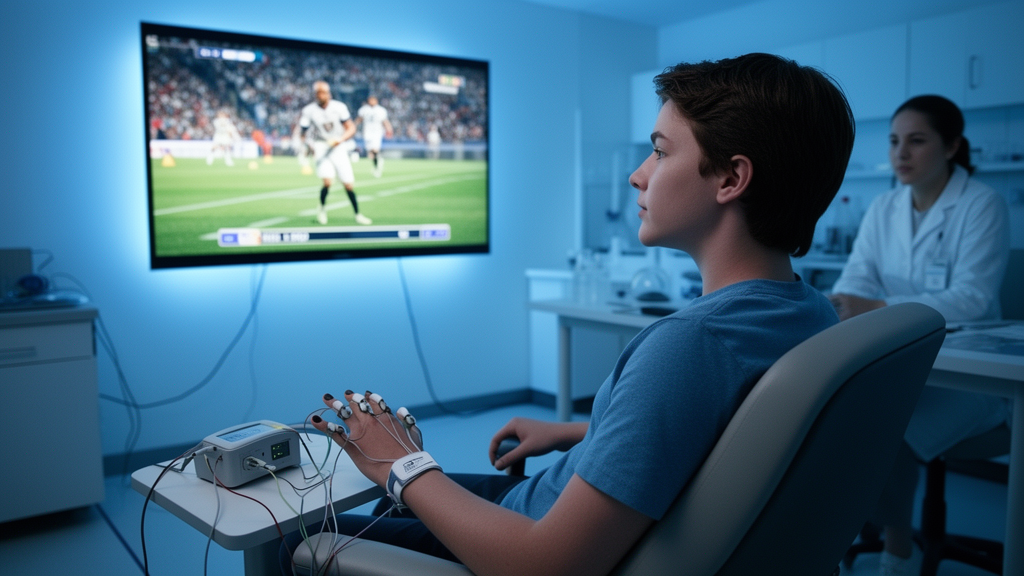
Researchers have mapped how specific audiovisual patterns in real television commercials coincide with moment-to-moment changes in viewers’ physiological arousal, using electrodermal activity recorded while people watched nationally aired Spanish sport advertisements.
The research team analyzed 750 seconds of footage drawn from 22 sport advertisements that had aired nationally in Spain between 2023 and 2025. Thirty participants watched the commercials while the researchers recorded group-level electrodermal activity, a physiological signal commonly used as an index of emotional arousal. Rather than treating each advertisement as a single unit, the authors synchronized the physiological recording with the content of the commercials second by second, allowing them to ask which features were present at moments of higher or lower arousal.
Methodologically, the electrodermal signal was decomposed into two components: a tonic measure, reflecting slower changes in baseline skin conductance level, and a phasic measure, capturing brief bursts of activity associated with discrete responses. Both were expressed as bounded arousal indices ranging from 0 to 1. Each second of the commercials was then coded across nine audiovisual categories by two independent raters, whose agreement was high, with kappa coefficients ranging from 0.83 to 0.94.
The analysis operated at two levels. At the micro level, the researchers used one-way ANOVAs with minimum cell-size rules, repeating the analyses with cluster-robust standard errors clustered by advertisement to account for the fact that many seconds come from the same spot. At the macro level, they correlated the density of each feature within an advertisement with the spot’s overall arousal across the 22 advertisements.
Several findings emerged. Sound design and location subtype were significant modulators of arousal under both classical and cluster-robust inference, making them the most robust differentiators in the corpus. Shot type reached significance only under cluster-robust inference. Lighting, on-screen branding, and emotional elements were significant only under classical inference, a pattern the authors treat cautiously given the nesting of seconds within spots. Role, gender, and location category did not differentiate physiological responses.
Some of the most striking descriptive observations came from specific feature combinations. Intimate human voices, described as murmurs, coincided with the highest tonic arousal values in the entire corpus, with a mean of 0.81, although the authors note this was a feature observed in a single advertisement and report it as an illustrative case rather than a generalizable effect.
At the level of whole advertisements, the density of extreme close-ups was the only nominal positive correlate of phasic arousal, with a correlation of .433 and an uncorrected p-value of .044. However, after correction for false discovery rate, this association was no longer statistically significant, with a corrected p-value of .257. Densities of auditory complexity showed no association with arousal at all. For this reason, the authors describe all macro-level associations as hypothesis-generating rather than established findings.
The authors are explicit about the limitations of their design. Because seconds are nested within advertisements, observations are not independent, and many of the coded features recur in only a few of the 22 spots, which limits statistical power and generalizability. All effects are therefore interpreted as associations within this particular corpus rather than causal effects of the audiovisual features. In addition, no memory outcome was measured, so the study cannot speak to whether moments of elevated arousal corresponded to better recall or persuasion, questions that remain for future experimental work.
With those caveats in place, the authors position second-by-second synchronization of electrodermal activity with content coding as a diagnostic, hypothesis-generating tool. Rather than delivering definitive rules about what makes sport advertising emotionally engaging, the approach is intended to locate where arousal dynamics occur within real commercials and to identify candidate features, such as sound design, location subtype, and intimate vocal elements, that merit controlled experimental testing.
Subject of Research: Second-by-second electrodermal activity analysis of audiovisual features in sport advertising
Article Title: Audiovisual patterns of emotional advertising and physiological engagement: a marketing science perspective on sport storytelling
Article References: López-Iglesias, M., Matellanes-Lazo, M., Carreño-Villada, J.-L., & Martín-Guerra, E. (2026). Audiovisual patterns of emotional advertising and physiological engagement: a marketing science perspective on sport storytelling. Frontiers in Communication, 11, 1978623. https://doi.org/10.3389/fcomm.2026.1978623
Image Credits: AI Generated
DOI: 10.3389/fcomm.2026.1978623
Keywords: sport advertising, electrodermal activity, physiological arousal, emotional advertising, audiovisual patterns, marketing science, skin conductance, brand storytelling, content coding, advertising research, Audiovisual, patterns
Cite Scienmag News
Courtney Benton. (October 28, 2026). Second-by-Second Skin Readings Map Audiovisual Features Linked to Viewer Arousal in Sport Ads. Scienmag. https://scienmag.com/second-by-second-skin-readings-map-audiovisual-features-linked-to-viewer-arousal-in-sport-ads/
Courtney Benton. "Second-by-Second Skin Readings Map Audiovisual Features Linked to Viewer Arousal in Sport Ads." Scienmag, 28 October 2026, https://scienmag.com/second-by-second-skin-readings-map-audiovisual-features-linked-to-viewer-arousal-in-sport-ads/. Accessed 29 October 2026.
Courtney Benton. "Second-by-Second Skin Readings Map Audiovisual Features Linked to Viewer Arousal in Sport Ads." Scienmag. October 28, 2026. https://scienmag.com/second-by-second-skin-readings-map-audiovisual-features-linked-to-viewer-arousal-in-sport-ads/