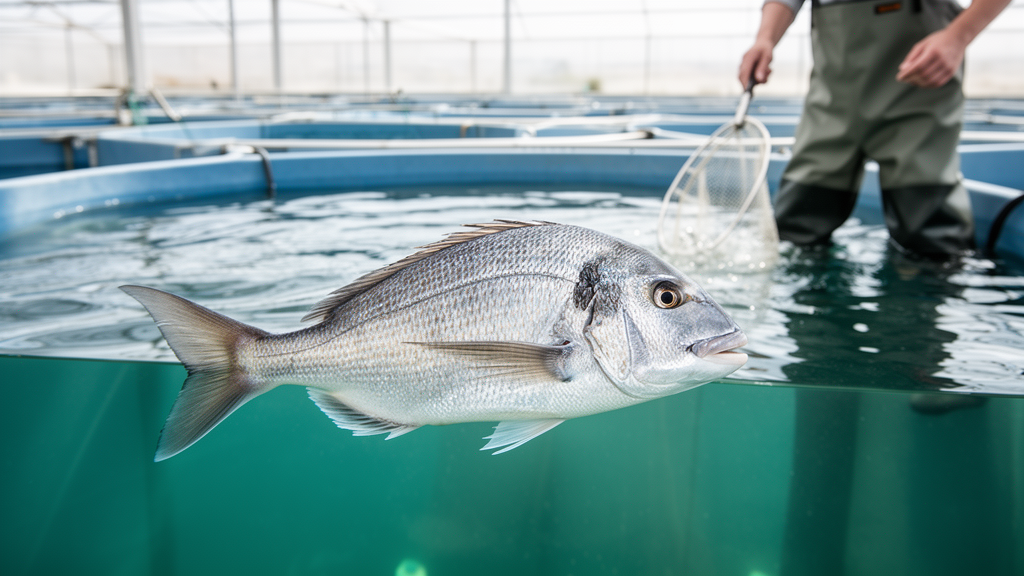
On fish farms, what a fish eats has long been assumed to steer the microbes living in and on its body. A new longitudinal study of gilthead sea bream (Sparus aurata) suggests that assumption needs a major revision: across an entire production cycle, the passage of the seasons explained more of the variation in gut and skin microbial communities than diet did, and dietary effects, where they appeared at all, were fleeting and dependent on the time of year.
The research, published in the journal Animal Microbiome, was carried out by Ricardo Domingo-Bretón, Federico Moroni, Álvaro Belenguer, Josep Alvar Calduch-Giner, Fernando Naya-Català, Jaume Pérez-Sánchez and colleagues. The team analysed 16S rRNA time-series data from four compartments at once: the fish’s skin and gut mucosa, and the inlet and rearing water of the production system. This multi-compartment, longitudinal design is what allowed the researchers to separate the influence of diet from the influence of seasonal environmental change, something that shorter or single-compartment studies cannot reliably do.
The results were striking. Temporal progression emerged as the dominant factor structuring the microbiome, consistently explaining more compositional variance than diet in both gut and skin communities. Dietary effects were detected in skin-associated communities, but these responses were transient and season-dependent. In contrast, the autochthonous gut mucosal populations showed strong resilience to dietary perturbation, retaining a persistent core microbiome of 20 taxa independently of diet and time. Yet even within this stable core, most taxa exhibited pronounced temporal fluctuations in abundance, revealing a subtle coexistence of taxonomic persistence and dynamic abundance shifts within the intestinal microbiome.
The environmental side of the study proved equally revealing. Inlet seawater communities showed reproducible seasonal rhythmicity over two consecutive years, strongly associated with seawater temperature. When fish were introduced into the system, the rearing water communities were restructured, becoming enriched in fish-associated and copiotrophic taxa commonly reported in aquaculture systems, including Vibrio, Tenacibaculum, Photobacterium and Alteromonas. Notably, the skin and rearing water microbiomes displayed parallel temporal trajectories, with a subset of genera showing highly concordant seasonal dynamics across compartments, indicating ecological coupling at the host–water interface.
Taken together, the findings suggest that microbiome structure in gilthead sea bream under production conditions is driven primarily by seasonal environmental factors rather than diet. The authors conclude that seasonal filtering constrains microbiome responsiveness to diet while simultaneously structuring both host-associated and surrounding water communities. For aquaculture, this carries a practical implication: dietary interventions interpreted without longitudinal sampling may be misattributed, since apparent dietary effects could in fact reflect seasonal change. The coupled microbial dynamics between host and environment also point to a promising application, as rearing-water microbiome analysis could serve as a non-invasive proxy for tracking host-associated microbial changes within aquaculture systems.
For a species reared in environmentally exposed systems, where ectothermic physiology ties the fish’s internal world to the temperature of the water around it, the study underscores how climate-related seasonal variation may shape farmed fish microbiomes in ways that feed formulations alone cannot override. The work is being shared early as a peer-reviewed, accepted manuscript, citable with a permanent DOI and subject to further editorial edits before the final version of record appears.
Subject of Research: Seasonal and dietary drivers of microbiome structure across host and water compartments in farmed gilthead seabream
Article Title: Diet and seasonal dynamics shape microbiome structure across host and environmental compartments in gilthead seabream (Sparus aurata): a longitudinal multicompartment study
Article References: Domingo-Bretón, R., Moroni, F., Belenguer, Á., Calduch-Giner, J. A., Naya-Català, F., & Pérez-Sánchez, J. (2026). Diet and seasonal dynamics shape microbiome structure across host and environmental compartments in gilthead seabream (Sparus aurata): a longitudinal multicompartment study. Animal Microbiome. https://doi.org/10.1186/s42523-026-00649-3
Image Credits: AI Generated
DOI: 10.1186/s42523-026-00649-3
Keywords: gilthead seabream, microbiome, aquaculture, seasonality, 16S rRNA, gut microbiota, skin microbiome, rearing water, diet, temperature, Vibrio, longitudinal study
Cite Scienmag News
Daisy Hatcher. (October 28, 2026). Season beats diet: temperature drives farmed seabream microbiomes. Scienmag. https://scienmag.com/season-beats-diet-temperature-drives-farmed-seabream-microbiomes/
Daisy Hatcher. "Season beats diet: temperature drives farmed seabream microbiomes." Scienmag, 28 October 2026, https://scienmag.com/season-beats-diet-temperature-drives-farmed-seabream-microbiomes/. Accessed 28 October 2026.
Daisy Hatcher. "Season beats diet: temperature drives farmed seabream microbiomes." Scienmag. October 28, 2026. https://scienmag.com/season-beats-diet-temperature-drives-farmed-seabream-microbiomes/