


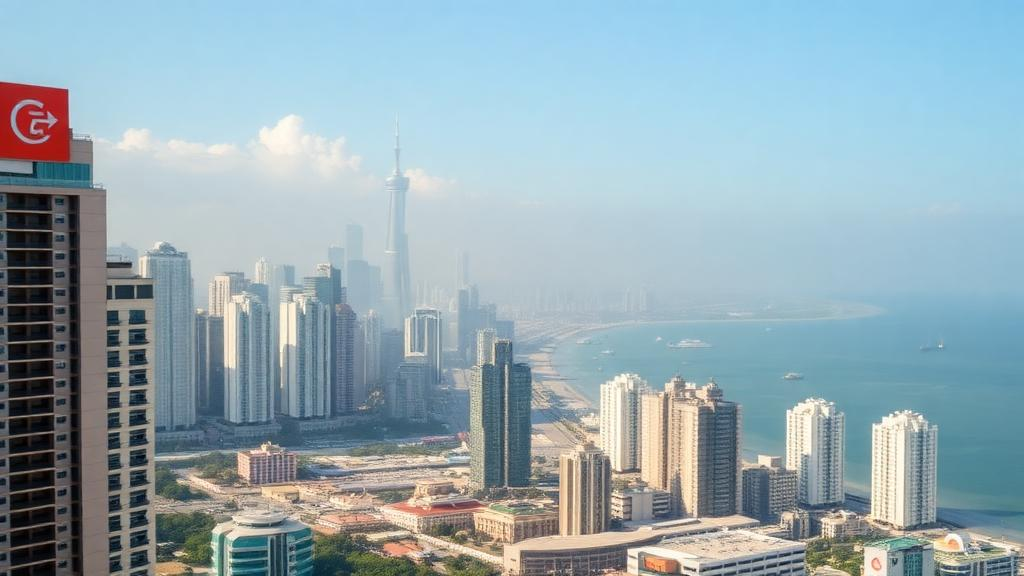
For years, coastal megacities have poured billions into cutting emissions, only to watch their air quality respond in baffling and sometimes contradictory ways. Fine particulate matter, the notorious PM2.5, has generally trended downward, yet ground-level ozone has crept upward in many of the same cities during the very same period. A new study published in Air Quality, Atmosphere & Health offers a compelling explanation for this paradox, and it comes from an unexpected quarter: the daily rhythm of sea and land breezes that most residents barely notice. Using four years of observations and a sophisticated air quality model, researchers led by Kexin Liu and Lin Wu of Nankai University, together with colleagues from the Tianjin Environmental Meteorological Center and the Institute of Atmospheric Physics of the Chinese Academy of Sciences, have shown that the local wind circulation along the coast of Tianjin fundamentally reshapes how pollutants respond to emission controls. Their findings suggest that the same policy can succeed spectacularly on one type of day and be partially undone on another, depending entirely on which way the wind is blowing in from the sea.
The research team focused on Tianjin, a sprawling port megacity on the Bohai Bay in northern China, during the period from 2017 to 2020. These years coincided with aggressive national emission reduction programs, making the city an ideal natural laboratory for separating the effects of pollution controls from those of weather. The scientists combined ground-based chemical observations with the WRF-NAQPMS modeling system, a coupled meteorology and air quality model widely used in China for forecasting and policy analysis. By running the model with fixed meteorology and varying emissions, and vice versa, they could disentangle how much of the observed change in each pollutant came from human activity and how much came from the atmosphere itself. This decomposition technique, often called a factor-separation or scenario approach, is one of the most rigorous tools available for attributing air quality trends, and the team applied it not just to annual averages but to distinct weather regimes defined by the sea-land breeze cycle.
The headline numbers from the study are striking in themselves. Emission reductions between 2017 and 2020 drove PM2.5 concentrations down by 7.1 micrograms per cubic meter, a decline driven primarily by reductions in carbonaceous components and sulfate, the chemical fingerprints of combustion and industrial sources. Yet over the same period, ozone rose by 24.5 micrograms per cubic meter according to the model, closely matching the net observed increase of 23.0 micrograms per cubic meter. Meteorology, averaged across the whole year, played a comparatively minor role, contributing a decline of 1.7 micrograms per cubic meter for PM2.5 and 1.4 micrograms per cubic meter for ozone. On paper, this looks like a familiar story: cleaner particles, dirtier air in a different form, with weather as a footnote. But the averages, the researchers found, were hiding the real drama.
When the team broke the data down by circulation regime, the modest annual meteorological contributions dissolved into wildly divergent day-by-day realities. On sea breeze days, when cool marine air pushes inland during the afternoon, meteorology was the only regime in which it actually increased ozone, adding 2.2 micrograms per cubic meter. More remarkably, the sea breeze offset 5.1 micrograms per cubic meter of the PM2.5 reductions that emission controls had achieved, effectively erasing a substantial fraction of the hard-won progress. During these periods, the researchers also observed concurrent increases in nitrate and elemental carbon, indicating that the marine air flow was not simply diluting pollution but actively reshaping its chemical composition, likely by transporting and transforming aerosol precursors along the coast. The sea breeze, in other words, is not a cleansing wind; it is a chemical conveyor.
The land breeze told the opposite story with even greater intensity. On land breeze days, when the nocturnal flow reverses and carries air from the city out toward the sea, interannual meteorological changes favored PM2.5 reduction with a contribution of 32.70 micrograms per cubic meter, a figure nearly five times larger than the annual mean decline. This meteorological assist was accompanied by substantial reductions in nitrate and elemental carbon, confirming that the ventilation effect was removing real pollution rather than merely redistributing it. Then there were the stagnant, stable days, the bane of every air quality manager. Under these conditions, meteorological factors were the primary driver of interannual PM2.5 increases, contributing a staggering 30.80 micrograms per cubic meter, and PM2.5 peaks exceeded 150 micrograms per cubic meter even with emission reductions in full force. On such days, the atmosphere itself overwhelmed the benefits of a decade of controls.
The diurnal asymmetry the study documents adds another layer of complexity. Daytime sea breezes dominated ozone production, because the marine air arriving over the sun-heated land encounters a shallow, turbulent boundary layer in which photochemistry runs at full throttle. Precursor gases trapped near the surface are efficiently mixed and cooked into ozone under intense solar radiation. At night, the land breeze stage favored pollutant accumulation and secondary formation, as weak winds and temperature inversions allowed emissions to pool near the ground while heterogeneous chemistry continued to manufacture secondary aerosols in the dark. This means that a single 24-hour cycle in a coastal city contains two chemically distinct pollution environments, each responding differently to the same emission inventory. A policy calibrated against daily averages will inevitably misjudge both.
Why does ozone rise even as its precursors fall? The answer lies in the nonlinear photochemistry of the troposphere. Ozone formation depends on the ratio of nitrogen oxides to volatile organic compounds, and in many Chinese cities the chemical regime is what atmospheric scientists call volatile organic compound limited or transitional. When nitrogen oxide emissions drop, ozone destruction by nitrogen oxides weakens faster than ozone production, so ozone concentrations climb even though the ingredients for smog are diminishing. This VOC-limited behavior has been documented across the North China Plain and is a central reason why the co-control of PM2.5 and ozone has become the defining challenge of Chinese air quality policy. The Tianjin study adds a crucial spatial dimension to this problem: the sea-land breeze modulates the local chemical regime on a daily cycle, meaning the effective sensitivity of ozone to emissions can flip between morning and afternoon.
The implications for policy are profound. The study’s central conclusion is that regime-specific meteorological contributions dwarf the annual averages used in most policy evaluations, and that sea-land breeze circulation therefore fundamentally modulates pollutant responses to emission controls. The authors argue for circulation-specific co-control strategies in coastal megacities. In practice, this could mean scheduling stricter temporary emission curbs on forecast sea breeze days, when ozone formation will be amplified and particulate reductions partially offset, while relaxing controls on land breeze days when natural ventilation does much of the work. It could also mean targeting volatile organic compound reductions more aggressively than nitrogen oxides in coastal zones, to push the photochemical regime toward one where further nitrogen oxide cuts actually lower ozone. Cities from the Pearl River Delta to the Yangtze River Delta, where sea breeze effects on coastal ozone are already documented, could apply the same framework.
There is also a warning embedded in the findings about the future. Related research has shown that ocean warming and urbanization are weakening sea-land breezes in coastal megacities, which means the natural ventilation and chemical transport patterns that the Tianjin study quantified are themselves changing. A control strategy optimized for today’s breeze climatology may misfire as the circulation shifts. Moreover, the study’s demonstration that stagnant conditions can push PM2.5 above 150 micrograms per cubic meter despite emission reductions underscores that meteorological variability remains a first-order driver of extreme pollution events, not a second-order correction. Climate change is expected to alter the frequency and persistence of such stagnant episodes across many densely populated coastal regions, adding yet another moving part to an already intricate system.
What makes this study resonate beyond atmospheric science is its reframing of a familiar frustration. Residents of coastal cities have long sensed that some breezy days feel fresh and others feel thick with haze, and now there is a quantitative framework explaining why. The daily dance between sea and land is not background noise in the air quality record; it is a key modulation, capable of amplifying or erasing the effects of policy at scales that rival the policies themselves. For the growing number of megacities clustered along the world’s coastlines, from Tianjin to Mumbai to Lagos, the message is clear: to manage air pollution in a coastal city, you must first learn to read the wind.
Subject of Research: How sea–land breeze circulation modulates PM2.5 and ozone responses to emission reductions in coastal megacities
Article Title: Key modulation of PM2.5–O3 responses to emission reductions by sea–land breeze in coastal megacities
Article References: Liu, K., Wu, L., Lu, M., Tang, X., Kong, L., Zhang, Y., & Wang, Z. (2026). Key modulation of PM2.5–O3 responses to emission reductions by sea–land breeze in coastal megacities. Air Quality, Atmosphere & Health, 19(10), Article 220. https://doi.org/10.1007/s11869-026-02038-w
Image Credits: AI Generated
DOI: 10.1007/s11869-026-02038-w
Keywords: PM2.5, ozone, sea–land breeze, emission reductions, coastal megacities, air quality modeling, WRF-NAQPMS, Tianjin, photochemistry, meteorology, co-pollution, co-control strategies
Cite Scienmag News
Russell Cooper. (October 1, 2026). Sea Breezes Secretly Sabotage Clean-Air Gains in Coastal Megacities. Scienmag. https://scienmag.com/sea-breezes-secretly-sabotage-clean-air-gains-in-coastal-megacities/
Russell Cooper. "Sea Breezes Secretly Sabotage Clean-Air Gains in Coastal Megacities." Scienmag, 1 October 2026, https://scienmag.com/sea-breezes-secretly-sabotage-clean-air-gains-in-coastal-megacities/. Accessed 4 October 2026.
Russell Cooper. "Sea Breezes Secretly Sabotage Clean-Air Gains in Coastal Megacities." Scienmag. October 1, 2026. https://scienmag.com/sea-breezes-secretly-sabotage-clean-air-gains-in-coastal-megacities/


