


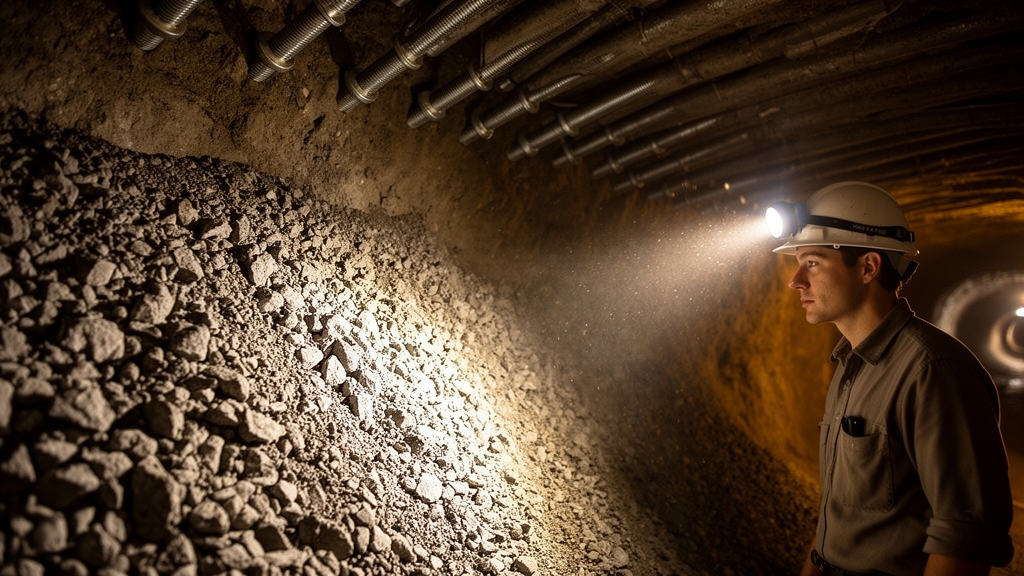
Deep beneath the coalfields of Shaanxi Province, China, one of mining’s most violent hazards—rockburst—is being tamed not with high-tech supports but with crushed rock waste. Solid backfill mining pumps broken gangue, the rocky refuse of coal extraction, into the emptied cavities of a mine to prop up overlying strata and absorb the stresses that would otherwise build toward a sudden, explosive failure. The success of that strategy hinges on a deceptively simple property: how stiffly the backfill compacts under load. A new experimental study now shows that something as mundane as the tumbling particles experience during transport can dramatically change that stiffness, and in a way engineers can exploit.
Researchers Bangyong Yu, Jinglin Jiang and Cheng Shen of Changzhou Vocational Institute of Engineering set out to answer a question that has received surprisingly little systematic attention: what happens to gangue particles, morphologically and mechanically, as they are abraded during vertical feeding, underground transport and pre-compaction? Their work, published in Frontiers in Earth Science, combined a Los Angeles abrasion machine, three-dimensional particle scanning and confined compression tests to trace the full chain from abrasion through shape change to mechanical response. The findings suggest that abrasion is not merely degradation—it can be a controllable tool for improving backfill quality.
The team collected gangue from the −592 m level of the Xiaojihan Coal Mine, crushed and sieved it into fractions between 10 and 30 millimetres, and blended the fractions according to a Talbot gradation with an exponent of 0.4 to mimic real backfill material. Each 5,000-gram specimen was then tumbled in a standard Los Angeles drum alongside twelve steel balls at one of five abrasion levels: 0, 250, 500, 750 or 1,000 revolutions. These levels were chosen to span mild handling through multi-stage transport, with the 500-revolution condition serving as the ASTM C131 standard baseline. After each run, the material was sieved, scanned and compressed to 16 megapascals in a servo-controlled rig.
The size distribution shifted dramatically as revolutions accumulated. After 1,000 revolutions, the 25–30 mm fraction had lost 87.6 percent of its mass, leaving only 12.5 percent of its initial proportion, while particles finer than 1.7 millimetres had grown to 29.9 percent of the total. Notably, the 20–25 mm range first gained mass by 250 revolutions before declining—evidence that coarse particles were breaking apart at the same time as intermediate particles were being ground down. The abrasion loss itself, defined as the mass fraction finer than 1.7 mm, rose almost perfectly linearly with revolution count, with a coefficient of determination of 0.996, though the final interval showed an uptick suggesting accumulated internal damage crossing a fragmentation threshold.
Three-dimensional scanning at 0.1 mm resolution revealed the shape story behind these numbers. Flatness—roughly, how elongated a particle is—generally fell with abrasion, with the 15–20 mm range showing the largest drop of 0.23. Sphericity climbed steadily, from initial values between 0.796 and 0.813 to between 0.843 and 0.871 after 1,000 revolutions, with the smallest particles gaining the most. That makes physical sense: smaller particles have a higher surface-area-to-volume ratio, so the same grinding action removes proportionally more of their angular protrusions. By the end of testing, shape differences among size fractions had narrowed considerably, indicating abrasion was homogenizing the population into rounder, more equiaxed grains.
Those morphological changes paid mechanical dividends. The initial tapped density of the packed specimens rose from 1.370 to 1.769 grams per cubic centimetre, following an exponential growth curve that plateaued near 750 revolutions. In compression, the secant modulus during the main loading stage—2 to 16 megapascals, the stress regime imposed by overlying strata—nearly doubled, from 80.77 to 156.40 megapascals. The final axial strain at 16 megapascals dropped from 0.206 to 0.106, a 48.5 percent reduction, meaning the abraded backfill deformed only about half as much under the same load. The most pronounced jump in stiffness occurred between 500 and 750 revolutions.
The authors explain these gains through a cascading mechanism. Early in the process, coarse particles fragment—almost 60 percent of the 25–30 mm mass vanished within the first 250 revolutions—but the fragments initially do little more than fill voids without altering the load-bearing skeleton. In the middle stage, continued breakage generates abundant intermediate and fine material that slots into gaps between coarse grains, while worn edges allow particles to rotate and slide into denser arrangements. Contacts shift from sharp point-to-point interactions toward distributed surface-to-surface contacts, transmitting stress more uniformly through force chains. Tapped density rose linearly with sphericity and fell linearly with flatness, both with coefficients of determination above 0.95, tying packing efficiency directly to particle shape.
The study identifies three distinct stages: a mild modification stage from 0 to 250 revolutions, where the compaction modulus barely budged; a rapid improvement stage from 250 to 750 revolutions, where strain fell by 42.6 percent and stiffness surged; and a stabilization stage from 750 to 1,000 revolutions, where gains flattened even as abrasion loss kept climbing. The 500–750 revolution window emerged as the sweet spot—by 750 revolutions the material had already reached 92.9 percent of the stiffness achieved at 1,000 revolutions, so further tumbling delivered diminishing returns alongside continued material loss.
Perhaps the most practical result is the correlation between abrasion loss and final axial strain, with a coefficient of determination of 0.918. Because abrasion loss can be measured rapidly by simple sieving, it can serve as a cheap proxy for the compaction state of a backfill batch—no 3D scanning or compression testing required. In the field, engineers could adjust transport distance, handling stages, feeding methods and initial gradation to steer the material toward the favorable 750-revolution abrasion state before it enters the goaf, improving stress transfer to the coal ribs and reducing rockburst risk while avoiding wasteful over-processing.
The authors caution that the results rest on a single gangue lithology from the Xiaojihan mine and a single gradation, and that Los Angeles revolutions are a relative measure of abrasion intensity rather than a direct match for real handling conditions. Gangue composition, cementation and weathering vary widely, so the quantitative values should be applied elsewhere with care. Even so, the study reframes a familiar nuisance—particles rattling around in a mine’s transport system—as a tunable process, one that could make backfilled waste rock a stiffer, safer guardian against the sudden violence of deep-mining rockbursts.
Subject of Research: Abrasion-induced morphology evolution and compaction behavior of gangue particles used in coal mine backfill
Article Title: Morphology evolution and compaction behavior of gangue particles under abrasion: an experimental study
Article References: Yu, B., Jiang, J., & Shen, C. (2026). Morphology evolution and compaction behavior of gangue particles under abrasion: an experimental study. Frontiers in Earth Science, 14, Article 1948926. https://doi.org/10.3389/feart.2026.1948926
Image Credits: AI Generated
DOI: 10.3389/feart.2026.1948926
Keywords: gangue particles, backfill mining, abrasion, Los Angeles abrasion test, compaction, sphericity, flatness, particle size distribution, rockburst, coal mining, tapped density, secant modulus
Cite Scienmag News
Violet Maxwell. (October 15, 2026). Scuffed and Stronger: How Abrasion Makes Mine Waste a Better Rockburst Shield. Scienmag. https://scienmag.com/scuffed-and-stronger-how-abrasion-makes-mine-waste-a-better-rockburst-shield/
Violet Maxwell. "Scuffed and Stronger: How Abrasion Makes Mine Waste a Better Rockburst Shield." Scienmag, 15 October 2026, https://scienmag.com/scuffed-and-stronger-how-abrasion-makes-mine-waste-a-better-rockburst-shield/. Accessed 15 October 2026.
Violet Maxwell. "Scuffed and Stronger: How Abrasion Makes Mine Waste a Better Rockburst Shield." Scienmag. October 15, 2026. https://scienmag.com/scuffed-and-stronger-how-abrasion-makes-mine-waste-a-better-rockburst-shield/


