


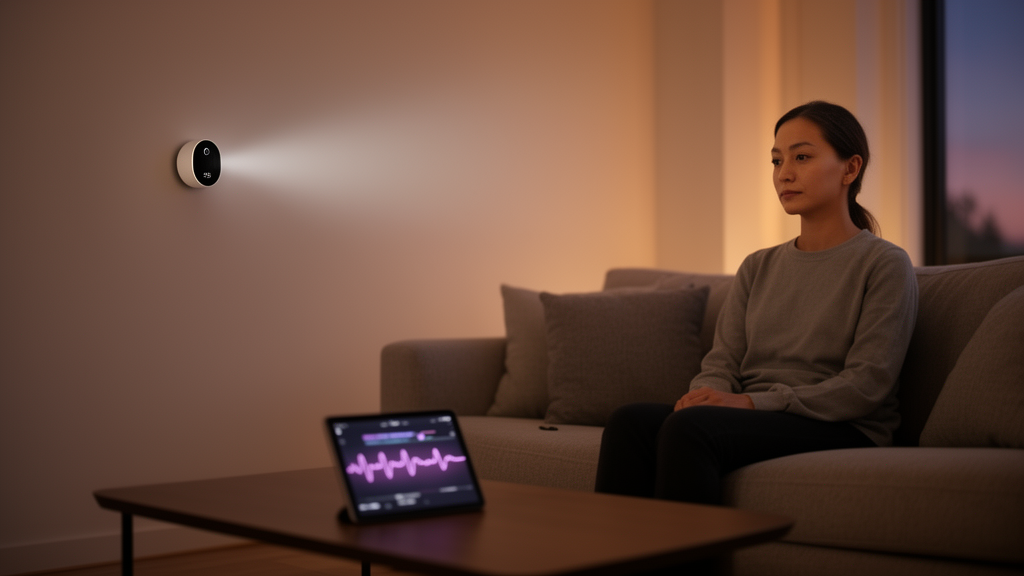
The future of healthcare monitoring may involve nothing more than a sensor mounted on a wall, quietly watching a patient breathe. A sweeping systematic review published in Frontiers in Medical Technology has mapped the rapidly evolving landscape of non-contact medical Internet of Things (IoT) systems, devices that can measure heart rate, respiration, temperature, oxygen saturation, and blood pressure without ever touching the human body. Drawing on 88 recent studies assembled under PRISMA guidelines, the review offers the clearest picture yet of which technologies are maturing, which vital signs are being neglected, and why the field still struggles to move from laboratory promise to hospital bedside.
The appeal of contactless monitoring is easy to understand. Traditional hospital instrumentation, from finger-clip pulse oximeters to adhesive electrode patches and inflatable blood pressure cuffs, works well enough in controlled clinical settings, but it is uncomfortable for long-term wear, can irritate fragile skin in elderly and neonatal patients, and requires constant replacement and maintenance. Non-contact systems sidestep all of this by capturing physiological information at a distance. Cameras read the subtle color shifts in facial skin caused by pulsing blood flow. Radar transmitters bounce millimeter-wave signals off the chest and detect the millimeter-scale movements of breathing and heartbeat. Wi-Fi routers measure how the human body perturbs ambient wireless channels. Acoustic sensors and infrared detectors add further modalities, and modern machine learning pipelines fuse these raw signals into usable clinical estimates.
What distinguishes the new review is its system-level perspective. Previous surveys tended to examine a single sensing technology, such as radar or computer vision, or focused narrowly on signal processing algorithms. The authors instead characterized every included study across five dimensions: sensing modality, system architecture, the physiological parameter being targeted, the validation setting, and reported performance. They also evaluated methodological quality and, critically, asked how often privacy-preserving mechanisms had actually been built into the systems, an unusually honest question for a field whose primary instruments are cameras and radio transmitters pointed at people in intimate moments of illness.
The results reveal a field of striking imbalance. Radar and vision-based systems dominate the literature, together accounting for roughly three-quarters of all studies analyzed. These two technologies have matured fastest because their underlying physics and computer vision toolchains are comparatively well developed, and because both can plausibly reach the accuracy thresholds needed for clinical triage. By contrast, approaches based on sound, Wi-Fi sensing, embedded sensors integrated into furniture, and mixed-modality combinations remain at an earlier stage of validation, with fewer studies, smaller cohorts, and less standardized evaluation.
Even more striking is the concentration on two vital signs. Respiration rate appears in 83 percent of the reviewed studies, and heart rate in 67 percent, a significant overlap given that many systems extract both from the same chest-motion or skin-color signal. No other physiological parameter exceeds 11 percent of the corpus. Blood pressure, oxygen saturation, and body temperature, all staples of routine clinical assessment, remain largely unaddressed by contactless methods. The reason is physics as much as preference: breathing and heartbeat produce measurable mechanical displacement and periodic optical change that sensors can resolve with modest hardware, whereas blood pressure and SpO₂ estimation from a distance requires subtle modeling of vascular properties that current remote techniques capture only indirectly and with limited reliability.
Perhaps the most sobering finding concerns measurement itself. The review found that heterogeneous reporting metrics across studies prevent direct statistical comparison of performance between modalities. One radar study might report mean absolute error on healthy volunteers at one meter; a vision study might report correlation coefficients on hospitalized patients at three meters under different lighting. Without standardized datasets, common evaluation protocols, and agreed-upon error metrics, clinicians and hospital administrators have no rigorous way to compare a radar system against a camera-based alternative, and the field’s headline accuracy numbers remain effectively incommensurable. This absence of benchmarking, the authors argue, is now a primary brake on clinical translation.
When it comes to deployment, the review’s central message is that context should drive technology selection, not laboratory accuracy rankings. Radar excels in hospital wards and intensive care units, where patients may be covered by blankets, moving restlessly, or positioned unpredictably, conditions that defeat optical systems but not penetrating radio waves that measure motion through fabric and darkness. Vision and acoustic systems, meanwhile, suit structured clinical spaces with stable lighting and predictable geometry, such as examination rooms and sleep laboratories, where a camera’s rich spatiotemporal information can be fully exploited. Embedded sensor designs, built into eldercare beds and chairs, offer a middle path: technically not remote, but requiring no wearable and no user cooperation, making them practical for dementia care and nursing homes where continuous compliance cannot be assumed.
For settings where the stakes are highest, the review points to mixed radar and vision systems as the emerging precision tool. By fusing the robustness of radar with the richness of optical sensing, hybrid architectures can provide redundant, mutually validating measurements suitable for neonatal monitoring and postoperative care, where a single missed apnea event or unrecognized desaturation can be catastrophic. The trade-offs are real: greater hardware complexity, harder signal fusion, and higher cost. But as both sensing strands mature, the fusion approach increasingly looks like the endpoint toward which precision-critical contactless monitoring is converging.
The review does not shy away from the field’s persistent failures. Signal reliability in uncontrolled environments remains the fundamental technical challenge: ambient light changes, multipath radio reflections, other people moving through the scene, pets, fans, and vibrating beds all contaminate the weak physiological signals these systems hunt for. Privacy and ethical concerns compound the problem, since cameras and radar implicitly surveil patients, families, and sometimes entire rooms, raising questions about consent, data ownership, and secondary use that few current systems adequately address. Finally, poor integration with existing healthcare infrastructure, electronic health records, nursing alarm systems, and clinical workflows, means that even accurate prototypes often die at the pilot stage, unable to slot into the operational reality of hospitals.
As a forward-looking contribution, the authors propose a conceptual federated, edge-based learning framework, explicitly presented as a design proposal rather than a validated system. The core idea is compelling: instead of shipping raw camera and radar data to central servers, processing would occur at the edge device itself, with only model updates, not identifiable physiological data, shared across institutions through federated learning. Such an architecture would simultaneously address privacy, reduce bandwidth, and allow hospitals to pool learning without pooling patient data. Combined with the review’s other prescriptions, standardized open datasets, unified evaluation metrics, and co-design with clinical end users, this roadmap suggests that contactless vital-sign monitoring may finally be approaching the inflection point where it leaves the demonstration stage and becomes an invisible, ambient layer of everyday clinical care.
Subject of Research: Non-contact medical IoT systems for monitoring physiological biomarkers
Article Title: A systematic review of non-contact medical IoT systems for physiological biomarker monitoring
Article References: Banik, B., Ghose, S., Nahiun, A. H., Lin, Y., Shalaginov, A., & Ghose, D. (2026). A systematic review of non-contact medical IoT systems for physiological biomarker monitoring. Frontiers in Medical Technology, 8, Article 1917332. https://doi.org/10.3389/fmedt.2026.1917332
Image Credits: AI Generated
DOI: 10.3389/fmedt.2026.1917332
Keywords: non-contact monitoring, medical IoT, radar sensing, vision-based sensing, respiration rate, heart rate, vital signs, federated learning, edge computing, patient monitoring, healthcare technology, PRISMA review
Cite Scienmag News
Denise Maddox. (October 15, 2026). Contactless Health Monitoring: IoT Systems Track Vital Signs Without Touching You. Scienmag. https://scienmag.com/contactless-health-monitoring-iot-systems-track-vital-signs-without-touching-you/
Denise Maddox. "Contactless Health Monitoring: IoT Systems Track Vital Signs Without Touching You." Scienmag, 15 October 2026, https://scienmag.com/contactless-health-monitoring-iot-systems-track-vital-signs-without-touching-you/. Accessed 15 October 2026.
Denise Maddox. "Contactless Health Monitoring: IoT Systems Track Vital Signs Without Touching You." Scienmag. October 15, 2026. https://scienmag.com/contactless-health-monitoring-iot-systems-track-vital-signs-without-touching-you/


