


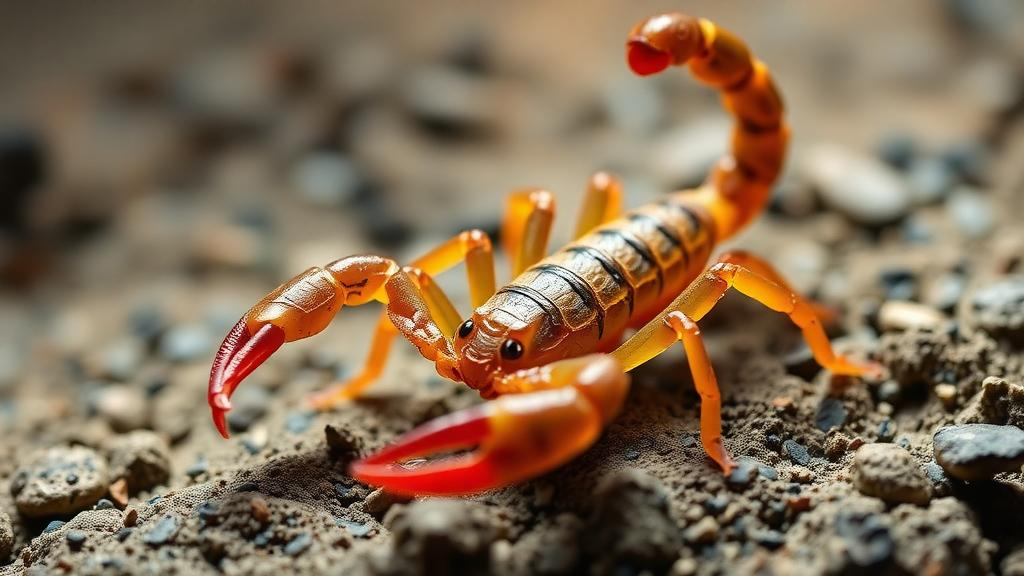
In a finding that reads like something out of a toxinological detective story, researchers in Australia have discovered that the venom of the Malaysian forest scorpion Heterometrus spinifer contains a small molecule called senecioylcholine that directly activates nicotinic acetylcholine receptors, the same class of nerve receptors that respond to nicotine in humans. The discovery, published in Frontiers in Arachnid Science, marks the first time that an agonist of these receptors has been identified from scorpion venom, and it points to an unexpected case of convergent evolution spanning three wildly different branches of the animal kingdom.
Nicotinic acetylcholine receptors, or nAChRs, are pentameric ligand-gated ion channels found throughout the nervous systems of vertebrates and invertebrates. Each pentamer is assembled from a combination of four distinct categories of transmembrane subunits, namely alpha, beta, gamma, and delta. The most abundant functionally characterized subtypes within the mammalian central nervous system are alpha7 homomeric receptors and alpha4beta2 heteromeric receptors, both of which bind nicotine with high affinity. Acetylcholine, the endogenous agonist of these receptors, is an excitatory neurotransmitter widely distributed across all kingdoms of life, mediating cholinergic transmission in the central and peripheral nervous systems and regulating physiological functions as diverse as muscle contraction, immune responses, pain signaling, and reproduction in mammals and honeybees.
Given the importance of acetylcholine in physiology, it is unsurprising that many venomous organisms have evolved toxins that interfere with cholinergic transmission to facilitate prey capture or defense against predators. Cone snail venoms, for example, contain a wide variety of toxins that modulate the activity of acetylcholine receptors, while acylpolyamines from spider venoms have been shown to inhibit these receptors. Conversely, only one spider-venom peptide, κ-atracotoxin-Hv1c from the Blue-Mountains funnel web spider Hadronyche versuta, has been reported as a positive allosteric modulator of insect nAChRs. In scorpions, there is evidence that the venom of Buthus occitanus tunetanus depolarizes muscle cells via modulation of nAChRs, but the active venom component has not been identified. The peptide toxins OSK-1 from the Central Asian scorpion Orthochirus scrobiculosus and HelaTx1 from the Vietnamese forest scorpion Heterometrus laoticus were reported to inhibit nAChRs. Except for the presence of acetylcholine in the venom of Heterometrus spinifer, no other agonists of nAChRs have yet been identified from scorpion venoms.
To hunt for new modulators, the team, led by researchers from the Institute for Molecular Bioscience at The University of Queensland and the Centre for Bioinnovation at the University of the Sunshine Coast, employed a high-throughput fluorescent imaging plate reader, or FLIPR, screen of arthropod venoms against nAChRs expressed in the human SH-SY5Y neuroblastoma cell line. The SH-SY5Y cells endogenously express alpha7 and alpha3* nAChRs, making them an ideal platform for detecting agonistic and antagonistic activity. The researchers screened 22 spider venoms and four scorpion venoms, loading the calcium-sensitive dye into the cells and recording fluorescent calcium responses with excitation wavelengths of 470–495 nm and emission wavelengths of 515–575 nm. A two-step addition protocol was used for all FLIPR measurements, with 300 seconds of data recorded after the first addition of crude venom or venom fractions, followed by another 300 seconds recorded after the second addition of 30 micromolar nicotine. To confirm that the calcium response was mediated by nAChRs, 30 micromolar d-tubocurarine, a potent nAChR inhibitor, was included in the dye loading buffer.
Several venoms caused an increase in fluorescence, consistent with an increase in intracellular calcium, but only the calcium response evoked by H. spinifer venom was inhibited by tubocurarine. The venom of the Malaysian forest scorpion was therefore selected for subsequent experiments to identify the venom component responsible for increasing nAChR-mediated activity. Activity-guided fractionation of the venom using C18 reversed-phase high-performance liquid chromatography revealed a complex venom profile, but only fraction 10, eluting at 13.5 minutes, activated nAChRs in the FLIPR assay. Fraction 10 increased nAChR activity by 43.1 percent compared to control, while co-addition of tubocurarine reduced the activity to 50.8 percent of the control value, thus recapitulating the nAChR agonistic activities of crude H. spinifer venom.
Fraction 10 was further fractionated using a shallower acetonitrile gradient on C18 reversed-phase HPLC, which yielded the active subfraction 4, eluting at 11.1 minutes. Liquid chromatography mass spectrometry analysis showed that subfraction 4 contained only one major compound, with a mass of 186.1 Da in positive mode. Subfraction 4 increased nAChR activity by 73.4 percent compared to control, while addition of tubocurarine reduced the activity almost completely to 2.0 percent. Analysis of the subfraction using matrix-assisted laser desorption/ionization mass spectrometry revealed no masses larger than 1 kDa, so the researchers turned to high-resolution mass spectrometry, which revealed a single compound attributed to the molecular formula C10H20NO2, corresponding to a previously described choline ester named senecioylcholine, originally isolated from the hypobranchial gland of several molluscan species in the Muricoidea family.
However, there are two isomers of senecioylcholine, namely tigloylcholine and angeloylcholine, with identical mass formulas, and based on high-resolution mass spectrometry data alone it was impossible to determine which of these isomers corresponds to the native venom-derived compound. All three isomers were therefore chemically synthesized, and liquid chromatography mass spectrometry co-elution studies were performed to identify the native compound. The researchers found that only senecioylcholine co-eluted with the active nAChR agonist purified from subfraction 4 of H. spinifer venom, leading them to conclude that the nAChR agonist in the scorpion venom is indeed senecioylcholine.
With the compound identified, the team turned to the question of what senecioylcholine actually does in the venom. Synthetic senecioylcholine and its isomers tigloylcholine and angeloylcholine were not insecticidal when injected into sheep blowflies. At the highest doses injected, senecioylcholine, at 10.8 micromoles per gram, caused no mortality, with the maximum extent of induced paralysis being 20 percent at 30 minutes but reducing to 0 percent at 24 hours. Tigloylcholine, at 10.1 micromoles per gram, caused no paralysis or mortality, while angeloylcholine, at 9.0 micromoles per gram, induced 10 percent paralysis and mortality at 24 hours. This lack of insecticidal activity, combined with the fact that H. spinifer is a very large scorpion measuring 10 to 15 centimeters in length with massive pedipalps used to crush insect prey without the need for venom, makes it highly unlikely that senecioylcholine is used for capture of insect prey.
A more likely role for senecioylcholine in H. spinifer venom is defense against vertebrate predators, consistent with the defensive role that this choline ester appears to play in marine gastropods and the tiger moth Arctia caja, and the fact that H. spinifer uses venom predominantly in a defensive capacity. The only previous reports of senecioylcholine in nature are in the hypobranchial glands of marine gastropods in the Muricidae family and the defensive glands of the tiger moth. The common physiological property of the choline esters found in muricid gastropods, including senecioylcholine, is their ability to evoke excitatory paralysis of the skeletal musculature, an nAChR-mediated action that is suppressed by the anticholinergic agent atropine. Murexine, a related choline ester commonly found in the hypobranchial glands of muricid gastropods, causes muscle paralysis in dogs, fish, frogs, and octopods, and severe muscle contracture in birds, an activity particularly relevant given that birds are major predators of both scorpions and the tiger moth.
Forest scorpions are opportunistic predators that feed on diverse prey, including small vertebrates such as frogs, lizards, and small rodents. Murexine induces muscle paralysis in vertebrates, and high doses are lethal to birds and mice, and thus the researchers cannot rule out the possibility that senecioylcholine is also used in prey capture. Heterometrus venom also contains high concentrations of acetylcholine, approximately 80 micromolar, which was reported to cause reversible venom-induced contractions in the chick biventer cervicis muscle. These effects of acetylcholine would be potentiated by the nAChR agonistic activity of senecioylcholine, thereby facilitating the incapacitation of vertebrates. Based on the data and previous reports, the most likely role of senecioylcholine in H. spinifer venom is for defense against vertebrate predators and to facilitate capture of small vertebrate prey. Given that senecioylcholine has previously only been found in moths and molluscs, its presence in the venom of scorpions appears to represent an interesting case of convergent evolution. It remains to be determined whether choline esters are ubiquitous in scorpion venoms or limited to specific families or genera, a question that could reshape how toxinologists view the small-molecule components of venoms that have been largely neglected in the omics era of toxinological research.
Subject of Research: Senecioylcholine in Heterometrus spinifer scorpion venom activates vertebrate nicotinic acetylcholine receptors
Article Title: Senecioylcholine in Heterometrus spinifer scorpion venom activates vertebrate nicotinic acetylcholine receptors
Article References: Senecioylcholine in Heterometrus spinifer scorpion venom activates vertebrate nicotinic acetylcholine receptors. (n.d.). https://doi.org/10.3389/frchs.2026.1888189
Image Credits: AI Generated
DOI: 10.3389/frchs.2026.1888189
Keywords: Senecioylcholine, Heterometrus, spinifer, scorpion, venom, activates, vertebrate, nicotinic, acetylcholine, receptors, scientific research
Cite Scienmag News
Louis Brooks. (October 15, 2026). Scorpion venom hides a tiny molecule that switches on human nerve receptors. Scienmag. https://scienmag.com/scorpion-venom-hides-a-tiny-molecule-that-switches-on-human-nerve-receptors/
Louis Brooks. "Scorpion venom hides a tiny molecule that switches on human nerve receptors." Scienmag, 15 October 2026, https://scienmag.com/scorpion-venom-hides-a-tiny-molecule-that-switches-on-human-nerve-receptors/. Accessed 15 October 2026.
Louis Brooks. "Scorpion venom hides a tiny molecule that switches on human nerve receptors." Scienmag. October 15, 2026. https://scienmag.com/scorpion-venom-hides-a-tiny-molecule-that-switches-on-human-nerve-receptors/


