


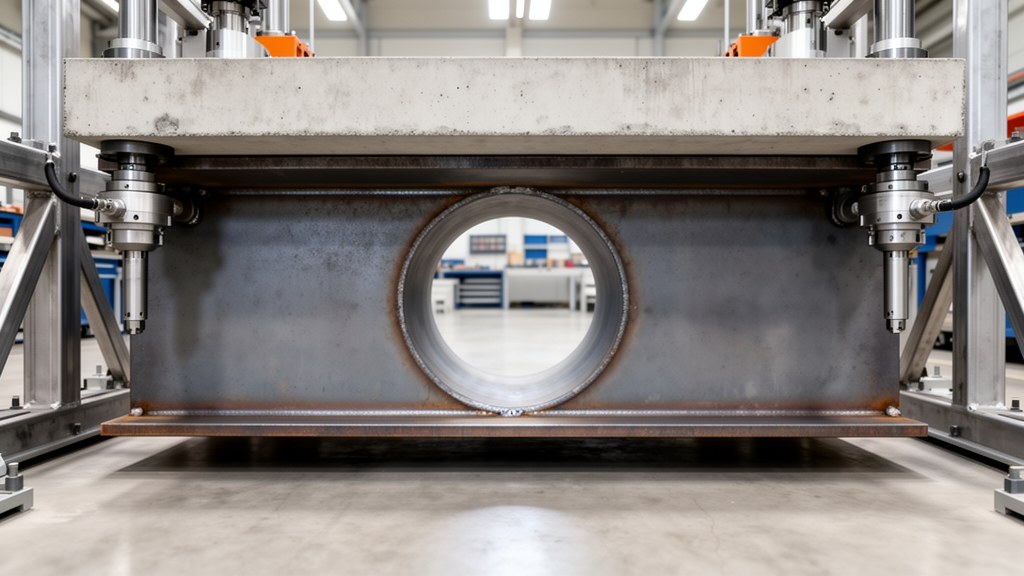
Every modern building hides a quiet compromise inside its floors. Engineers must thread heating ducts, ventilation pipes, and electrical conduits through the structural skeleton, and the cheapest way to do that is to punch holes directly through the webs of the beams that carry the floor itself. These web openings preserve precious floor-to-floor height, but they come at a cost: they cut away load-bearing material, redistribute stresses around the perforation, and increase deflection. A new study published in Frontiers in Materials has now mapped that cost with unusual precision, running 330 nonlinear finite element models of composite steel-concrete beams and then distilling the results through a statistical optimization framework. The verdict is strikingly clear: when it comes to surviving the assault of a web opening, the circle is king.
Composite beams are among the workhorses of contemporary construction. A steel I-section is joined to a concrete slab, usually cast on profiled steel decking, by head-stud shear connectors, so that the two materials act together as a single structural unit. The concrete resists compression, the steel resists tension, and the combination delivers remarkable stiffness and strength with minimal depth. But the steel web, the vertical plate between the top and bottom flanges, is exactly where engineers want to place openings for building services. Introducing a hole there disrupts the smooth flow of shear forces, creates local bending in the Tee-sections above and below the opening, and can trigger the so-called Vierendeel mechanism, a failure mode in which the beam behaves like a frame with weak joints rather than a solid girder.
The research team, led by Mastan Sheik of Aditya University in India, together with colleagues from SR University, SRM Institute of Science and Technology, and Aditya University, attacked the problem systematically. They modeled a four-meter composite beam consisting of an ISMB 400 steel section, a 120-millimeter-thick concrete slab spanning 1,200 millimeters in width, a 1-millimeter deck sheet, and 19-millimeter head-stud shear connectors. Five opening shapes were investigated: circular, hexagonal, octagonal, rectangular, and triangular. Three opening areas were tested, measuring 7,853, 31,415, and 125,663 square millimeters, corresponding to roughly 0.25, 0.5, and 0.75 times the beam depth. Spacing-to-diameter ratios ranged from 1.08 to 3.00, values adopted from the AISC Steel Design Guide Series, British Standard BS 5950, and SCI P355. Every combination was simulated in ABAQUS v6.14, producing a dataset of 330 finite element models.
Before trusting any of those simulations, the team validated their modeling framework against laboratory experiments reported by Du and colleagues in 2021. Two simply supported composite beams, one without a web opening and one with a reinforced opening, had been tested under three-point bending with a 1,000-kilonewton hydraulic jack. The researchers reproduced the same geometry, supports, loading, and material properties in ABAQUS and compared predictions against measurements. The agreement was remarkable. The deviation in ultimate load was less than 1 percent, the difference in yielding load was approximately 1 percent, and the predicted displacements closely matched the experimental values. The numerical model even reproduced the qualitative failure behavior, capturing the flexural deformation of the steel beam and the localized separation between the profiled sheeting and concrete near the opening.
The finite element models themselves were built with considerable care. Concrete was described by the Concrete Damaged Plasticity model, which captures tensile cracking and compressive crushing with a dilation angle of 35 degrees and an eccentricity of 0.1. The steel beam was modeled as an elastic-plastic material with strain hardening, the deck sheet as elastic-perfectly plastic, and the shear studs as ductile steel components transferring longitudinal shear between slab and section. Surface-to-surface contact with finite sliding connected the components, with an isotropic friction coefficient of 0.1. A mesh sensitivity study ensured that further refinement changed the predicted ultimate load by less than 1.5 percent, and a dynamic implicit step simulated the nonlinear response under a displacement load applied at midspan.
The results delivered a hierarchy of performance. Circular openings exhibited the highest load-bearing capacity among all five shapes considered. At the largest opening size and the tightest spacing ratio, the circular configuration outperformed hexagonal and octagonal openings by 7 percent, rectangular openings by 80 percent, and triangular openings by 92 percent. The mechanical explanation is elegant: a circle has no corners, so stresses diffuse smoothly around the perforation without the sharp geometric transitions that concentrate load at angular vertices. Rectangular and triangular openings, by contrast, generate severe stress concentrations at their corners, amplify local bending demands in the Tee-sections, and intensify the Vierendeel action and web-post buckling between adjacent openings. Hexagonal and octagonal shapes, with their gentler angular transitions, behaved almost as well as circles but trailed slightly.
Opening area proved equally consequential. Increasing the perforated area consistently reduced the ultimate load capacity, because a larger hole removes more effective web material and intensifies local deformation. The smallest openings, at 7,853 square millimeters, delivered capacities 6 to 31 percent higher than the intermediate and largest openings, depending on shape. Interestingly, the stiffness response was not strictly monotonic: the intermediate 0.5D openings sometimes showed higher computed stiffness than the smaller ones, a nonlinear effect the authors attribute to limited deformation development around the opening rather than any gain in net section capacity. The largest openings, at 125,663 square millimeters, caused the greatest web disruption and the most significant local deformation, reducing both stiffness and strength.
The spacing-to-diameter ratio, which governs how much steel web remains between adjacent openings, emerged as a critical design lever. Narrow web posts between closely spaced openings provide a restricted load-transfer path, concentrate stress, and invite local buckling. As the ratio increases, the broader web post offers a more stable route for forces to reroute around the perforations, raising the ultimate load. But the benefit is not limitless: the response-surface analysis revealed that a middle value is optimal within the explored design space, and the effect saturates rather than improving indefinitely.
To move beyond raw simulation data, the team processed their finite element results through a design of experiments framework using MINITAB 20 and Design-Expert 13. An L27 orthogonal array organized the factor-level combinations, and response surface methodology generated main-effect plots, contour plots, and regression equations describing the predicted load response. Analysis of variance then quantified the statistical significance of each parameter. The findings were unambiguous: opening area and spacing-to-diameter ratio were the dominant factors influencing ultimate load, with their interaction producing the highest F-values across all opening geometries. The regression models achieved coefficients of determination as high as 0.99, and residual diagnostics confirmed that no single observation unduly influenced the fit. Within the investigated parameter range, the highest-response combination was an opening area of 31,415 square millimeters paired with a spacing-to-diameter ratio of 1.50.
For practicing engineers, the study offers a practical screening tool for early design decisions. Rather than evaluating hundreds of configurations manually, designers can use the response-surface relationships to compare alternative opening patterns before detailed code-based verification, selecting geometrically efficient perforations that preserve structural performance while accommodating building services. The authors caution that their findings apply only within the explored parameter ranges and that the experimental validation covers a restricted number of configurations, so projections for untested combinations remain numerical extrapolations. Future work should include broader experimental testing across more opening geometries, sizes, and loading situations, and may extend the framework to additional failure modes such as fracture. Still, the integration of validated nonlinear finite element modeling with design-of-experiments optimization marks a meaningful step forward, demonstrating how computational simulation and statistical rigor can together transform a messy structural compromise into a solvable design problem.
Subject of Research: Nonlinear finite element analysis and design of experiments optimize web openings in composite steel-concrete beams
Article Title: Non-linear analysis of composite steel-concrete beam with web openings using finite element method and design of experiments
Article References: Non-linear analysis of composite steel-concrete beam with web openings using finite element method and design of experiments. (n.d.). https://doi.org/10.3389/fmats.2026.1947456
Image Credits: AI Generated
DOI: 10.3389/fmats.2026.1947456
Keywords: composite steel-concrete beam, web openings, finite element analysis, design of experiments, response surface methodology, structural engineering, optimization, Non-linear, analysis, composite, steel-concrete, beam
Cite Scienmag News
Denise Maddox. (October 15, 2026). Circular openings prove strongest in composite steel-concrete beams, 330-model study finds. Scienmag. https://scienmag.com/circular-openings-prove-strongest-in-composite-steel-concrete-beams-330-model-study-finds/
Denise Maddox. "Circular openings prove strongest in composite steel-concrete beams, 330-model study finds." Scienmag, 15 October 2026, https://scienmag.com/circular-openings-prove-strongest-in-composite-steel-concrete-beams-330-model-study-finds/. Accessed 15 October 2026.
Denise Maddox. "Circular openings prove strongest in composite steel-concrete beams, 330-model study finds." Scienmag. October 15, 2026. https://scienmag.com/circular-openings-prove-strongest-in-composite-steel-concrete-beams-330-model-study-finds/


