

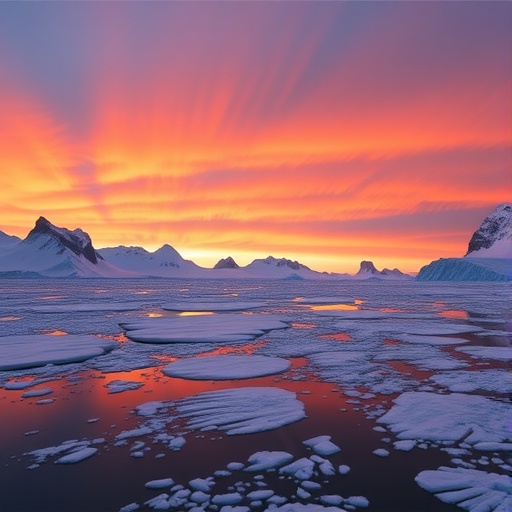
As the relentless grip of the climate crisis tightens, Antarctica stands as a stark illustration of both the fragility and the urgency embedded in our planet’s environmental future. Recent cutting-edge computational simulations have thrust the Antarctic Peninsula into the spotlight, revealing a spectrum of potential futures shaped by human-driven emissions. These scenarios, ranging from low to very high greenhouse gas outputs, provide a chilling forecast of profound transformations—alterations that could irrevocably compromise ice sheets, ecosystems, and global climate systems.
The Antarctic Peninsula, a unique and heavily scrutinized region, functions as more than just a remote icy expanse. It is a nexus for scientific inquiry, tourism, and marine resource exploitation, yet simultaneously, it is exceptionally vulnerable to both climatic shifts and human disturbance. Decades of observations, including firsthand accounts from veteran researchers such as Professor Peter Convey, have chronicled palpable changes: glaciers retreat, ice shelves weaken, and previously permanent features like Manhaul Rock, once barely emerging from the ice, now blatantly exposed. These tangible signs underscore the Peninsula’s accelerating transformation.
To grasp the future trajectory of this polar region, scientists deployed sophisticated climate models that integrate various emissions trajectories—an approach that distills complex interactions among temperature, ice dynamics, ocean circulation, and biological responses into predictive frameworks. These studies categorize outcomes into three core scenarios based on projected temperature increases relative to preindustrial levels: a modest 1.8°C rise reflecting aggressive emission reductions, a medium-high scenario with a 3.6°C increase representing current trends, and a dire scenario potentially reaching 4.4°C that assumes continued high emissions.
The models highlight a sobering pattern of ecosystem destabilization under rising temperatures. Ice shelves, the floating extensions of glaciers that buttress inland ice, face accelerating threats from warming waters. Their disintegration portends enhanced glacier flow into the ocean, escalating global sea level rise. Land and sea ice reductions alter albedo effects, thus amplifying regional warming and disrupting the delicate balance of atmospheric and oceanic circulation patterns crucial to climate regulation both locally and globally.
Marine ecosystems, particularly krill populations—cornerstone species that underpin Antarctic food webs—are projected to suffer due to reduced sea ice coverage and warmer waters. The loss of these vital organisms would ripple upwards, jeopardizing penguins, seals, and whales. Terrestrial ecosystems, albeit more limited in scope, are not spared; altered snow and ice conditions affect the distribution and survivability of native flora and invertebrates accustomed to extreme cold. The interconnectedness of these ecosystems means that biological shifts have cascading effects hard to fully anticipate.
Significantly, the research underscores that under the medium to high emissions pathways, changes become irreversible on any meaningful human timescale. The retreat of glaciers and collapse of ice shelves would mark a dramatic reshaping of the Peninsula’s geography and ecology, challenging any natural reclamation. This permanence underscores a crucial scientific and moral imperative: the choices made today will resonate through generations, underscoring the long-term stakes of today’s policy decisions.
Scientific endeavors themselves confront new challenges within this shifting landscape. Infrastructure damage from unpredictable and extreme weather events hampers researchers’ ability to gather observational data vital to model refinement. The feedback loop between data scarcity and prediction uncertainty complicates efforts to prepare for or mitigate impending changes. These barriers accentuate the broader theme of vulnerability—not just ecological but also in human capacities for monitoring and responding to climate signals.
Perhaps most striking is the Antarctic Peninsula’s global connectivity despite its isolation. Alterations here reverberate through oceanic current systems such as the Antarctic Circumpolar Current, influencing global climate processes and sea level patterns worldwide. This interconnectedness dispels any illusion of Antarctica as a distant spectator to climate change; instead, it emerges as an essential and active participant in Earth’s warming narrative.
Amidst these daunting forecasts, the research injects a crucial note of cautious optimism. The lower emissions scenario demonstrates tangible benefits in moderating ice loss, preserving key glacier structures, and sustaining biological communities. These outcomes do not merely deter catastrophe but also reflect manageable challenges where adaptive responses and ongoing research can play a vital role. This pathway conveys a message of hope anchored in immediate climate action and global cooperation.
The trajectory of Antarctic change encapsulates a broader planetary lesson about thresholds and tipping points. The models illuminate how incremental temperature rises disproportionately magnify impacts, emphasizing the nonlinear nature of climate responses. The Peninsula serves as a sentinel, warning of systemic shifts that could cascade into broader climate destabilization if unchecked. This underscores the urgency of translating scientific insight into effective and enforceable global climate policies.
Furthermore, the findings carry profound implications for conservation strategies, fisheries management, and international governance frameworks overseeing Antarctic affairs. As ecosystems morph and species relocate southwards in response to temperature stress, rigid management regimes will need to evolve rapidly. Adaptive, data-informed policies must account for dynamic ecological realities rather than static baselines, highlighting the intrinsic challenges in preserving Antarctic biodiversity under changing conditions.
In conclusion, the multifaceted research into the Antarctic Peninsula’s future stands as a compelling testament to the high stakes embedded in climate science today. It integrates empirical observation, sophisticated modeling, and ecological insight to depict trajectories that hinge on human choices. The stark dichotomy between manageable and irreversible impacts crystallizes climate change as not merely a distant threat but an immediate challenge demanding decisive action. The Antarctic Peninsula’s fate is a mirror reflecting humanity’s role at a critical juncture of planetary stewardship.
Subject of Research: Not applicable
Article Title: The Antarctic Peninsula under present day climate and future low, medium-high and very high emissions scenarios
News Publication Date: 20-Feb-2026
Web References: http://dx.doi.org/10.3389/fenvs.2025.1730203
References: Frontiers in Environmental Science, DOI: 10.3389/fenvs.2025.1730203
Image Credits: Prof Peter Convey
Keywords: Antarctic Peninsula, climate change, emissions scenarios, glacier retreat, ice shelves, sea level rise, ecosystems, Southern Ocean, Antarctic wildlife, computational modeling, environmental science, global climate impact


