


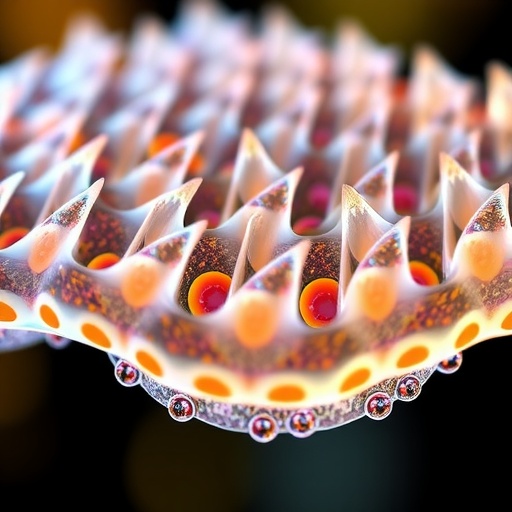
In a groundbreaking advancement that could revolutionize energy storage technology, researchers from the Dalian Institute of Chemical Physics (DICP) at the Chinese Academy of Sciences have unveiled a novel approach for creating ultrathin polymer membranes with unprecedented precision and performance. This innovation stems from a deeper understanding of the classical method known as nonsolvent-induced phase separation (NIPS), a widely used technique in the industrial fabrication of porous polymeric membranes for over six decades.
The study elucidates the intricate microstructural evolution during the NIPS process, a longstanding enigma due to the simultaneous formation of various pore architectures such as macrovoids and cellular pores. By dissecting the formation mechanisms of these distinct pore types, the team overcame a critical knowledge barrier that hampered the rational design and fine-tuning of membrane properties necessary for advanced applications.
Central to their breakthrough was the development of a specialized observation cell that allowed independent examination of the macrovoids’ and cellular pores’ nucleation and growth. This methodological innovation modulated the flow geometry at the interface between the nonsolvent and the polymer solution, effectively decoupling the simultaneous pore formation events that traditionally co-occurred and obscured understanding.
The researchers discovered that macrovoids originate primarily from hydrodynamic instabilities, phenomena that can now be precisely controlled through careful manipulation of the nonsolvent–polymer interface geometry. Contrasting this, the generation of cellular pores was found to be thermodynamically driven. They formulated a quantitative model correlating the area density of these cellular pores with foundational thermodynamic parameters, showcasing a predictive capability previously unattainable.
This granular insight into the phase separation kinetics also facilitated the elimination of mass transfer interference and spatial heterogeneity instigated by the presence of macrovoids. Consequently, the team could map the intrinsic relationship between membrane formation kinetics and the interdiffusion dynamics of solvent and nonsolvent, illuminating fundamental principles governing membrane morphology.
Utilizing the newfound knowledge, the researchers engineered a free-standing porous polymer membrane with an ultrathin profile measuring a mere 2.7 micrometers. Remarkably, this membrane exhibits a dual advantage of high selectivity alongside superior conductivity—a combination that is exceptionally challenging to achieve and pivotal for energy storage applications.
When integrated into a vanadium redox flow battery, a promising technology for large-scale energy storage, the membrane demonstrated stellar electrochemical performance. The battery achieved an energy efficiency exceeding 80% at a high current density of 220 milliamperes per square centimeter, underscoring the membrane’s practical potential in real-world energy systems.
This achievement not only exemplifies a leap forward in material synthesis but also provides a robust theoretical framework that industry and academia can leverage for the bespoke design of porous membranes. Such membranes can now be precisely tailored for specific functionalities, offering pathways to enhance the performance and durability of various electrochemical devices.
Moreover, this clarification of the microstructural mechanisms underpinning NIPS paves the way for further innovations in membrane technology. By understanding and manipulating the phase separation parameters at a fundamental level, researchers and manufacturers can optimize membranes for applications ranging from water purification and gas separation to advanced batteries and fuel cells.
The insights revealed by Prof. LI Xianfeng and his team herald a new era where membrane structure is no longer a product of trial and error but of informed design. This shift holds promise for numerous technologies dependent on membranes, enhancing efficiency and sustainability in the face of growing global energy and environmental challenges.
In summary, this research transforms our comprehension of nonsolvent-induced phase separation, providing a sophisticated toolkit for controlling pore structures with high fidelity. The ultrathin membrane realized from these efforts stands as both a scientific and engineering marvel with immediate relevance to energy technologies poised to play critical roles in the green energy transition.
News Publication Date: 27-May-2026
Web References:
10.1093/nsr/nwag306
Keywords
Nonsolvent-Induced Phase Separation, Porous Polymer Membranes, Macrovoids, Cellular Pores, Membrane Microstructure, Vanadium Flow Battery, Energy Storage, Hydrodynamic Instability, Polymer Solution Interface, Membrane Formation Kinetics, Electrochemical Performance, Ultrathin Membranes
Cite Scienmag News
Neil Sanderson. (June 9, 2026). Scientists Uncover Polymer Membrane Formation and Develop Enhanced Version. Scienmag. https://scienmag.com/scientists-uncover-polymer-membrane-formation-and-develop-enhanced-version/
Neil Sanderson. "Scientists Uncover Polymer Membrane Formation and Develop Enhanced Version." Scienmag, 9 June 2026, https://scienmag.com/scientists-uncover-polymer-membrane-formation-and-develop-enhanced-version/. Accessed 4 September 2026.
Neil Sanderson. "Scientists Uncover Polymer Membrane Formation and Develop Enhanced Version." Scienmag. June 9, 2026. https://scienmag.com/scientists-uncover-polymer-membrane-formation-and-develop-enhanced-version/


