


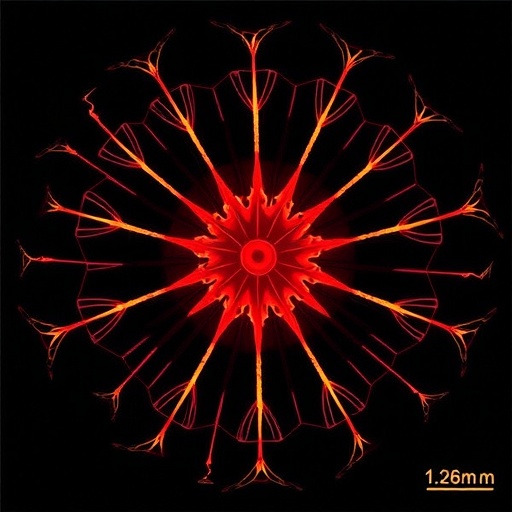
In the intricate ballet of cell division, the choreography must be flawless to ensure that chromosomes split accurately between daughter cells. This process is guided by spindle fibers—dynamic, filamentous structures that extend from opposite poles of the cell, pulling chromosomes apart to their designated sides. Despite the fundamental importance of spindle fibers in mitosis, the molecular mechanisms governing their precise assembly—specifically where and when these fibers form—have remained an elusive mystery to scientists for decades.
Recent groundbreaking research from the Okinawa Institute of Science and Technology (OIST) and the University of California, San Diego has shed new light on this complex puzzle. Their study, published in the prestigious journal Science Advances, elucidates how a pivotal protein called SPD-5 orchestrates the timing and location of spindle fiber formation during cell division in the model organism Caenorhabditis elegans. This discovery not only enhances our understanding of basic cell biology but could also pave the way for therapeutic interventions in diseases arising from cell division errors.
Central to spindle fiber formation is the centrosome, an organelle that acts as the main microtubule organizing center within animal cells. The centrosome comprises two centrioles and an enveloping cloud of proteins known as the pericentriolar matrix (PCM). During mitosis, this PCM undergoes significant expansion, dramatically increasing its capacity to nucleate microtubules. In the roundworm C. elegans, the major structural element of the PCM is the protein SPD-5. This protein plays an indispensable role by recruiting and activating γ-tubulin complexes, which serve as nucleation points where microtubules begin to polymerize.
The critical question addressed by the researchers was: How does SPD-5 become activated specifically at centrosomes to initiate spindle assembly without triggering premature microtubule nucleation elsewhere in the cell? The answer lies in the conformational dynamics of SPD-5 itself. Prior to activation, SPD-5 exists in a compact, “auto-inhibited” form, folded onto itself with its two γ-tubulin binding domains occluding one another. This structural ‘off’ state effectively prevents SPD-5 from binding γ-tubulin complexes prematurely, safeguarding the cell from erroneous microtubule formation.
As the cell prepares to enter mitosis, subtle yet critical biochemical modifications transform this molecular guardian. Phosphorylation— the addition of phosphate groups mediated by specific kinases—induces a dramatic conformational shift in SPD-5. This post-translational modification triggers the protein to unfold, akin to a clenched fist opening into a hand, selectively exposing one γ-tubulin complex binding site. The initial interaction between SPD-5 and a γ-tubulin complex then catalyzes yet another structural rearrangement, revealing the second binding domain. This bipartite docking mechanism dramatically enhances the stability and strength of SPD-5’s association with γ-tubulin complexes, ensuring robust and spatially restricted spindle fiber nucleation.
This stepwise activation model of SPD-5 not only elucidates the exquisite regulation of microtubule nucleation but also exemplifies the sophisticated control strategies cells employ to preserve genomic integrity. By maintaining SPD-5 in an inactive conformation until phosphorylation signals are received, cells prevent ectopic spindle assembly that could otherwise trigger chromosomal instability—a hallmark of cancer and developmental disorders.
What makes this finding particularly compelling is its implication beyond C. elegans. The fundamental architecture of centrosomes is conserved across metazoans, including humans. Human cells express CDK5RAP2 proteins, homologs of SPD-5, which have been linked to neurodevelopmental diseases such as microcephaly. Mutations in CDK5RAP2 disrupt centrosome function and spindle organization, leading to faulty chromosome segregation and detrimental developmental consequences. Ohta and her team are now setting their sights on deciphering whether the CDK5RAP2 family undergoes a similarly nuanced phosphorylation-controlled activation, a discovery that could reveal novel targets for therapeutic intervention.
The implications of this discovery extend toward a broader understanding of how precise temporal and spatial control within cells prevents catastrophic errors. With spindle fibers forming exclusively at centrosomes during the defined window of mitosis, cells ensure the fidelity of chromosome segregation. Errors in this process can lead to aneuploidy, fueling tumorigenesis or developmental abnormalities. By revealing the molecular toggling mechanism of SPD-5, this study illuminates a linchpin in the maintenance of cellular and organismal health.
The methodology embraced in this study involved sophisticated biochemical assays and structural analyses that captured SPD-5 in its various functional states. Through these experiments, the researchers not only pinpointed the phosphorylation events responsible for SPD-5’s activation but also visualized the subsequent spatial rearrangement of binding sites that enable γ-tubulin docking. This molecular interrogation provides a powerful demonstration of how structural biology can unravel dynamic cellular assemblies in real-time.
Furthermore, this research underscores the critical importance of enzyme-mediated post-translational modifications—particularly phosphorylation—in governing cellular architecture and function. By modulating protein conformation and interactions with exquisite finesse, phosphorylation acts as a master regulator of the cell cycle, coordinating multiple components to work in harmony.
The potential therapeutic applications of this knowledge cannot be overstated. Many cancers and developmental disorders trace their roots to malfunctioning centrosome dynamics and aberrant spindle formation. By targeting the phosphorylation states or mimicking the conformational transitions of key proteins like SPD-5 and CDK5RAP2, it may be possible to design drugs that restore proper spindle assembly. Such interventions could correct chromosomal missegregation, reducing disease severity and improving patient outcomes.
Midori Ohta, the lead investigator of this study, emphasizes that this research opens new frontiers for understanding fundamental cellular processes. She notes, “By unraveling precisely how SPD-5’s structure is remodeled through phosphorylation, we gain critical insight into the temporal regulation of spindle fiber formation—an insight that could have far-reaching implications for human health.” The meticulous work achieved by OIST and UC San Diego marks a leap forward in cell biology, bridging molecular detail to cellular function and organismal consequence.
In conclusion, the discovery of SPD-5’s stepwise activation through phosphorylation offers an elegant explanation for the spatiotemporal specificity of spindle fiber nucleation during mitosis. It unveils a molecular safety lock that meticulously governs microtubule formation, protecting cells from premature or misplaced spindle assembly. As investigations progress toward human CDK5RAP2 proteins, this work has the potential to revolutionize our understanding of neurodevelopmental diseases and cancer, opening exciting avenues for targeted therapies that maintain the delicate balance of cell division.
Keywords
Centrosome, SPD-5, phosphorylation, γ-tubulin complexes, microtubules, spindle fibers, cell division, mitosis, protein conformation, C. elegans, CDK5RAP2, neurodevelopmental disorders
Cite Scienmag News
Denise Maddox. (May 27, 2026). Scientists Uncover Mechanism Behind Precise Spindle Formation in Dividing Cells. Scienmag. https://scienmag.com/scientists-uncover-mechanism-behind-precise-spindle-formation-in-dividing-cells/
Denise Maddox. "Scientists Uncover Mechanism Behind Precise Spindle Formation in Dividing Cells." Scienmag, 27 May 2026, https://scienmag.com/scientists-uncover-mechanism-behind-precise-spindle-formation-in-dividing-cells/. Accessed 4 September 2026.
Denise Maddox. "Scientists Uncover Mechanism Behind Precise Spindle Formation in Dividing Cells." Scienmag. May 27, 2026. https://scienmag.com/scientists-uncover-mechanism-behind-precise-spindle-formation-in-dividing-cells/


