


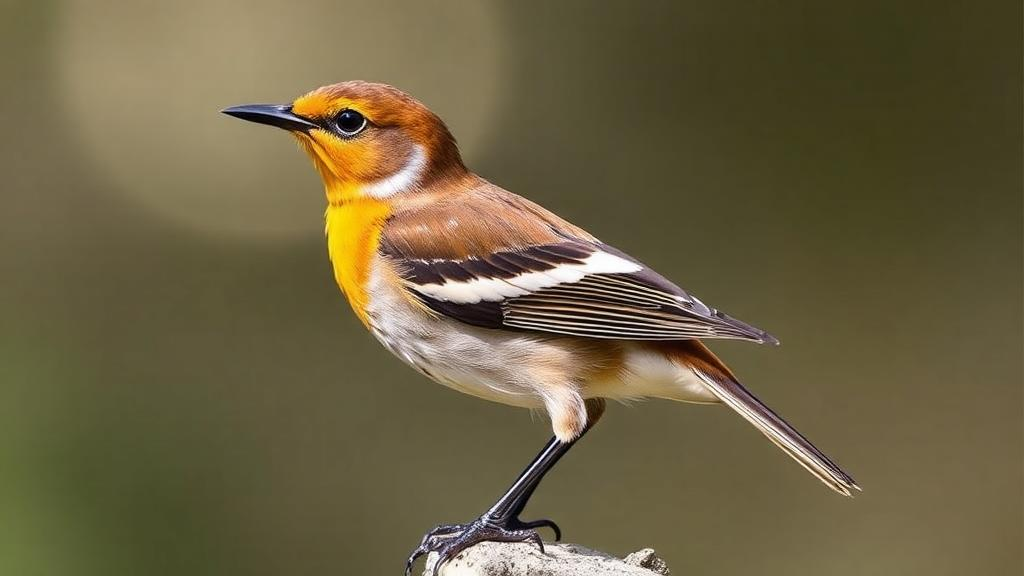
For more than a century, measuring a bird has meant catching one. Ornithologists have long relied on mist nets, traps, and museum drawers to obtain the linear morphometric traits—bill length, tarsus length, wing length, body length—that underpin much of modern ecology and evolutionary biology. These measurements feed into everything from community ecology to macroevolutionary studies of how form tracks function across the tree of life. Now, a new study published in Ecology and Evolution suggests that a camera, a tape measure, and a bit of trigonometry may be enough to replace the net.
The research, led by Facundo X. Palacio of Argentina’s Museo de La Plata and CONICET, tested whether a simple photogrammetric framework known as the pinhole camera model can produce reliable estimates of bird morphology from field photographs. The model describes how a three-dimensional scene is projected onto a two-dimensional camera sensor: light from a point in the scene passes through the aperture and maps to a corresponding point on the sensor, so the physical size of an object relates proportionally to its size in the image, its distance from the camera, and the focal length of the lens. In other words, if you know how far away the bird is and what lens you used, you can convert pixels into millimeters.
That idea had already proven itself on large mammals. Researchers using camera traps estimated the size of reindeer with a mean relative error of roughly minus nine percent, and similar approaches have been applied to leopards and other terrestrial species. But large animals are forgiving subjects. Small, mobile, wary creatures like birds pose a far harder problem: they flee, hide in dense vegetation, perch high in the canopy, and present constantly changing angles to the lens. Earlier attempts hinted at promise—one team estimated bill, head, tarsus, and body length in free-ranging chickens with estimates that did not differ from a one-to-one relationship with true values—yet those tests involved a single large-bodied species at short distances. A stereo-camera study of kiwi achieved remarkable accuracy on taxidermied specimens in daylight but produced biases exceeding twenty percent on live birds at night.
To find out whether the method could survive contact with real fieldwork, the team first built a controlled experiment. Four Neotropical species spanning roughly 25 to 300 grams—House Sparrow, Rufous-bellied Thrush, Campo Flicker, and Chimango Caracara—were represented by museum-mounted specimens posed in lifelike positions. Using a Canon DSLR with a 70–300 mm lens fixed at 1.50 meters on a tripod, the researchers photographed each specimen from three horizontal distances (3, 5, and 7 meters), eleven different heights along a ladder, and four orientations relative to the focal plane: 0, 20, 40, and 60 degrees. In total, 580 photographs were captured, with reference values established from images that included a metric scale. The design deliberately mirrored the geometry of real birdwatching: the distances chosen match those at which observers typically encounter birds.
The results were strikingly patterned. Under optimal conditions, with the specimen parallel to the focal plane, body and wing length showed the lowest biases—between one and six percent and one and nine percent respectively—while tarsus and bill length fared somewhat worse, at five to twelve and two to fifteen percent. When the researchers fitted generalized least squares models to explain the absolute relative bias, the three predictors—distance, viewing angle, and elevation angle—accounted for nearly all the variability, with pseudo-R-squared values between 0.974 and 0.995. The dominant factor was the angle of the bird relative to the focal plane: the further a bird rotated away from parallel, the more its projected length shrank, a classic foreshortening effect. Distance, counterintuitively, had only weak and variable effects, and moderate distances of three to ten meters actually emerged as a sweet spot, balancing geometric distortion against image resolution.
The trait differences have a logical anatomical basis. Bills and wings are typically fully exposed on a perched bird, making their outlines easy to trace in an image. The tarsus, by contrast, is often partially hidden by feathers at the joint with the tibia, forcing observers to guess where the structure begins. Body length is harder still, because it must be measured along a bird’s natural, often curved posture rather than the relaxed, flattened position used in museum protocols. The authors therefore recommend prioritizing bill or wing length when measuring birds photographically, and they note that the tarsus also showed the lowest repeatability across repeated photographs of the same individuals—an intraclass correlation of 0.73, compared with 0.94 for body length, 0.81 for wing length, and 0.80 for bill length.
Then came the real test. Over ten surveys between July and November 2024 in the talares forests and Ligustrum-invaded woodlands of the Parque Costero del Sur Biosphere Reserve in Buenos Aires province, the team photographed 99 individual birds from 37 species, recording the horizontal distance to each bird with a tape measure and its elevation angle with a clinometer. Mean shooting distance was about 9.5 meters, ranging from 1.55 meters for a Mottle-cheeked Tyrannulet to over 39 meters for a White-tipped Dove. Because capturing the same wild birds to verify measurements was impractical, the photographic estimates were benchmarked against two independent references: the global AVONET morphological database and caliper measurements of museum specimens of the same species from the Museo de La Plata collection.
The correlations were strong across the board. Photographic estimates correlated with AVONET values at 0.84 for tarsus length up to 0.92 for bill length, and with museum measurements at 0.82 to 0.95, all highly significant. Uncorrected estimates mostly fell below the one-to-one line—a systematic underestimation expected from foreshortening—but the relative ranking of species was preserved. That preservation matters enormously for community ecology, because many functional diversity metrics depend on the relative positions of species in trait space rather than their absolute values. When the researchers computed functional richness and functional divergence for their photographed assemblage and compared them against 500 bootstrap assemblages simulated from AVONET, the observed values fell comfortably within the simulated distributions, suggesting that photo-based trait data can reproduce community-level patterns.
The team also applied a trigonometric correction, dividing measured lengths by the cosine of the body’s inclination angle to compensate for out-of-plane rotation. The correction brought estimates closer to the one-to-one relationship on average, though with greater variability, and the authors caution that it is an approximation rather than a full three-dimensional reconstruction. A single two-dimensional image collapses depth information, so different combinations of yaw and pitch can produce indistinguishable projections, and the rotation angle of the whole body does not necessarily match the effective projection angle of each individual structure. Their practical advice: photograph birds as parallel to the focal plane as possible, at low elevation angles, from moderate distances, and take two or three shots of the same individual to average out error.
The implications reach well beyond ornithological curiosity. Photogrammetry could open morphological research to raptors, parrots, and other taxa that are difficult or risky to capture, and to environments like dense cities where trapping is impractical. The same geometry can quantify prey items carried to nests, as demonstrated in seabird diet studies, or measure the architecture of conspicuous but inaccessible structures like Rufous Hornero oven nests—all without handling a single feather. The authors are candid about the caveats: four experimental species cannot represent the full diversity of bird form, photographic sampling may favor bolder or more exposed individuals, and body length from a photo is an approximation of the standard total length rather than an equivalent. But the core message stands. With nothing more than a camera, a tape measure, and a clinometer, ecologists can now measure the birds they see—no nets required.
Subject of Research: Photogrammetric estimation of bird morphological traits from field photographs using the pinhole camera model
Article Title: Measuring Bird Morphology From Field Photographs
Article References: Palacio, F. X., Elso, E., & Montalti, D. (2026). Measuring Bird Morphology From Field Photographs. Ecology and Evolution, 16(10), Article e74422. https://doi.org/10.1002/ece3.74422
Image Credits: AI Generated
DOI: 10.1002/ece3.74422
Keywords: photogrammetry, pinhole camera model, bird morphology, morphometrics, ornithology, field photography, functional diversity, AVONET, non-invasive methods, community ecology, trait measurement, Ecology and Evolution
Cite Scienmag News
Gavin Prescott. (October 8, 2026). Scientists Turn Ordinary Bird Photos Into Precise Body Measurements. Scienmag. https://scienmag.com/scientists-turn-ordinary-bird-photos-into-precise-body-measurements/
Gavin Prescott. "Scientists Turn Ordinary Bird Photos Into Precise Body Measurements." Scienmag, 8 October 2026, https://scienmag.com/scientists-turn-ordinary-bird-photos-into-precise-body-measurements/. Accessed 8 October 2026.
Gavin Prescott. "Scientists Turn Ordinary Bird Photos Into Precise Body Measurements." Scienmag. October 8, 2026. https://scienmag.com/scientists-turn-ordinary-bird-photos-into-precise-body-measurements/


