


For millions of people living with advanced retinal degeneration, the prospect of regaining even a fragment of sight has long seemed out of reach. Now an international research team has reported results from the first clinical cohort of blind patients treated with an optogenetic therapy for advanced retinitis pigmentosa, and the findings suggest that the remarkable effect first demonstrated in a single patient in 2021 can be reproduced across a group. The study, led by José-Alain Sahel of the University of Pittsburgh and Botond Roska of the Institute of Molecular and Clinical Ophthalmology Basel (IOB), together with GenSight Biologics and an international team of researchers, was published in the New England Journal of Medicine. Five years after the landmark proof-of-concept result in one patient, the new data show that optogenetic vision restoration works beyond a single exceptional case, marking what researchers describe as an important milestone for the field.
The therapy takes a fundamentally different approach from conventional gene replacement treatments. Retinitis pigmentosa is an inherited disease in which the retina’s light-sensing cells, the photoreceptors, gradually lose their ability to respond to light, and mutations in more than 100 different genes can cause the condition. Because the genetic causes are so varied, treatments directed at any single genetic defect can only help a small fraction of patients. Optogenetic therapy sidesteps that problem entirely: instead of repairing a broken gene, it gives surviving retinal ganglion cells a new job. These cells, which normally relay signals from photoreceptors to the brain, are genetically reprogrammed to become light-sensitive themselves, effectively converting them into a substitute photoreceptor layer even at very advanced stages of blindness.
In the trial, each participant received a single injection into their worse-seeing eye carrying the genetic instructions for ChrimsonR, a light-sensitive protein derived from microbial opsins that responds to amber light. ChrimsonR was chosen for its spectral properties, since amber light is less likely to cause phototoxic damage than shorter wavelengths and can penetrate ocular tissue relatively well. The genetic payload prompts the ganglion cells to produce the protein in their membranes, so that when amber light strikes them, they depolarize and fire signals upward through the visual pathways. But the engineered cells respond only to light levels far brighter than ordinary ambient illumination, which is where the second component of the system comes in.
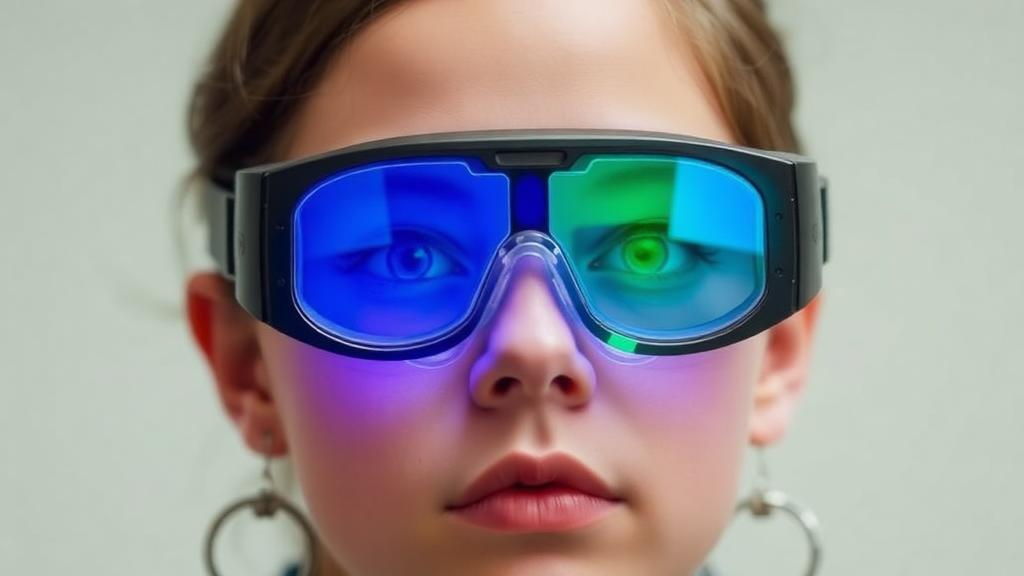
That component is a pair of special goggles equipped with a camera. The goggles capture the visual scene in front of the wearer and convert changes in that scene into pulses of amber light projected onto the treated retina, delivering the intensity and contrast that ChrimsonR requires to activate. Put simply, the gene therapy makes surviving retinal cells sensitive to light, and the goggles provide the light signal those cells need. The combination transforms the goggles into an artificial photoreceptor interface: the camera does the work that dead photoreceptors once did, and the reprogrammed ganglion cells pass the information along to the brain in a form the visual system can begin to interpret.
Safety was the primary endpoint of the study, a critical question for any therapy involving an injection into an eye that still retains some residual function. Within the limits of the study, the treatment was considered safe. Most eye-related adverse events were mild or moderate, and one severe event occurred immediately after injection but resolved within minutes after treatment. That favorable safety profile, combined with evidence of benefit, removes one of the biggest obstacles standing between optogenetics and wider clinical application, since any therapy that permanently alters retinal cells must first demonstrate that it does not endanger the eye it is meant to help.
The efficacy results were equally significant. Seven of the ten patients became more sensitive to light after treatment, and six of them reached the predefined threshold for a clinically meaningful improvement. Among the eight patients who completed visual behavioural testing, four improved in tasks such as detecting or locating objects. Even more patients improved in ecologically meaningful activities: finding a doorway in a room, or following a line on the floor while wearing the goggles. These are precisely the kinds of visual abilities that determine whether a person with profound vision loss can navigate independently, orient themselves in unfamiliar spaces, and move through daily life with greater confidence.
Objective confirmation came from measurements of brain activity. Imaging showed signals consistent with visual information actually reaching the visual areas of the brain in treated patients, indicating that the signals generated by the reprogrammed ganglion cells and delivered through the goggles were not merely artifacts of retinal stimulation but were being transmitted and processed along the normal visual pathways. For a therapy that works by co-opting cells that were never designed to be photoreceptors, this demonstration that the brain can receive and register the new input is a crucial piece of evidence that the approach taps into the residual architecture of the visual system.
One of the study’s most instructive findings concerns the role of rehabilitation. Training played an important part in the outcomes: patients who spent more time learning to use the goggles tended to perform better on object-detection tests. That pattern suggests that the brain requires practice to interpret the unfamiliar, pixelated signal arriving from the engineered ganglion cells, and that rehabilitation may be an essential component of optogenetic therapy rather than an optional add-on. The implication for future clinical practice is that successful treatment will likely involve not just an injection and a device, but a structured program of visual training that helps patients learn to make sense of their new input.
The researchers are careful about what the therapy does and does not achieve. The treatment did not restore normal sight, and the patients still could not read or recognize faces. The visual experience produced by the system is far coarser than natural vision, constrained by the resolution of the goggles, the properties of ChrimsonR, and the density of surviving ganglion cells. Yet the significance of the results lies elsewhere: the study demonstrates that even at a very advanced stage of blindness, when photoreceptors are long gone, surviving retinal ganglion cells can be made responsive to light and can transmit visual information to the brain. That principle, now validated in a cohort rather than a single patient, opens a therapeutic window that did not previously exist for this population.
Stefan Futterknecht, second author of the study, who played a major role in analyzing the data, captured the significance of the moment: “This study represents an important milestone for optogenetic vision restoration. It demonstrates that the effects first observed in a single patient can be reproduced across several patients and provides a foundation for developing more sensitive and effective future therapies.” The full article, “Optogenetic Therapy for Restoring Aspects of Visual Function,” appeared in the New England Journal of Medicine. The same international collaboration that performed the 2021 proof-of-concept study carried out this work, and the consistency between the two results strengthens confidence that optogenetic vision restoration is a reproducible clinical reality. The path forward, the researchers indicate, lies in developing more sensitive and effective optogenetic proteins, refining the goggles, and optimizing training protocols, so that the partial sight demonstrated in this cohort can be deepened and extended to more of the people waiting for it.
Subject of Research: Optogenetic gene therapy with light-stimulating goggles for restoring visual function in blind patients with advanced retinitis pigmentosa
Article Title: Optogenetic therapy is safe and allows blind people to detect objects
Article References: Optogenetic therapy is safe and allows blind people to detect objects. (n.d.). Original publication
Image Credits: AI Generated
DOI: Not provided
Keywords: optogenetics, retinitis pigmentosa, gene therapy, ChrimsonR, retinal ganglion cells, vision restoration, clinical trial, New England Journal of Medicine, IOB Basel, photoreceptors, visual rehabilitation, blindness
Cite Scienmag News
Juliet Wilcox. (October 8, 2026). Gene Therapy With Goggles Lets Blind Patients See Objects, Five-Year Study Shows. Scienmag. https://scienmag.com/gene-therapy-with-goggles-lets-blind-patients-see-objects-five-year-study-shows/
Juliet Wilcox. "Gene Therapy With Goggles Lets Blind Patients See Objects, Five-Year Study Shows." Scienmag, 8 October 2026, https://scienmag.com/gene-therapy-with-goggles-lets-blind-patients-see-objects-five-year-study-shows/. Accessed 8 October 2026.
Juliet Wilcox. "Gene Therapy With Goggles Lets Blind Patients See Objects, Five-Year Study Shows." Scienmag. October 8, 2026. https://scienmag.com/gene-therapy-with-goggles-lets-blind-patients-see-objects-five-year-study-shows/


