


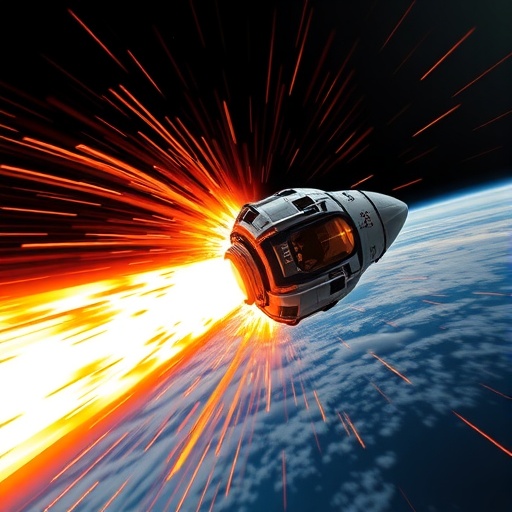
Every time a spacecraft comes home, it does so by riding a wall of fire. A vehicle returning from orbit tears into the upper atmosphere at speeds measured in kilometers per second, and the air ahead of it cannot get out of the way fast enough. Instead, the gas piles up into a shockwave that heats the craft’s surface to several thousand degrees, wrapping the vehicle in a glowing shroud of plasma. For decades, the answer to that furnace has been armor: heat-resistant tiles and sacrificial materials that char and erode on purpose, carrying heat away as they burn. The approach is reliable, but it exacts a toll — added weight, surface wear, high cost and long repair times — and it imposes a hard ceiling on how quickly a spacecraft can be made ready to fly again. As the space industry pushes toward reusable vessels, that model is looking increasingly out of step. Now researchers at Tokyo Metropolitan University have reported a striking advance toward a radically different solution: slowing a spacecraft and shielding it from heat using nothing but a magnetic field, tested in the laboratory at unprecedented strength.
The concept is known as magnetohydrodynamic aerobraking, or MHD aerobraking, and it turns the reentry environment’s most feared feature into an asset. At hypersonic speeds, a vehicle’s colossal kinetic energy has nowhere to go except into the surrounding gas, and the shock layer is where that energy is dumped. Crucially, the superheated shock layer that envelops a descending craft is not merely hot gas; it is a weakly ionized plasma, seeded with free electrons and ions that make it electrically conductive. Whenever an electrically conducting fluid streams through a magnetic field, currents are induced within it, and those currents interact with the field to generate a force — the Lorentz force — that pushes back against the flow. Switch on a sufficiently strong magnet aboard a reentering vehicle and the ultra-hot plasma in front of it is decelerated and driven outward, dragging the shockwave with it. The payoff is twofold. The blistering shock layer is expanded and pushed farther from the craft’s surface, so far less heat flows into the vehicle. At the same time, the inflated shock layer increases aerodynamic drag, slowing the craft down — a magnetic parachute that doubles as an invisible heat shield, with no moving parts and nothing sacrificed along the way.
Previous laboratory work has resoundingly supported the idea, but putting it to the test is a formidable challenge in its own right. The customary method has been to nest a permanent magnet inside a small test model and strike it with a shockwave, reproducing a slice of the reentry environment on a laboratory bench. The technique proves the principle, yet it leaves engineers boxed in. A permanent magnet offers one fixed field strength and one fixed field geometry; there is no dialing the field up or down, no reshaping it, no tailoring it to a different nose cone or capsule profile. The magnet must also physically fit inside the model, constraining the shape and size of every test article built this way. That makes systematic parametric studies — sweeping field strength, field shape and model geometry to map exactly how the effect responds — nearly impossible to run. For a technology intended one day to protect vehicles worth hundreds of millions of dollars, researchers need quantitative answers to precisely those questions before anyone can design a flight system with confidence. What the field has lacked is a testbed in which the magnetic field itself becomes a controllable experimental variable rather than a built-in constant.
A team led by Associate Professor Kohei Shimamura of Tokyo Metropolitan University has now built exactly that. Their platform replaces the permanent magnet with a powerful electromagnet mounted inside a small model, formed from a customizable set of coils whose arrangement can be redesigned for each experiment. Powering the coils is a pulse-forming network, or PFN — an assembly of energy-storage components that discharges an intense, precisely shaped pulse of current, generating a strong magnetic field that remains quasi-steady for the fleeting duration of a test. The model sits in a hypersonic expansion tube, a ground-based facility for testing aircraft and spacecraft in extreme environments, where a shockwave traveling at more than seven kilometers per second — upwards of 25,000 kilometers per hour — washes over it for tens of microseconds. Timescales that short leave no room for sloppy coordination, so the team engineered the system to track the shockwave’s arrival and synchronize the magnetic pulse to its duration, ensuring the field is fully active for the entire test window. A high-speed camera, cued by the same timing scheme, recorded the light given off by the heated shock layer — the so-called self-emission layer that traces exactly where the plasma sits around the model.
To showcase the platform’s flexibility, the researchers built two different models, each fitted with a coil configuration specifically tailored to its shape — evidence that the magnet can be matched to the vehicle rather than the other way around. The electromagnets delivered fields of 1.24 and 1.58 tesla, the latter more than double the field strength achievable with a conventional neodymium permanent magnet and dramatically beyond what embedded-magnet experiments have reached. The difference showed up in the images as clearly as in the numbers. With the field switched on, the self-emission layer surrounding the model was observed to be more than 15 percent thicker — direct visual evidence that the shock layer had been pushed outward, away from the surface, at the very instant a hypersonic shockwave was slamming into the vehicle. In effect, the team filmed the magnetic cushion in action. And because the fields came from programmable coils rather than fixed chunks of magnetized metal, the same rig can now march systematically through different field strengths and geometries, converting a one-off physics demonstration into a genuine engineering tool for designing future magnetic heat shields.
The ability to reach higher fields is more than a numbers game, because the physics of MHD aerobraking rewards magnetic strength disproportionately. The currents induced in the shock-layer plasma scale with the magnetic field, and the force those currents experience scales with the field as well, so the push on the plasma grows with the square of the magnetic field strength. Doubling the field roughly quadruples the effect — which is why leaping past the permanent-magnet ceiling to pulsed fields of 1.58 tesla is a qualitative step rather than an incremental one. Stronger fields mean the shock layer can be driven farther out, thickening the insulating buffer between a vehicle’s skin and gas hot enough to melt most engineering materials, while simultaneously boosting the drag that bleeds away the kinetic energy of orbital flight. Tunability adds a second, subtler advantage: a mission designer could, in principle, adjust both the strength and the shape of the field to match a particular trajectory, nose geometry or atmospheric density, the way a pilot trims an aircraft for different phases of flight. What was once a fixed, all-or-nothing demonstration becomes a knob that engineers can actually turn.
The implications extend well past the laboratory bench. Spaceflight is in the midst of a reusability revolution, yet thermal protection remains stubbornly consumable: ablative shields are designed to be destroyed with every reentry, and tiled surfaces demand inspection and repair between flights. A magnetic system that keeps superheated plasma at arm’s length could lighten that burden — reducing weight, curbing surface wear, cutting costs and shortening the turnaround that currently limits how often a spacecraft can fly. Every kilogram of shield that survives a flight intact is a kilogram that does not need to be replaced before the next one. It could also change how vehicles shed speed. Aerodynamic drag generated by an inflated magnetic shock layer consumes no propellant, so MHD aerobraking could complement, or in principle partially replace, the retro-propulsion burns on which today’s landers and booster systems rely. And because the underlying mechanism depends only on the interplay between a magnetic field and ionized gas — not on any particular atmosphere — the same core technology could ultimately serve any future space mission that involves reentry into an atmosphere, whether that of Earth, Mars or a destination not yet on anyone’s itinerary.
The Tokyo Metropolitan University system is deliberately positioned as a stepping stone. The team describes the work as a vital step toward planned tests of real reentry experiments, in which instrumented vessels would carry magnetic systems through genuine atmospheric entry, and toward the maturation of a core technology for future spaceflight. Between the laboratory and a flight demonstration lie formidable engineering challenges: magnets light enough to fly, power systems capable of feeding them, and coils robust enough to survive embedded in a heat-battered airframe. But the new platform finally allows researchers to attack the fundamental questions first — how strong a field is enough, what shape it should take, and how much thermal relief and drag a given design actually buys — long before hardware has to survive a real descent. The research was supported by JSPS KAKENHI Grant Numbers 21KK0078 and 26KJ1885 and was published in the Journal of Spacecraft and Rockets.
For now, the picture emerging from the laboratory is striking in its own right: a hypersonic shockwave tearing across a miniature spacecraft at seven kilometers per second while an invisible magnetic field visibly shoulders the fireball aside, inflating the glowing layer and buying the model precious extra clearance from destruction. It is a demonstration measured in microseconds and tesla, yet it points toward a future in which the deadliest phase of spaceflight is tamed not by armor that burns away, but by fields that switch off when the journey is done. If the planned flight experiments bear out what these coils have revealed, the wall of fire that every returning spacecraft must endure may one day be held at bay by magnetism itself — with the atmosphere recast from adversary into brake, and the magnetic field serving as the quiet, tireless guardian standing between a vehicle and the furnace of homecoming.
Cite Scienmag News
Grant Pearson. (August 29, 2026). Scientists test magnetic brakes to slow spacecraft during high-speed reentry. Scienmag. https://scienmag.com/scientists-test-magnetic-brakes-to-slow-spacecraft-during-high-speed-reentry/
Grant Pearson. "Scientists test magnetic brakes to slow spacecraft during high-speed reentry." Scienmag, 29 August 2026, https://scienmag.com/scientists-test-magnetic-brakes-to-slow-spacecraft-during-high-speed-reentry/. Accessed 3 September 2026.
Grant Pearson. "Scientists test magnetic brakes to slow spacecraft during high-speed reentry." Scienmag. August 29, 2026. https://scienmag.com/scientists-test-magnetic-brakes-to-slow-spacecraft-during-high-speed-reentry/


