


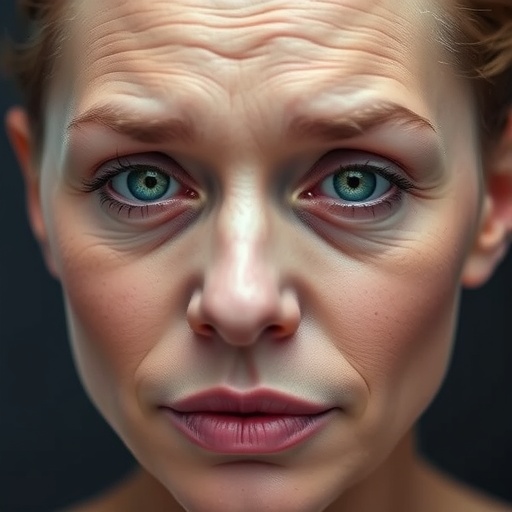
An international team led by researchers at Hiroshima University has uncovered a way to detect early-stage deterioration in human skin collagen—before any visible thinning or fragmentation of the fiber network occurs. Published in ACS Nano on July 16, 2026, the study focuses on how collagen’s molecular organization and supramolecular chirality, a measure of structural handedness, degrade ahead of the changes typically visible with standard microscopy.
Collagen is not a simple scaffold; it is a hierarchical material in which order at the smallest scales supports mechanics across larger tissue dimensions. Conventional imaging can often identify late remodeling events—such as reduced fiber thickness or network disconnection—but these observations arrive after collagen has already begun to lose functional organization.
To reveal what happens earlier, the team combined advanced optical imaging with chiroptical spectroscopy in a correlative multimodal workflow. Crucially, they analyzed the same physical tissue sections rather than comparing separate samples or modalities. This strategy reduces ambiguity about whether observed spectral shifts truly correspond to the same collagen architectures seen optically.
The experiments incorporated synchrotron radiation vacuum-ultraviolet circular dichroism (SR-VUVCD) and multi-dimensional quantum cascade laser vibrational circular dichroism (MultiD-QCL-VCD). In practice, these methods probe how chiral molecular and supramolecular arrangements affect the polarization-dependent absorption and vibrational signatures of collagen.
The results show a clear decoupling between collagen mass and structural coherence. Even after supramolecular chirality coherence collapses sharply, tissue sections can still retain much of their bulk collagen coverage and overall presence. Only later does fibrillar rarefaction—the late-stage visual loss of the fiber network density—become prominent.
“Our findings suggest that collagen should be understood as an organizationally dependent hierarchical material, not merely as visible fibers,” said Katsuya Inoue, a corresponding author. The work emphasizes that morphology alone can miss functional collapse occurring at length scales beyond what conventional imaging readily captures.
Beyond diagnostic potential, the framework provides a path to assess tissue integrity earlier in wound healing and biomaterial evaluation. By identifying organizational failure before irreversible macroscopic degradation, researchers may be able to intervene sooner and tailor regenerative strategies with better mechanistic feedback.
Keywords
dermal collagen; supramolecular chirality; circular dichroism; SR-VUVCD; MultiD-QCL-VCD; correlative multimodal imaging; extracellular matrix; fibrillar rarefaction; tissue remodeling
Cite Scienmag News
Beatrice Stafford. (July 16, 2026). Scientists Identify Invisible Early Indicators of Skin Aging. Scienmag. https://scienmag.com/scientists-identify-invisible-early-indicators-of-skin-aging/
Beatrice Stafford. "Scientists Identify Invisible Early Indicators of Skin Aging." Scienmag, 16 July 2026, https://scienmag.com/scientists-identify-invisible-early-indicators-of-skin-aging/. Accessed 3 September 2026.
Beatrice Stafford. "Scientists Identify Invisible Early Indicators of Skin Aging." Scienmag. July 16, 2026. https://scienmag.com/scientists-identify-invisible-early-indicators-of-skin-aging/


