

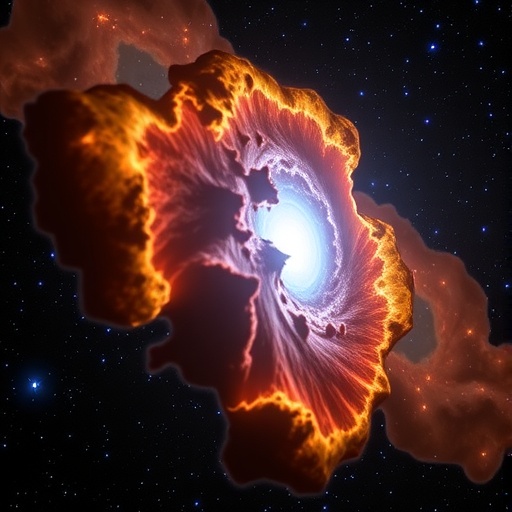
In a compelling new development that could redefine our understanding of stellar remnants, researchers from the Institute of Science and Technology Austria (ISTA) have unveiled findings that suggest the existence of a previously unrecognized class of white dwarf stars. Their study, recently published in Astronomy & Astrophysics and detailed in an arXiv preprint, highlights two extraordinary objects, dubbed Gandalf and Moon-Sized, both exhibiting a rare combination of ultra-massiveness, intense magnetic fields, rapid rotation, and significant X-ray emission, despite appearing in isolation without stellar companions. These remarkable characteristics not only challenge conventional binary star models but also open an intriguing window into the complex aftermath of stellar mergers.
White dwarfs typically mark the end stages of stellar evolution for stars like our Sun. After exhausting their nuclear fuel, these stars shed their outer layers and collapse into dense, Earth-sized remnants predominantly supported by electron degeneracy pressure. Our Sun itself is expected to embark on this evolutionary pathway in roughly five to eight billion years. Traditionally, many white dwarfs have been studied in binary or multi-star systems, where mass transfer from a companion results in observable X-ray emissions often linked to accretion phenomena. Yet, the detection of such emissions from isolated remnants, as in the case of Gandalf and Moon-Sized, unequivocally points toward a new astrophysical mechanism at play.
The object named Gandalf, first observed during the postdoctoral research of assistant professor Ilaria Caiazzo, immediately caught the attention of the team due to peculiar signals suggesting circumstellar material presence. Early assumptions posited Gandalf as a binary; however, puzzling observations emerged. The rotational period of Gandalf is an astonishing six minutes, drastically outpacing the fastest known orbital period of 80 minutes among similar systems. This extreme spin rate is inconsistent with typical synchronization expected in binaries, raising significant questions about its true nature and the origin of the observed circumstellar material.
Further scrutiny of Gandalf’s optical emission spectra revealed a striking dual-peaked hydrogen emission signature reminiscent of cat ears, which at first glance suggested a symmetrical accretion disk. Yet, this feature exhibited variability over the six-minute spin period, leading to the unexpected conclusion that the material might in fact be arranged in a half-ring structure encircling the white dwarf. Such a configuration indicates the presence of a strong and highly asymmetric magnetic field, a rare trait among white dwarfs, particularly those at advanced stages of evolution.
In contrast, Moon-Sized, discovered earlier by the ISTA team and described in a 2021 publication, shares several defining traits with Gandalf: extreme magnetism, rapid rotation, significant mass—comparable to our Sun but compressed into a volume roughly that of the Moon—and X-ray emissions absent any evident companion star. However, Moon-Sized exhibits no signs of circumstellar material and is estimated to be substantially older, with its merger-origin event dating back approximately 500 million years, compared to Gandalf’s much younger 60 to 70 million-year history. Notably, Moon-Sized’s X-ray luminosity is around 100 times lower, suggesting a more evolved state and possibly a fading mechanism for its high-energy emissions.
These shared characteristics—ultra-massiveness, magnetism, rapid spin, isolation, and persistent X-ray emission—firmly establish Gandalf and Moon-Sized as prototypes for a novel class of white dwarf remnants born from violent merger events rather than standard binary evolution. The discovery underscores the complexity of post-merger stellar dynamics and raises critical questions about how such remnants retain and evolve their extreme physical parameters over time.
Exploring the origins of the persistent X-ray emission from these isolated objects presents a formidable astrophysical puzzle. The researchers propose three primary scenarios. The first, and favored by co-author Aayush Desai, suggests an intrinsic mechanism analogous to pulsar behavior in highly magnetized neutron stars. In this outflow scenario, the white dwarf’s rapid rotation and intense magnetic field generate an energetic particle wind or magnetospheric activity that results in self-sustained X-ray emission independent of external accretion.
The second hypothesis involves a fallback mechanism from residual merger debris. Material initially thrown into eccentric orbits by the violent stellar collision could gradually return, interacting with the remnant and producing accretion-powered X-rays over hundreds of millions of years. This long-lived tail of circumbinary matter might explain ongoing emission in the absence of a present-day companion.
Finally, an inflow of ‘pollutant’ material such as asteroids or disrupted planetary bodies, known to affect roughly one-third of white dwarfs through atmospheric contamination, was considered. While Gandalf exhibits hints of such pollution, likely through carbon or silicon signatures, Moon-Sized lacks comparable evidence. This asymmetry and the timing of X-ray emissions make the pollution scenario less compelling as a universal explanation for both objects.
Beyond the immediate astrophysical implications, these findings hold significant consequences for our broader understanding of stellar evolution and the lifecycle of planetary systems. The existence of such highly magnetic, ultra-massive merger remnants raises questions about their impact on surrounding environments, including any potential planets that might survive or form in their vicinity. They also provoke further inquiries into the frequency and identification of similar objects across the galaxy.
Determining the defining criteria for this newly proposed class involved careful deliberation. While astronomers typically require multiple detections to establish a firm classification, the identification of two separate objects sharing five distinct and overlapping properties constitutes strong evidence in favor of a discrete category. As Caiazzo emphasizes, discovering even a single unprecedented object can ignite scientific interest, but coincident findings of this nature underscore a pattern that beckons deeper exploration.
The ISTA team’s work exemplifies the synergy between observational astrophysics and theoretical modeling, employing advanced spectroscopy, timing analysis, and magnetospheric dynamics to unravel stellar mysteries. Their insights set the stage for future investigations, including targeted searches for additional candidates, refined modeling of magnetic field evolution in merger remnants, and detailed simulations of accretion processes absent binary companions.
As the research community continues to probe these enigmatic stars, the challenge remains to elucidate which of the five defining properties—mass, magnetic field strength, rotational velocity, isolation, and X-ray emission—serve as essential markers for membership in this class. Upcoming observations with next-generation X-ray observatories and complementary multi-wavelength studies will be instrumental in resolving these questions.
In summary, the discovery of Gandalf and Moon-Sized marks a pivotal step in astrophysics, illuminating a heretofore hidden pathway in stellar remnant evolution. These celestial objects, forged in the crucible of cosmic collisions, not only broaden our taxonomy of stars but also deepen our understanding of how extreme physical conditions sculpt the universe’s stellar graveyard.
Subject of Research: Not applicable
Article Title: A half ring of ionized circumstellar material trapped in the magnetosphere of a white dwarf merger remnant.
News Publication Date: 10-Feb-2026
Web References:
- DOI link: 10.1051/0004-6361/202556432
- Caiazzo group’s research page: https://ista.ac.at/en/research/caiazzo-group/
- 2021 discovery of “Moon-Sized” white dwarf: https://doi.org/10.1038/s41586-021-03615-y
References:
- Cristea, A., Caiazzo, I., Desai, A. et al. (2026). A half ring of ionized circumstellar material trapped in the magnetosphere of a white dwarf merger remnant. Astronomy & Astrophysics. DOI: 10.1051/0004-6361/202556432
Image Credits: © ISTA
Keywords
White dwarfs, stellar remnants, white dwarf mergers, magnetospheres, X-ray emission, ultra-massive white dwarfs, rapid rotation, magnetic fields, circumstellar material, astrophysics, stellar evolution, isolated compact objects


