


In the quest for a sustainable hydrogen economy, the production of hydrogen via electrochemical water splitting powered exclusively by renewable electricity stands as a cornerstone technology. Alkaline water electrolysis (ALKWE) represents one of the most promising methods due to its relative cost-effectiveness and scalability. However, pushing the boundaries of ALKWE to achieve ampere-level current densities while maintaining energy efficiency and electrode longevity has remained a formidable challenge. This difficulty primarily stems from a fundamental trade-off between catalytic activity and operational stability during the hydrogen evolution reaction (HER), aggravated by the troublesome behavior of hydrogen bubbles at elevated current densities.
Hydrogen bubbles that vigorously form and detach during electrolysis can severely disrupt mass transport at the electrode surface. These bubbles not only occlude catalytic active sites temporarily but, under continuous cycling, can induce mechanical stresses leading to catalyst layer degradation and detachment. Such dynamics diminish both the immediate electrochemical performance and the long-term durability of the electrodes, which are critical parameters for any industrial-scale electrolyzer. Consequently, these problems create a persistent bottleneck in the realization of commercially viable, high-current-density ALKWE.
Addressing this intricate challenge, a multidisciplinary research team from the Dalian Institute of Chemical Physics (DICP) of the Chinese Academy of Sciences (CAS) has pioneered a revolutionary “atomic-to-macro” multiscale electrode architecture. Their design harmoniously integrates hierarchical porosity and atomic-level interface engineering within a monolithic electrode framework. This approach not only combats the deleterious effects of gas bubble formation but also significantly advances catalytic activity and mechanical robustness, charting new territory in hydrogen production technologies.
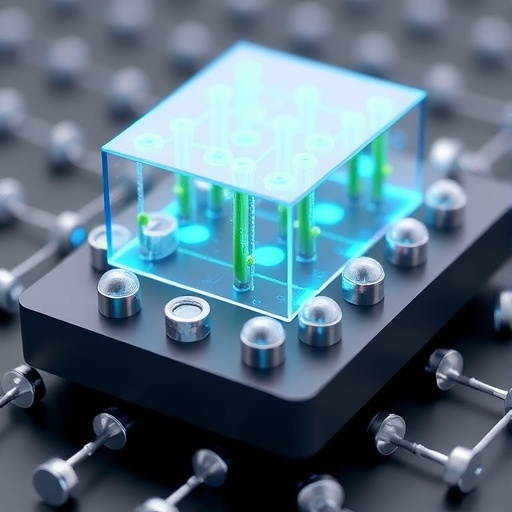
Central to their innovation is the fabrication of a monolithic nickel/molybdenum dioxide (Ni/MoO₂) composite electrode. The electrode features abundant atomic heterointerfaces between Ni nanoparticles and MoO₂ nanoscale structures, which are anchored in situ on a highly porous nickel framework fabricated via state-of-the-art powder metallurgy techniques. This tri-scale porosity — encompassing nano, micro, and macro levels — is meticulously engineered to facilitate electrolyte accessibility, solid-gas interaction management, and structural integrity.
The profound impact of the interfacial electron transfer between nickel and molybdenum dioxide cannot be overstated. Electrons flowing from Ni to MoO₂ subtly modulate the hydrogen adsorption energy (H), optimizing the binding strength to strike a delicate balance. This moderation enhances the intrinsic kinetics of hydrogen evolution by weakening the H adsorption sufficiently to promote facile desorption of H₂ molecules, circumventing a common bottleneck in catalytic processes. Compared to monolithic catalysts, the engineered interfaces here exhibit a newfound synergy that propels catalytic efficiency to unprecedented heights.
Beyond atomic-level interactions, the electrode’s multiscale porous network addresses macroscopic transport issues that plague high-current-density electrolysis. The hierarchical porosity intertwined with the hydrophilic MoO₂ coating expedites bubble detachment by weakening bubble adherence forces and promoting efficient electrolyte permeation. This design minimizes mass transport limitations, ensuring continuous supply and removal of reactants and products. The accelerated bubble detachment not only preserves accessible active sites but also significantly reduces associated mechanical stresses on the catalyst layer.
Durability, arguably the Achilles’ heel in earlier ALKWE systems, receives equal attention in this multiscale strategy. The robust chemical and mechanical bonding between Ni and MoO₂ constituents, integrated seamlessly within the porous nickel skeleton, fosters exceptional structural stability. This cohesion mitigates catalyst delamination and prolongs the electrode lifetime, critical factors for real-world deployment. The team’s rigorous long-term testing verifies the electrode’s capability to sustain operational integrity over thousands of hours without notable loss in activity.
Electrochemical performance metrics exemplify the success of this design. The Ni/MoO₂ electrode achieves an impressively low overpotential of 145 millivolts at a current density of 1 ampere per square centimeter in 1 molar KOH electrolyte. This performance surpasses state-of-the-art benchmarks, notably outperforming commercial Pt/C catalysts which typically demand around 300 millivolts under similar conditions. Such energy efficiency gains could dramatically reduce operational costs in industrial alkaline electrolyzers.
The practical applicability of this electrode is further confirmed under realistic industrial conditions. When evaluated in alkaline electrolyzers operating with concentrated 30 weight percent KOH at temperatures exceeding 85 degrees Celsius, the cell voltage stabilizes at 1.80 volts at 1 A cm⁻². This setup enables an energy consumption rate as low as 4.3 kilowatt-hours per normal cubic meter of hydrogen, a significant step toward economically viable green hydrogen production. Impressively, the electrode retains performance stability beyond 1,000 continuous operating hours, demonstrating its commercial potential.
This research also underscores the vital role of marrying nanotechnology with advanced manufacturing techniques. The powder metallurgy preparation of the porous nickel framework allows scalability and consistency, critical for transitioning laboratory innovations into mass-produced electrolyzers. The in situ growth of heterointerface-rich Ni/MoO₂ nanostructures ensures intimate contact and electronic synergy, unlocking catalytic enhancements impossible through simple physical mixing or layering.
Professor DENG Dehui, a corresponding author of the study, emphasized the broader impact of the work: “This atomic-to-macro multiscale electrode design strategy finally breaks the longstanding impasse in high-current-density ALKWE caused by the activity-stability trade-off. Our approach not only delivers high-efficiency hydrogen production but also sets a new paradigm for the design of durable and robust electrodes.” The team’s work represents a critical advancement in green hydrogen technologies, paving the way for future developments in sustainable energy systems aligned with global carbon neutrality goals.
Published in the highly esteemed Journal of the American Chemical Society, these findings promise to influence both academic research and industrial innovation. The combination of deep mechanistic understanding with materials engineering provides a powerful blueprint for designing next-generation electrolysis devices. Moreover, the comprehensive testing regime incorporating theoretical modeling and practical benchmarks establishes confidence in the electrode’s readiness for real-world applications.
Ultimately, the breakthrough by DICP’s team shifts the landscape of sustainable hydrogen production. By integrating atomic-scale engineering with macro-scale structuring, they eliminate the classic pitfalls of ALKWE, offering a scalable, efficient, and durable electrode solution. As global demand for clean hydrogen escalates, such pioneering electrode designs could become pivotal in realizing a low-carbon future powered by renewable resources, transforming the global energy infrastructure fundamentally.
News Publication Date:
25-Mar-2026
Web References:
https://doi.org/10.1021/jacs.5c21735
References:
Journal of the American Chemical Society. DOI: 10.1021/jacs.5c21735
Cite Scienmag News
Bethany Barker. (April 16, 2026). Scientists Develop Multiscale Electrode Design to Boost Hydrogen Production Efficiency. Scienmag. https://scienmag.com/scientists-develop-multiscale-electrode-design-to-boost-hydrogen-production-efficiency/
Bethany Barker. "Scientists Develop Multiscale Electrode Design to Boost Hydrogen Production Efficiency." Scienmag, 16 April 2026, https://scienmag.com/scientists-develop-multiscale-electrode-design-to-boost-hydrogen-production-efficiency/. Accessed 4 September 2026.
Bethany Barker. "Scientists Develop Multiscale Electrode Design to Boost Hydrogen Production Efficiency." Scienmag. April 16, 2026. https://scienmag.com/scientists-develop-multiscale-electrode-design-to-boost-hydrogen-production-efficiency/


