


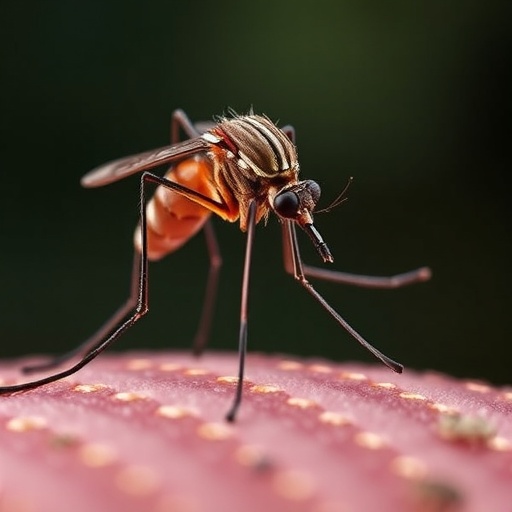
In the quiet hum of a summer evening, an unseen drama unfolds at the microscopic level—a battle between humans and mosquitoes that is far more complex than it appears. This delicate encounter is critical, not just for the immediate irritation of an itchy bite but because it is the gateway for the transmission of dangerous pathogens responsible for diseases such as malaria, Zika virus, West Nile virus, and dengue fever. These mosquito-borne illnesses collectively claim close to a million human lives annually, underscoring the urgent need for deeper understanding and better control measures. Recent advances in mathematical modeling, led by Kyle Dahlin of Virginia Tech, are shedding new light on how the peculiar behaviors of mosquitoes influence the spread of disease across populations.
The moment a mosquito lands on skin is not a simple event. Before drawing blood, the insect performs a behavior known as probing—a stage where it inserts its needle-like mouthpart multiple times, searching for blood vessels. Paradoxically, this probing phase itself can facilitate pathogen transmission as the mosquito injects saliva containing viruses or parasites into the host without immediately beginning to feed. This nuanced insight complicates traditional perspectives on disease transmission, suggesting that even unsuccessful feeding attempts can initiate infection cycles.
Kyle Dahlin and his interdisciplinary team tackled the challenge of capturing these intricate behaviors in a comprehensive mathematical model. Their model extends beyond standard assumptions by including all potential outcomes of mosquito-host interactions: whether the mosquito successfully bites, is swatted away, fails to bite yet probes, or abandons one host in favor of another. Each of these scenarios, often ignored in classical models, plays a crucial role in how diseases propagate in real-world environments where host defense mechanisms and mosquito persistence vary.
The innovation lies in integrating these behavioral contingencies into what Dahlin describes as a “looping” transmission framework. Unlike linear models where a mosquito bites once and either infects or does not, Dahlin’s approach accounts for the probabilistic feedback loops resulting from multiple bites, probing attempts, and host switching. This modeling framework allows researchers to predict more accurately how disease prevalence might respond to different intervention strategies and mosquito behaviors.
One of the most counterintuitive findings emerging from this work is the revelation that from a population-level perspective, allowing a mosquito to complete its bite might reduce overall transmission compared to scenarios where the mosquito is repelled or disturbed mid-probing. While this insight is provocative, it is rooted in a detailed consideration of how interrupted feeding can cause mosquitoes to seek additional hosts, thereby broadening the spread of pathogens. It underscores the importance of considering mosquito behavior heterogeneity in designing control measures.
This sophisticated model has significant implications for vector control strategies. For example, it suggests that insecticides or repellents that deter mosquitoes before landing may be more effective in curbing disease spread than those that interrupt feeding after probing begins. Such nuanced knowledge offers a more targeted approach to deploying chemical interventions, potentially enhancing their efficacy while minimizing unnecessary ecological impacts.
Dahlin’s work, supported by the National Science Foundation through the Mathematical and Physical Sciences Ascending Postdoctoral Research Fellowship, combines mathematical rigor with biological realism. Collaborating with renowned mathematicians Lauren Childs and Michael Robert, the team constructed this modeling framework to bridge individual mosquito behaviors with epidemiological outcomes across human populations, offering a holistic perspective absent in previous attempts.
The significance of this research extends beyond academic circles. Mosquito-borne diseases remain a daunting global health threat, disproportionately affecting vulnerable populations in tropical and subtropical regions. By improving our understanding of the transmission dynamics at an individual mosquito level and scaling this understanding up to population health, this work stands to inform public health policies and intervention strategies with a precision not achieved before.
Despite its promise, the model is not positioned as a standalone solution—a silver bullet against mosquito-borne diseases. Instead, Dahlin emphasizes it as a valuable tool in an ever-growing arsenal aimed at mitigating disease risk. It complements ongoing efforts such as vaccine development, habitat control, and community education, contributing a critical piece to an intricate puzzle.
The research publication, appearing in the Bulletin of Mathematical Biology, opens avenues for further exploration, particularly in parameterizing the model with empirical data from various ecological contexts and mosquito species. Such refinement is crucial for tailoring control strategies to local conditions, enhancing their effectiveness and sustainability.
Ultimately, this pioneering framework transforms how scientists and policymakers conceptualize and address the vexing problem of mosquito-borne diseases. As mosquitoes continue to evolve and adapt, so must our scientific approaches, combining biology, mathematics, and epidemiology to unravel the complexity of disease transmission and chart a path toward diminished human suffering.
Cite Scienmag News
Kristina Jarvis. (November 6, 2025). Scientists Develop Models to Combat the Mosquito Menace. Scienmag. https://scienmag.com/scientists-develop-models-to-combat-the-mosquito-menace/
Kristina Jarvis. "Scientists Develop Models to Combat the Mosquito Menace." Scienmag, 6 November 2025, https://scienmag.com/scientists-develop-models-to-combat-the-mosquito-menace/. Accessed 4 September 2026.
Kristina Jarvis. "Scientists Develop Models to Combat the Mosquito Menace." Scienmag. November 6, 2025. https://scienmag.com/scientists-develop-models-to-combat-the-mosquito-menace/


