


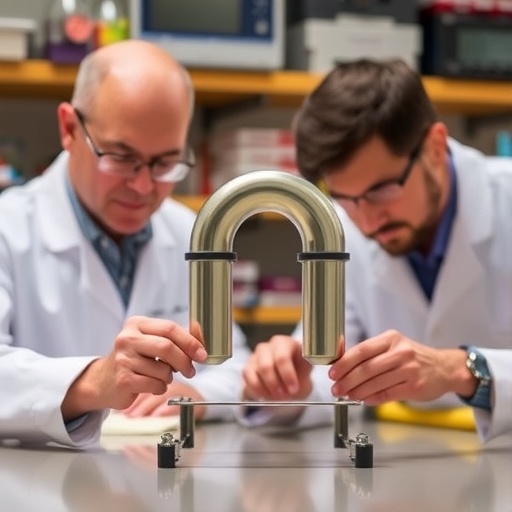
In the relentless pursuit of sustainable technological advancement, the spotlight has increasingly fallen on rare earth elements (REEs), a group of critical minerals indispensable to modern electronics, renewable energy systems, and national defense infrastructures. The escalating demand for these elements—found in everyday devices such as smartphones, electric vehicles, and wind turbines—has catalyzed a wave of innovative research aimed at revolutionizing their extraction and recycling processes. Recent groundbreaking work spearheaded by researchers at the University of Mississippi and the Pacific Northwest National Laboratory (PNNL) suggests that a seemingly simple tool—a magnet—could dramatically enhance the efficiency and environmental footprint of rare earth element recovery.
Rare earth elements, including dysprosium and lanthanum, are predominantly sourced through laborious and chemically intensive industrial processes. These methods often entail the use of vast quantities of organic solvents, incur high energy costs, and generate copious amounts of chemical waste. Traditional extraction strategies, while effective in separating such chemically similar ions, place substantial strain on environmental resources and economic viability, highlighting an urgent need for more sustainable alternatives. The innovative magnet-assisted separation technique developed by this collaborative research team aims to address these challenges by leveraging subtle differences in the magnetic properties intrinsic to certain REEs.
At the heart of this novel approach lies the exploitation of magnetic susceptibility—that is, the degree to which ions in solution respond to an applied magnetic field. Unlike conventional separation methods that rely primarily on chemical affinity or membrane technologies, this strategy harnesses localized magnetic field gradients to induce selective transport and concentration of target ions. Utilizing permanent magnets, the researchers demonstrated that even minor variations in magnetic moments among rare earth ions can be amplified to drive effective separation. This magnetic field-driven process not only accelerates ion enrichment but also curtails the need for environmentally detrimental solvents and decreases overall energy consumption.
One of the fundamental technical breakthroughs underpinning this research is the deployment of a laser-based imaging system developed by PNNL scientists. This system enables real-time visualization of ion migration within liquid feedstocks, revealing dynamic enrichment and depletion zones generated by the applied magnetic gradients. By carefully analyzing these “ion concentration waves,” the team unearthed the intricate interplay between magnetic drift, diffusion, and self-induced electric fields, painting a complex yet controllable picture of electrochemical potential formation. Such insights lay the groundwork for optimizing magnetic field configurations to maximize the selectivity and throughput of rare earth separations.
Furthermore, the team’s research uncovered that combining a precipitating agent with the magnetic field yielded enhanced crystallization of the separated ions, a critical step in isolating purer rare earth compounds. This synergy between magnetic manipulation and precipitation not only streamlines the isolation process but also minimizes the generation of secondary waste products, aligning with broader goals of green chemistry and circular resource utilization. This multi-modal approach showcases the potential for magnets to function as both a driving force and a catalyst in critical metal recovery workflows.
Ivani Jayalath, a doctoral student at the University of Mississippi’s Department of Chemistry and a key contributor to the study, emphasized the transformative nature of this method. Unlike traditional solvent-heavy separation techniques, the magnetic-assisted approach presents a paradigm shift towards faster processing times and reduced environmental hazards. Its simplicity and sustainability promise scalability and integration within existing recovery infrastructure, potentially revolutionizing rare earth supply chains.
The broader implications of this research extend beyond academic novelty. Supply chain disruptions and geopolitical tensions have underscored the precarious nature of rare earth element availability, stimulating urgent calls for resilient domestic extraction technologies. The magnet-driven process represents a promising strategy to tap into secondary sources such as coal power plant waste, mining byproducts, and oil and gas well effluents—resources that have historically been underutilized due to inefficient or costly extraction barriers. By unlocking these domestic reserves, the technology could bolster national security and economic independence.
Giovanna Ricchiuti, a postdoctoral researcher at PNNL and the study’s first author, highlighted the inherent technical hurdles posed by the chemical and physical homogeneity among rare earth ions. The nuanced, precise application of magnetic gradients to discriminate among these elements marks a significant leap in separation science, embodying the innovative spirit required to tackle the global demand for critical minerals. This approach not only elevates separation efficiency but also contributes valuable knowledge to the fundamental physics and electrochemistry of ion transport phenomena.
Lastly, the research community recognizes that while this study is a pivotal first step, further investigations are essential to refine the technique for industrial deployment. Ongoing work aims to enhance the magnetic field configurations, scale up continuous processing capabilities, and explore integration with existing purification stages. The potential to reduce energy expenditure, mitigate toxic solvent usage, and minimize chemical waste establishes this magnet-assisted method as a beacon for sustainable material science innovation.
As the quest for robust and sustainable supply chains intensifies worldwide, the fusion of magnetism and chemistry heralded by this cutting-edge research offers a pragmatic and impactful route for critical rare earth element recovery. Meeting the burgeoning needs of technologies that power electric vehicles, renewable energy installations, and advanced electronics requires not only securing these vital minerals but doing so in a manner that safeguards environmental integrity. By turning to magnets, scientists are ushering in an era where fundamental physics meets pressing industrial challenges, paving the way toward a cleaner, more resilient future.
Web References:
- University of Mississippi
- Pacific Northwest National Laboratory Non-Equilibrium Transport Driven Separations
- Separation and Purification Technology Journal
References:
Ricchiuti, G., Jayalath, I., et al. “Localized magnetic field gradients accelerate ion enrichment and formation of electrochemical potentials for critical metal separation.” Separation and Purification Technology, DOI: 10.1016/j.seppur.2025.136148
Keywords
Rare earth elements, Magnetic separation, Ion transport, Electrochemical potentials, Critical minerals, Sustainable extraction, Magnetic susceptibility, Environmental impact, Supply chain resilience, Green chemistry, Electrochemical imaging, Material recovery
Cite Scienmag News
Bethany Barker. (April 21, 2026). Scientists Demonstrate How Simple Magnets Unlock Solutions to Complex Problems. Scienmag. https://scienmag.com/scientists-demonstrate-how-simple-magnets-unlock-solutions-to-complex-problems/
Bethany Barker. "Scientists Demonstrate How Simple Magnets Unlock Solutions to Complex Problems." Scienmag, 21 April 2026, https://scienmag.com/scientists-demonstrate-how-simple-magnets-unlock-solutions-to-complex-problems/. Accessed 4 September 2026.
Bethany Barker. "Scientists Demonstrate How Simple Magnets Unlock Solutions to Complex Problems." Scienmag. April 21, 2026. https://scienmag.com/scientists-demonstrate-how-simple-magnets-unlock-solutions-to-complex-problems/


