


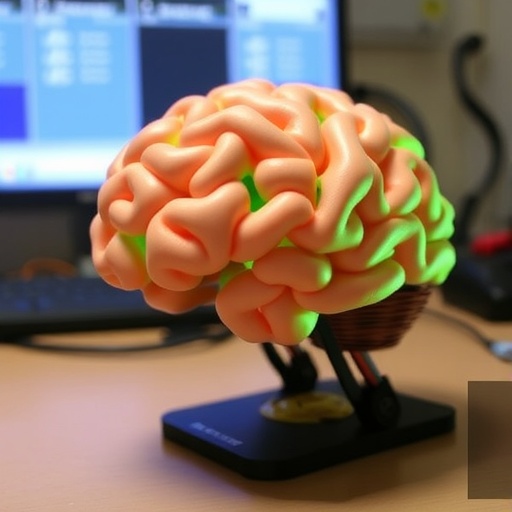
In the realms of computer science and artificial intelligence, the quest to create machines that can learn like humans has been an ongoing ambition. Traditional artificial intelligence systems require extensive amounts of processing power and vast datasets for training, rendering them not only costly but also energy-intensive. As the digital world continues to expand and evolve, researchers are examining alternatives that harness principles derived from the human brain itself. Neuromorphic computing represents a revolutionary shift in this direction, promising a future where computers can learn and adapt with unprecedented efficiency.
At the forefront of this exciting research is Dr. Joseph S. Friedman and his team at The University of Texas at Dallas. They have pioneered the development of a small-scale neuromorphic computer prototype capable of learning patterns and making predictions with significantly fewer training computations compared to traditional AI systems. This groundbreaking innovation is set to redefine how computer systems function, utilizing a fundamentally different approach to processing and learning that mimics neural activity in the brain.
The underlying principle of this research hinges on neuromorphic computing’s ability to closely integrate memory and processing in a manner analogous to the way biological neurons operate. Conventional computers separate memory storage from processing capabilities, which limits efficiency and effectiveness in performing AI tasks. By contrast, neuromorphic systems leverage hardware designed to emulate neuronal functions, allowing for the simultaneous processing and storage of data, thus enabling them to learn and adapt more dynamically.
One of the critical advancements in Friedman’s prototype is the incorporation of magnetic tunnel junctions (MTJs). These nanoscale devices consist of two magnetic layers separated by an insulating barrier and provide an innovative approach to achieving synaptic-like connections in a neuromorphic framework. By tuning the magnetic properties of MTJs, researchers can simulate the strengthening or weakening of synaptic pathways much like the human brain does during learning processes. This remarkable approach promises to enhance the robustness and reliability of neuromorphic systems.
The potential applications of neuromorphic computing are vast and varied, spanning from mobile devices to complex data processing tasks in a range of industries. As energy consumption continues to be a pressing concern in the tech world, innovative computing techniques like those developed by Friedman’s team can significantly reduce the need for energy-intensive data centers, opening the door for more sustainable computing practices.
Friedman’s research is grounded in theoretical frameworks laid out by neuropsychologist Dr. Donald Hebb, whose principle of Hebb’s law states that neurons that fire together wire together. This fundamental tenet serves as the backbone of how the neuromorphic computer learns. By establishing more conductive synaptic connections through coordinated neuron activity, these systems can adapt and respond intelligently, mimicking human cognitive processes more closely than ever before.
In addition to the technical innovations, the collaboration within the NeuroSpinCompute Laboratory is also noteworthy. By partnering with industry leaders such as Everspin Technologies Inc. and Texas Instruments, Friedman’s team is positioned to facilitate a seamless transition from prototypes to practical applications in real-world scenarios. This cooperation not only enhances the credibility of the research but also increases the likelihood of rapid technological advancement and commercialization.
Moreover, the cost-saving potential associated with neuromorphic computing cannot be overstated. The high financial burden of conventional AI training, often reaching hundreds of millions of dollars, poses significant barriers to innovation and accessibility. Neuromorphic systems promise a future where sophisticated AI can be deployed at a fraction of the cost, democratizing access to advanced computing for researchers, start-ups, and developers alike.
Looking ahead, the challenges of scaling up the prototype into larger systems remain. This transitional phase will involve intensive research and engineering to ensure that the neuromorphic approach retains its advantages as the systems increase in complexity and functional application. Nevertheless, the progress made thus far encourages optimism about the viability of these systems and their ability to transform the landscape of artificial intelligence.
As the research unfolds, the societal implications of neuromorphic computing also warrant attention. The balance between computational power, energy consumption, and the ethical ramifications of AI advancement is ever-present. Researchers like Friedman are not only focused on the technological aspects but are also engaging with the broader impacts their discoveries may have on society. The feasibility of smart devices powered by low-energy neuromorphic systems poses intriguing questions regarding privacy, surveillance, and the future role of AI in everyday life.
The findings from this research endeavor, published in the journal Nature Communications Engineering, mark a significant milestone in the field of neuromorphic computing. With the ongoing support from the National Science Foundation and additional grants from the U.S. Department of Energy, Friedman’s team is well-equipped to delve deeper into understanding and enhancing neuromorphic technologies. Their work represents a convergence of innovative thinking, groundbreaking research, and transformative potential within the realm of artificial intelligence.
As this technology continues to evolve, the promise of neuromorphic computing stands as a testament to human ingenuity. The pursuit of machines that learn and reason like us is no longer a distant dream, but rather a tangible reality that is gradually coming to fruition.
Through collaborations, innovative breakthroughs, and a commitment to sustainable development, the future of artificial intelligence appears brighter than ever. As researchers work towards making smarter, more energy-efficient machines, society may soon witness a new era of technology where computers do not merely serve us but learn and grow alongside us in a fundamentally more human-like manner.
Keywords
Neuromorphic computing, Artificial intelligence, Magnetic tunnel junctions, Energy efficiency, Learning algorithms, Brain-inspired computing, Computational neuroscience, Smart devices, Sustainable technology, Machine learning, Neural networks, Synaptic plasticity.
Cite Scienmag News
Cassandra Pierce. (October 31, 2025). Scientists Create Prototype of Brain-Inspired Computing System. Scienmag. https://scienmag.com/scientists-create-prototype-of-brain-inspired-computing-system/
Cassandra Pierce. "Scientists Create Prototype of Brain-Inspired Computing System." Scienmag, 31 October 2025, https://scienmag.com/scientists-create-prototype-of-brain-inspired-computing-system/. Accessed 4 September 2026.
Cassandra Pierce. "Scientists Create Prototype of Brain-Inspired Computing System." Scienmag. October 31, 2025. https://scienmag.com/scientists-create-prototype-of-brain-inspired-computing-system/


