


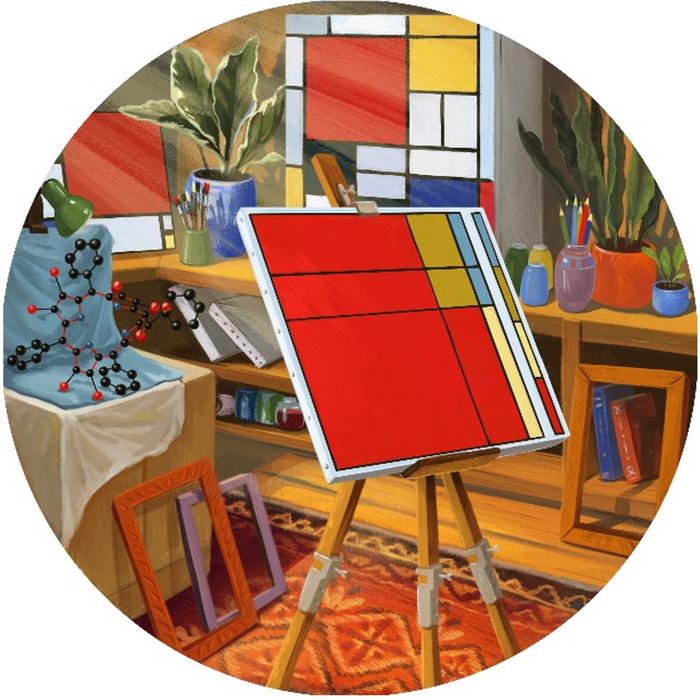
Scientists from Trinity College Dublin have created a computer program that “paints” the structure of molecules in the style of famous Dutch artist, Piet Mondrian, whose beautiful artworks will be instantly recognisable to many.

Credit: Prof. Mathias O Senge, Trinity College Dublin.
Scientists from Trinity College Dublin have created a computer program that “paints” the structure of molecules in the style of famous Dutch artist, Piet Mondrian, whose beautiful artworks will be instantly recognisable to many.
Mondrian’s style, whereby he used blocks of primary colours separated by lines of various widths on a white background, has been extensively copied or used as an inspiration in modern culture. But his deceptively simple artworks have also fascinated scientists for decades, finding niche applications in mathematics and statistics.
And now, researchers from the School of Chemistry are opening eyes and minds to the beauty of molecular structure, as well as posing new questions about the form and function of the molecules themselves.
Their computer program, which can be accessed at http://www.sengegroup.eu/nsd, produces a Mondrianesque plot of any molecule. It does so by following an artistic algorithm that marries the laws of chemistry that describe the 3D structure of a molecule based on its components with the 2D style of one of the most influential painters of the Modern era.
For the scientist, it helps to rapidly assess and demonstrate molecular symmetry, allowing for deeper insights than would emerge from traditional representations. And for the artist, it provides a visually pleasing image of contrasting interpretations of symmetry, hopefully providing inspiration for the incorporation of scientific ideas into work.
Mathias O Senge, Professor of Organic Chemistry in Trinity and Hans Fischer Senior Fellow at the Institute for Advanced Study of TU Munich is the senior author of a just-published article in the leading international journal, Angewandte Chemie, in which this creation is shared with the world. He said:
“For some years we have been working on this project, initially for fun, to output the structure of a molecule in an artistically pleasing manner as a painting in the style of Mondrian. The ‘paintings’ obtained are unique for each molecule and juxtapose what Mondrian and others aimed to do with the De Stijl artistic movement.
“Symmetry and shape are essential aspects of molecular structure and how we interpret molecules and their properties, but very often relationships between chemical structure and derived values are obscured. Taking our inspiration from Mondrian’s Compositions, we have depicted the symmetry information encoded within 3D data as blocks of colour, to show clearly how chemical arguments may contribute to symmetry.”
Christopher Kingsbury, postdoctoral researcher in TBSI, who conceived the project, is first author of the journal article. He said: “In chemistry, it is useful to have a universal way of displaying molecular structure, so as to help ‘blueprint’ how a molecule is likely to behave in different environments and how it may react and change shape when in the presence of other molecules. But a certain amount of nuance is inevitably lost.
“This concept of increasing abstraction by removing minor details and trying to present a general form is mimicked by the early work of Mondrian and in some senses this is what scientists intuitively do when reducing complex phenomena to a ‘simpler truth’. Thanks to our new approach very complex science is fed through an artistic lens, which might make it more accessible to a wider range of people.”
In recent years Professor Senge and his team have greatly enhanced our understanding of porphyrins, a unique class of intensely coloured pigments – also known as the “colours of life”. In one piece of work they created a suite of new biological sensors by chemically re-engineering these pigments to act like tiny Venus flytraps and grab specific molecules, such as pollutants. And now the new direction, in which science and art collide, may further develop our understanding of how porphyrins work.
“Great art gives us a new perspective on the world,” added Prof. Senge. “As a pastiche, this art may allow us to look at familiar molecules, such as porphyrins, in a new light, and help us to better understand how their shape and properties are intertwined. More generally, we believe that contemporary initiatives in ‘Art and Science’ require a transformative break of discipline boundaries and merger to ‘ArtScience’. There is a subtle interplay between science and art and mixing of both aspects in our respective fields of endeavour and this should be a focus for future developments in both areas.”
Journal
Angewandte Chemie
Cite Scienmag News
Bethany Barker. (July 12, 2024). Scientists create computer program that “paints” the structure of molecules in the style of Piet Mondrian. Scienmag. https://scienmag.com/scientists-create-computer-program-that-paints-the-structure-of-molecules-in-the-style-of-piet-mondrian/
Bethany Barker. "Scientists create computer program that “paints” the structure of molecules in the style of Piet Mondrian." Scienmag, 12 July 2024, https://scienmag.com/scientists-create-computer-program-that-paints-the-structure-of-molecules-in-the-style-of-piet-mondrian/. Accessed 3 September 2026.
Bethany Barker. "Scientists create computer program that “paints” the structure of molecules in the style of Piet Mondrian." Scienmag. July 12, 2024. https://scienmag.com/scientists-create-computer-program-that-paints-the-structure-of-molecules-in-the-style-of-piet-mondrian/

