


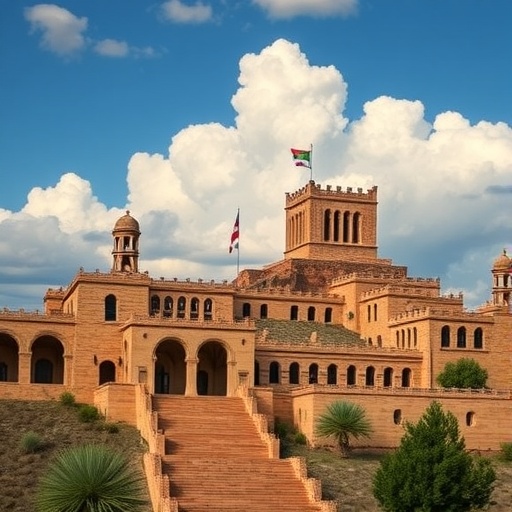
More than two thousand years ago, nestled in the heart of central Mexico, the vast and enigmatic city of Teotihuacan flourished as a major hub of population and cultural activity. At its zenith, this metropolis housed approximately 125,000 inhabitants, showcasing magnificent pyramids and architectural feats that underscored its significance in Mesoamerica. Despite its grandeur, the true identity of Teotihuacan’s residents has remained a compelling archaeological and linguistic mystery, captivating researchers for generations.
Recent groundbreaking work by linguists Magnus Pharao Hansen and Christophe Helmke of the University of Copenhagen proposes an exciting resolution to this puzzle. Published in the prestigious journal Current Anthropology, their research argues that the vibrant murals and scattered artifacts found throughout Teotihuacan are not merely decorative but form an actual writing system. These symbols, they assert, encode an early form of a Uto-Aztecan language lineage that later evolved into well-known tongues such as Cora, Huichol, and Nahuatl—the language famously spoken by the Aztecs.
Founded around 100 BCE, Teotihuacan rose to become a cultural colossus until its sudden decline around 600 CE. Scholars often liken its role and status in ancient Mesoamerica to that of Rome in the classical world, likening the city to a political and cultural epicenter whose influence reverberated across the region. However, unlike Rome, where abundant textual and historical records clearly chart its people’s language and identity, Teotihuacan’s occupants have largely remained anonymous, leaving behind only enigmatic ruins.
The comparison made by Pharao Hansen extends beyond mere size and importance; it touches upon the perplexing absence of concrete linguistic evidence to elucidate the city’s original inhabitants. “We have numerous other cultures in Mexico firmly linked to specific archaeological groups, yet Teotihuacan remains elusive. We cannot definitively say what language they spoke or how they relate to later Mesoamerican populations,” Hansen explains. This predicament presents a formidable challenge to scholars attempting to unravel the city’s ethno-linguistic legacy.
Christophe Helmke emphasizes that despite the cultural blending evident at Teotihuacan, such as artisans and residents from the contemporaneous Maya civilization, a distinct Teotihuacan identity persists architecturally and artistically. The murals, ceramics, and iconography are unmistakable markers that set this culture apart. Yet, until now, the very notion of these signs constituting a systematic, phonetic writing system had not been conclusively demonstrated.
The key breakthrough made by Hansen and Helmke lies in their linguistic detective work. They contend that the apparently pictographic signs encoding animals, objects, and abstract ideas also function phonetically, encoding the sounds of words in the ancestor tongue of the Uto-Aztecan language family. This dual role of logograms—sometimes literal, other times phonetic and rebus-like—has been the crucial insight enabling them to unlock the language embedded in Teotihuacan’s visual record. Such a sophisticated system had eluded decipherment for decades because it requires nuanced knowledge both of the ancient script and the evolution of Uto-Aztecan phonology.
Significantly, their work challenges the traditional historical narrative that Nahuatl-speaking peoples, such as the Aztecs, migrated into the Valley of Mexico only after Teotihuacan’s collapse. Instead, the linguistic connections uncovered suggest that Nahuatlic language speakers were present much earlier and could represent a continuous lineage from Teotihuacan through to the Aztec Empire. This realignment of timelines and identities may reshape our understanding of Mesoamerican demographic history and cultural continuity.
One of the most intricate aspects of this study involves “time-appropriate” linguistic reconstruction. Hansen and Helmke emphasize that deciphering ancient scripts requires interpreting phonetic values based on reconstructed protolanguages contemporaneous with the writing, not their modern descendants. As Helmke analogizes, reading ancient Danish runes with modern Danish pronunciation is ineffective. Similarly, linguistic reconstruction of proto-Uto-Aztecan phonetics was essential to faithfully approach the original sounds encoded in the murals and ceramics.
The authors describe the writing as a hybrid system, combining both logographic (direct meaning) and phonetic elements. For example, a painted coyote symbol might literally represent the animal in some contexts but function phonetically to compose entire words when deciphered as rebuses in others. This polysemous usage complicates interpretation and demands sophisticated cross-referencing with reconstructed lexicons and cultural contexts, making the deciphering effort an interdisciplinary endeavor at the nexus of archaeology, linguistics, and ethnohistory.
Despite methodological advances, the researchers acknowledge significant limitations due to the paucity of surviving texts. Pottery inscriptions and murals bearing these signs are relatively rare, and many remain undiscovered or poorly preserved. This scarcity constrains robust linguistic cross-validation, underscoring the urgency of fieldwork and discovery efforts to uncover additional inscriptions. Expanding the corpus will enable firmer conclusions and broader applications of their decipherment methods.
Magnus Pharao Hansen expresses cautious optimism, noting that their methodological approach—using time-sensitive phonetic reconstruction to break the code—offers a foundational toolkit for other scholars. He hopes this will inspire collaborative workshops and international discussions aimed at refining and expanding the understanding of Teotihuacan’s script. The interdisciplinary nature of their research bridges linguistics, archaeology, and anthropology, setting the stage for integrative scholarship in Mesoamerican studies.
The impact of this decipherment extends far beyond mere translation. If confirmed, it upends long-held assumptions about cultural discontinuity in ancient central Mexico by establishing a direct linguistic and ethnic line from Teotihuacan to later civilizations, including the Aztecs. This transformative insight may prompt revisions of Mesoamerican prehistory, cultural interaction models, and language evolution chronologies, and it could illuminate the socio-political dynamics that shaped this vibrant region two millennia ago.
As more murals and artifacts surface, bringing further textual evidence to light, this pioneering work lays the groundwork for a deeper understanding of Teotihuacan’s erstwhile inhabitants. It rekindles the possibility that soon we will no longer see Teotihuacan as merely an architectural marvel but as a vibrant literate society whose voice, long silent, is finally being heard by modern scholarship.
Cite Scienmag News
Courtney Benton. (October 6, 2025). Scientists Close In on Unraveling Mexican Mystery. Scienmag. https://scienmag.com/scientists-close-in-on-unraveling-mexican-mystery/
Courtney Benton. "Scientists Close In on Unraveling Mexican Mystery." Scienmag, 6 October 2025, https://scienmag.com/scientists-close-in-on-unraveling-mexican-mystery/. Accessed 3 September 2026.
Courtney Benton. "Scientists Close In on Unraveling Mexican Mystery." Scienmag. October 6, 2025. https://scienmag.com/scientists-close-in-on-unraveling-mexican-mystery/


