


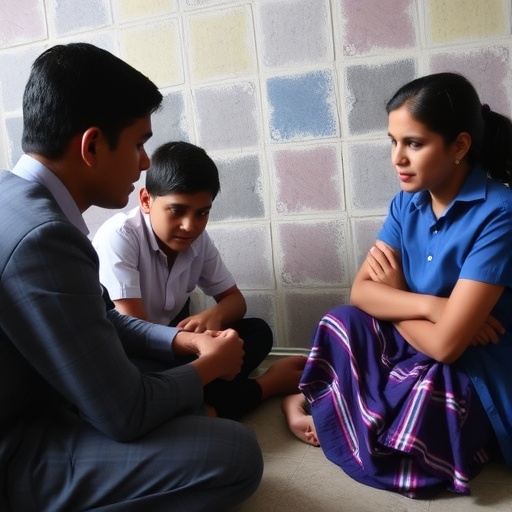
In a bold stride towards addressing adolescent mental health in low- and middle-income countries (LMICs), researchers are launching a pioneering study to evaluate a structured psychological intervention known as interpersonal therapy (IPT) within the school environment of Nepal. This innovative phase III realist cluster-randomised controlled trial (cRCT) seeks to unravel not only whether group-based IPT reduces depression among affected adolescents but also how, why, and under what circumstances it exerts its influence, marking a crucial advance in global mental health research.
Depression ranks as a predominant cause of disability worldwide, disproportionately impacting teenagers in resource-limited settings where mental health services are often scarce or inaccessible. In Nepal, geographic, economic, and social barriers compound this burden, leaving young people vulnerable with few avenues for effective support. Against this backdrop, the novel cRCT protocol, set across 48 public secondary schools spanning the districts of Chitwan and Nawalpur, aspires to harness schools as accessible platforms for delivering mental health care, thereby circumventing systemic obstacles to treatment.
The trial recruits adolescents aged 13 to 19, identified through the Patient Health Questionnaire adapted for adolescents (PHQ-A) with scores denoting clinically relevant depression. These participants will be assigned by school clusters to either receive the IPT intervention – consisting of two individual sessions followed by ten group therapy sessions executed weekly – or enhanced usual care, which might include referral to existing services or informational support. This parallel design permits a rigorous comparison between the therapeutic regimen and standard approaches within real-world educational contexts.
Central to the study’s ambition is its integration of a realist evaluation framework. Unlike classical trials that focus primarily on outcome efficacy, this cRCT endeavors to disentangle the complex web of context-mechanism-outcome configurations. Through detailed process evaluations assessing intervention fidelity, participant engagement, and setting-specific variables, the research team aims to identify which components of IPT are most effective, for whom, and under which school or community conditions. This nuanced understanding could drive precision mental health interventions tailored to diverse adolescent populations.
The timing of assessments at baseline, five weeks, seventeen weeks, and thirty-two weeks post-randomization allows researchers to capture not only immediate therapeutic effects but also sustained changes and potential relapse patterns. The primary outcome measured is the severity of depressive symptoms at the seventeen-week mark, lending insight into medium-term impact. Additionally, secondary outcomes encompass co-occurring anxiety, symptoms related to post-traumatic stress disorder, levels of functional impairment, school attendance records, and overall quality of life metrics, providing a holistic picture of adolescent well-being.
Beyond these clinical outcomes, the investigators delve into intermediary processes purported to drive recovery. Constructs such as hopefulness, regulation of emotional responses, and perceived social support will be quantitatively measured to explore mediating pathways that bridge IPT and symptom improvement. Assessing these factors paves the way for identifying core psychological mechanisms, which in turn can optimize therapeutic protocols and enhance scalability.
Economic evaluation constitutes a cornerstone of this trial’s design, recognizing the imperative of cost-effectiveness in health interventions targeting constrained settings. Through comprehensive analysis from both healthcare provider and societal perspectives, including direct expenses and broader benefits, the study will estimate cost-utility ratios and projected returns on investment. Such data are invaluable for policymakers and educators contemplating large-scale adoption of school-based mental health programs.
Lay facilitators, carefully trained to deliver IPT sessions, reflect a practical and sustainable workforce model addressing shortages of specialized mental health professionals in Nepal. This strategy underscores the trial’s commitment to community capacity-building and the decentralization of care, promising a template adaptable to similar LMIC contexts worldwide where human resources for mental health remain a critical bottleneck.
This study’s methodological rigor is matched by its contextual sensitivity. By embedding the intervention within the local school systems and engaging diverse stakeholders, the trial captures real-world complexities often absent in controlled experimental designs. The use of qualitative data to refine hypotheses and inform the mediation analyses enhances both internal validity and ecological relevance, bridging the gap between clinical research and public health implementation.
If proven effective, the findings from this comprehensive cRCT could ripple far beyond Nepal’s borders. The evidence would support integrating IPT into national education policies as part of a multifaceted school mental health package, leveraging existing infrastructures to deliver scalable, cost-efficient psychological care. Moreover, elucidating mechanisms of action offers a scientific foundation for customizing interventions to varying cultural and socioeconomic milieus, potentially transforming adolescent depression treatment paradigms globally.
The significance of this initiative extends into its potential to destigmatize mental health issues through the school setting, normalizing conversations around emotional well-being and fostering early help-seeking behavior. Such cultural shifts are vital for sustainable improvements in adolescent mental health outcomes and long-term societal benefits, including enhanced educational attainment and productivity.
As the world grapples with rising mental health challenges among youth, especially in underserved regions, this realist cRCT represents a beacon of innovation and hope. Its ambitious design harmonizes clinical efficacy assessment, mechanistic inquiry, economic evaluation, and pragmatic delivery models, embodying a holistic approach to global mental health research and practice.
This groundbreaking trial, officially registered under ISRCTN52852397, embodies a concerted effort to confront adolescent depression head-on in Nepal, spotlighting how targeted, context-aware psychological interventions can be effectively integrated into educational frameworks. Through meticulous scientific inquiry and community partnership, it aspires to pave avenues for scalable mental health solutions that resonate with the lived realities of vulnerable youth populations worldwide.
Cite Scienmag News
Glenn Wilkins. (September 25, 2025). School Therapy Trial for Nepali Teens’ Depression. Scienmag. https://scienmag.com/school-therapy-trial-for-nepali-teens-depression/
Glenn Wilkins. "School Therapy Trial for Nepali Teens’ Depression." Scienmag, 25 September 2025, https://scienmag.com/school-therapy-trial-for-nepali-teens-depression/. Accessed 4 September 2026.
Glenn Wilkins. "School Therapy Trial for Nepali Teens’ Depression." Scienmag. September 25, 2025. https://scienmag.com/school-therapy-trial-for-nepali-teens-depression/


