


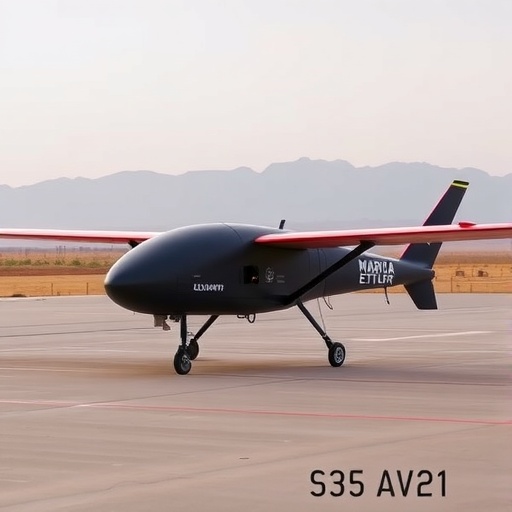
A new study has brought a futuristic Mars aircraft one step closer to reality—not by launching a spacecraft, but by solving one of the most stubborn problems in experimental aerodynamics: how to test a vehicle designed for the thin Martian atmosphere using a smaller model flying through Earth’s much denser air. The work focuses on the Long-Endurance Mars Exploration Flying Vehicle, or LEMFEV, an electrically powered, vertical-take-off-and-landing aircraft with a distinctive boxwing configuration. The concept is intended to combine the efficiency of fixed-wing flight with the operational flexibility of hovering and runway-free takeoff and landing. According to the study, a series of scaled flying demonstrators has now been designed and built for low-altitude flight tests on Earth, creating a practical bridge between computer simulations, wind-tunnel experiments and eventual Martian aviation.
The challenge is far more complicated than simply shrinking every dimension of an aircraft by the same factor. Aircraft do not respond to size changes in a perfectly proportional way because the surrounding fluid behaves differently at different scales. The researchers centered their analysis on three dimensionless quantities used in aerodynamic similarity: the Reynolds number, the Mach number and the Froude number. The Reynolds number compares inertial forces with viscous forces and strongly influences whether airflow remains smooth, separates from a surface or becomes turbulent. The Mach number describes the relationship between an aircraft’s speed and the local speed of sound, affecting compressibility. The Froude number compares inertial forces with gravity, making it especially important when matching the behavior of a flying vehicle at different sizes and under different gravitational conditions.
A full-scale aircraft operating on Mars would encounter a rarefied atmosphere whose aerodynamic conditions are difficult to reproduce simultaneously in a small Earth-based model. Reducing the dimensions of the aircraft changes its Reynolds number, while flying it in Earth’s atmosphere produces a different density and pressure environment from that on Mars. Matching speed can also create an unwanted mismatch in Mach number, and Earth’s gravity is substantially stronger than Mars’s, complicating the Froude-number relationship. The result is a model that may look geometrically correct while producing the wrong lift, drag or stall behavior. The study examines the consequences of these mismatches rather than treating them as minor technical imperfections. Its central argument is that a useful demonstrator must be designed around the aerodynamic quantities that matter most for the intended experiment, instead of relying on geometric scaling alone.
The researchers adopted a hybrid strategy that combines aerodynamic scaling with demonstrative testing. Rather than attempting to force the small aircraft to reproduce every flight parameter at once, they modified the airfoil—the cross-sectional shape of the wing—to recreate the performance of the original Martian design under Earth-based test conditions. This is a crucial distinction. An airfoil generates lift by altering the pressure distribution around the wing, while drag arises from several sources, including skin friction, pressure differences caused by flow separation and, at higher speeds, wave-related effects. When the Reynolds number changes, the boundary layer—the thin region of air directly next to the wing surface—develops differently. That can shift the point at which airflow separates and substantially alter the drag curve. By reshaping the airfoil, the team sought to compensate for the environmental mismatch and preserve the aerodynamic behavior that the Mars aircraft would be expected to exhibit.
The shape-adjustment process was performed through optimization, using the desired lift and drag curves as targets. In practical terms, the researchers searched for an Earth-scaled profile whose aerodynamic response would resemble that of the Martian airfoil, even though the model would fly in a different regime. The study reports that the resulting airfoil reproduced the intended performance with a nominal mean absolute drag-coefficient error of 5.5 percent. The drag coefficient is a dimensionless measure that allows aerodynamic resistance to be compared across different sizes, speeds and fluids. However, the authors also account for uncertainty in the analysis tools used to estimate the flow. With those uncertainties included, the estimated error rises to 17.0 plus or minus 3.6 percent. That larger figure is not a failure of the method; it is an indication of how sensitive low-Reynolds-number aerodynamic predictions can be and why physical flight tests remain necessary.
The design is especially eye-catching because LEMFEV is an electric vertical-take-off-and-landing boxwing aircraft. In a conventional airplane, the wings and tail are separated into distinct aerodynamic components. A boxwing joins lifting surfaces through vertical or near-vertical end structures, forming a closed or nearly closed arrangement when viewed from the side or front. Such configurations can offer structural and aerodynamic advantages, including the possibility of reducing certain induced-drag penalties associated with finite wings. They also introduce their own challenges, such as interference between lifting surfaces, complex airflow around junctions and demanding control requirements during transition between hovering and forward flight. The source study does not claim that the demonstrators have completed a Mars mission or validated the entire aircraft concept in flight. Instead, it addresses the foundational question of how to scale the vehicle credibly enough that Earth-based tests can reveal meaningful information about its aerodynamic behavior.
That distinction matters because Mars aircraft face a sharply different flight environment from Earth aircraft. The Martian atmosphere is much thinner, so a vehicle must move through the air rapidly or carry an unusually large lifting area to generate sufficient aerodynamic force. Lift depends on air density, velocity squared, wing area and the lift coefficient produced by the airfoil and aircraft attitude. A small change in any of these variables can determine whether an aircraft climbs, descends or stalls. The thin atmosphere also means that a Mars aircraft may operate at conditions where low-Reynolds-number effects dominate, creating boundary layers that remain largely laminar or transition unpredictably to turbulence. These flows can behave in ways unfamiliar to designers of ordinary Earth aircraft. The scaling method described in the study is intended to make an Earth model informative despite those differences, allowing engineers to investigate stability, control and performance before committing to expensive planetary hardware.
The project also highlights why subscale flight testing remains a powerful tool in aerospace research. Full-size prototypes are costly, slow to modify and potentially dangerous to operate, while computer models depend on assumptions about turbulence, transition, surface roughness and propulsion. A small flying demonstrator can test the combined behavior of a real airframe, its control system and its aerodynamic surfaces under actual atmospheric conditions. It can expose interactions that are difficult to capture in isolated airfoil simulations or wind-tunnel measurements. At the same time, a subscale aircraft is not automatically a reliable miniature of the final vehicle. Its propellers, motors, structural flexibility, sensors and control algorithms may all scale differently. The value of the LEMFEV demonstrators therefore depends on carefully interpreting what the tests can reproduce and what remains unique to the full-scale Martian design.
The study was conducted by Elena Karpovich of the Aircraft Design and Certification Department at the Moscow Aviation Institute, who is listed as the sole author and contributed to the conceptualization, methodology, investigation, analysis, writing and visualization. The work reports that all data supporting its findings are available by request and that no funding was received. It is part of a broader line of research into fixed-wing Martian aircraft, airfoil optimization and competing strategies for powering unmanned vehicles on Mars. The immediate result is not a flying robot already circling the Red Planet, but a design framework and a hardware pathway for testing one. By converting an otherwise unmanageable similarity problem into an optimization problem, the researchers have provided a way to build Earth-based models that are aerodynamically relevant rather than merely visually similar.
If the approach performs as intended in subsequent low-altitude trials, it could accelerate the development of aircraft capable of exploring regions that rovers cannot easily reach. Aerial vehicles could survey cliffs, lava plains, ancient river channels and other difficult terrain while covering far greater distances than ground-based machines. Electric propulsion could support repeated flights, provided the aircraft can generate and store enough energy in the Martian environment, while vertical takeoff and landing could allow operations from uneven terrain without a prepared runway. Those possibilities remain prospective: the present study establishes scaling methodology and reports the construction of demonstrator models, not a completed planetary flight system. Even so, the work addresses a deceptively fundamental obstacle. Before a Mars aircraft can search the horizon, engineers must first make sure that a model flying under Earth’s sky is telling the truth about flight on another world.
Cite Scienmag News
Denise Maddox. (August 28, 2026). Scaling Electric Boxwing eVTOL Martian Aircraft Demonstrator for Low-Altitude Earth Flight Tests. Scienmag. https://scienmag.com/scaling-electric-boxwing-evtol-martian-aircraft-demonstrator-for-low-altitude-earth-flight-tests/
Denise Maddox. "Scaling Electric Boxwing eVTOL Martian Aircraft Demonstrator for Low-Altitude Earth Flight Tests." Scienmag, 28 August 2026, https://scienmag.com/scaling-electric-boxwing-evtol-martian-aircraft-demonstrator-for-low-altitude-earth-flight-tests/. Accessed 11 September 2026.
Denise Maddox. "Scaling Electric Boxwing eVTOL Martian Aircraft Demonstrator for Low-Altitude Earth Flight Tests." Scienmag. August 28, 2026. https://scienmag.com/scaling-electric-boxwing-evtol-martian-aircraft-demonstrator-for-low-altitude-earth-flight-tests/


