


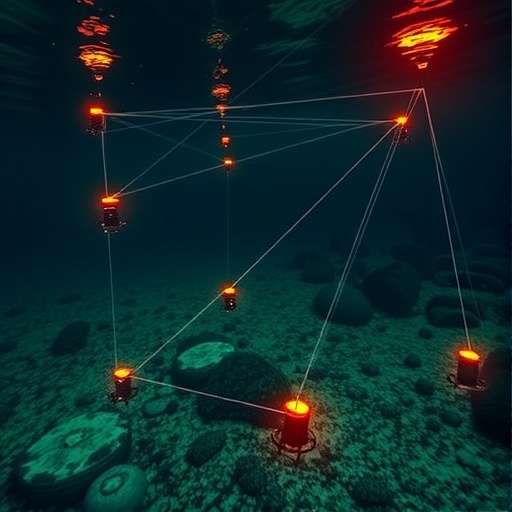
Underwater wireless sensor networks have long promised a revolution in how humanity monitors the ocean—tracking marine life, detecting pollution, safeguarding ports, and supporting offshore infrastructure. Yet these networks remain among the most difficult wireless systems to engineer. Sensors submerged in the sea must cope with corrosive salt water, powerful currents, drifting deployment positions, and severely constrained battery supplies, all while communicating through acoustic channels that are slow, noisy, and energy-hungry. When a sensor’s battery dies, a monitoring mission may quietly lose a critical pair of eyes. Now, a team of researchers from Hanoi University of Industry and Hanoi University of Science and Technology in Vietnam has unveiled a new computational approach that promises to squeeze substantially more life out of these fragile networks while keeping every monitored target under continuous watch.
The research, published in the Journal of Network and Systems Management, addresses one of the most stubborn optimization challenges in the field: the Maximum Lifetime Target Coverage problem in dynamic underwater wireless sensor networks, abbreviated MLTC-UWSN. The problem asks a deceptively simple question—given a fleet of battery-powered underwater sensors and a set of targets that must be continuously observed, how should the sensors be scheduled, switching on and off in carefully organized groups, so that the network survives as long as possible without ever leaving a target uncovered or disconnecting the communication fabric? The team’s answer is an enhanced genetic algorithm, named EGA-MLTC, that outperformed established metaheuristic competitors across a broad battery of simulation scenarios.
Genetic algorithms are computational analogues of natural selection. Candidate solutions are encoded as individuals in a population, their quality is measured by a fitness function, and the fittest individuals are selected, recombined through crossover, and randomly altered through mutation to produce the next generation. Over many iterations, the population evolves toward better solutions. The technique has proven effective for network scheduling problems, but underwater environments add layers of difficulty that can cripple naive implementations. Sensor states change over time as nodes drift, deplete, or fail; sensing is not binary but probabilistic, meaning a sensor’s ability to detect an event degrades with distance; and the solutions must maintain connectivity back to collection points while respecting the limited energy reserves of each device.
The Vietnamese team’s EGA-MLTC algorithm integrates several refinements designed to thrive under exactly these conditions. At its core is a key-time scheduling framework that divides network operation into discrete time slots, with the assumption that sensors maintain their status within a single slot. This framework allows the algorithm to continuously reorganize which sensors are active as the network’s condition evolves—when a node dies, when another drifts into a better sensing position, or when energy budgets shift, the schedule adapts. Within this framework, the enhanced genetic algorithm extracts disjoint sensor covers: groups of sensors, each capable of covering all targets and maintaining connectivity, that are activated in rotation so that no single group bears the full burden of operation. This rotation strategy, long recognized as central to extending wireless sensor network lifetime, becomes far more powerful when the cover sets are computed intelligently and updated dynamically.
The enhancements to the evolutionary machinery are where the method distinguishes itself. Improved crossover operators recombine promising schedules more effectively than standard approaches, blending useful structural features from two parent solutions to produce offspring that inherit the best of both. Enhanced mutation helps the search escape local optima—those deceptive regions of the solution space where a greedy algorithm might settle for a merely adequate schedule. Perhaps most importantly, diversity-preserving mechanisms keep the population from collapsing into a uniform cluster of similar solutions, a common failure mode in evolutionary computation known as premature convergence. By maintaining a rich variety of candidate schedules, the algorithm retains the exploratory power needed to discover unconventional cover arrangements that yield significant lifetime gains.
To validate the approach, the researchers benchmarked EGA-MLTC against well-regarded baseline metaheuristics, including Differential Evolution and Harmony Search, across diverse network scales, sensor densities, and environmental conditions. Differential Evolution, a powerful population-based optimizer that generates new candidates by combining differences between existing individuals, and Harmony Search, which mimics the improvisation of musicians seeking a pleasing harmony, are both established performers in wireless sensor network optimization. Beating them is no small feat. Yet the simulation results showed that EGA-MLTC consistently achieved longer operational lifetimes and more robust coverage than both competitors, demonstrating that the specific structural enhancements—rather than evolutionary computation alone—are responsible for the gains.
The practical implications reach well beyond the laboratory. Underwater sensor networks are increasingly central to marine monitoring and surveillance: they observe ocean temperatures and currents feeding climate models, monitor fisheries and endangered species habitats, detect seismic activity that may presage tsunamis, and protect critical maritime infrastructure. In each application, a network that dies early forces expensive recovery and redeployment operations, often requiring ships, remotely operated vehicles, or autonomous underwater vehicles to service the site. Extending the operational lifetime of an existing deployment—even by a meaningful percentage—translates directly into lower costs, fewer interruptions in data collection, and more reliable long-term ocean observatories. Because the probabilistic sensing model used in the study reflects the noisy reality of underwater detection, the coverage guarantees it enforces are more trustworthy than idealized binary assumptions.
The MLTC-UWSN problem itself is a formidable computational target. It combines several interacting subproblems: selecting which sensors belong to each active cover set, ensuring every target is sensed with sufficient probability, guaranteeing that active sensors can route data to collection points, and sequencing these cover sets over time to maximize total operation before energy exhaustion. This combination makes the problem combinatorial in nature, with solution spaces that grow explosively as networks scale. Exact methods quickly become intractable for realistic deployments, which is why metaheuristics—algorithms that trade guaranteed optimality for good solutions within practical computation times—dominate this research landscape. The genetic algorithm family has been particularly successful here because the cover-set scheduling problem maps naturally onto population-based search: each individual can represent a complete schedule, and the fitness function directly rewards longer lifetimes and stronger coverage.
What makes the underwater setting distinctive is its dynamism. Terrestrial sensor networks can often be treated as static, but underwater nodes are subject to currents and mobility, and their communication links fluctuate with tides, salinity, and thermal layers in the water column. A schedule that is optimal at deployment time may become badly suboptimal hours later as the network’s geometry shifts. The key-time scheduling framework embedded in EGA-MLTC directly confronts this reality by treating the schedule as something to be re-optimized as sensor states vary, rather than a one-time calculation frozen at the moment of deployment. This adaptive quality is central to the robust coverage the simulations revealed: when conditions changed, the algorithm reorganized active sensor sets rather than allowing holes to open in the surveillance fabric.
The research also fits into a broader surge of interest in evolutionary and nature-inspired computation for oceanic networks. Recent years have seen proposals ranging from jellyfish-inspired optimization for coverage enhancement to multi-population harmony search for underwater acoustic networks, alongside reinforcement learning hybrids and machine learning-driven management architectures. The Vietnamese team’s contribution to this landscape is notable for its completeness—addressing coverage, connectivity, and energy simultaneously under realistic probabilistic sensing—and for the demonstrated superiority of its diversity-preserving evolutionary strategy. The authors note that data and implementation code will be provided if required, offering a pathway for other research groups to reproduce and build upon the results.
Looking forward, the work suggests several promising directions. As underwater networks grow larger and incorporate mobile elements such as autonomous underwater vehicles, scheduling algorithms will need to handle even greater dynamism and potentially hybrid communication architectures. The energy modeling underpinning such approaches may also be refined with real-world acoustic communication traces, tightening the connection between simulation and sea-trial performance. For now, though, EGA-MLTC stands as a practical and scalable tool for one of marine technology’s most persistent pain points: keeping watch beneath the waves for as long as the mission demands, on batteries that were never meant to last that long. In an era when ocean observation is becoming indispensable to climate science, security, and resource management, algorithms that quietly extend the vigil of submerged sensors may prove among the most consequential pieces of the marine technology puzzle.
The study, led by Nguyen Thi My Binh of Hanoi University of Industry together with Tran Son Tung, Tran Le Dung, and corresponding author Ho Viet Duc Luong of Hanoi University of Science and Technology, was published on 23 May 2026. It underscores a theme increasingly common across modern engineering: that intelligent algorithms, thoughtfully adapted to the constraints of a hostile physical environment, can deliver the kind of system-level gains that hardware improvements alone cannot match. For underwater wireless sensor networks—and the ocean missions that depend on them—that intelligence may make the difference between a network that fades within months and one that keeps watching, reliably, for years.
Cite Scienmag News
Juliet Wilcox. (September 10, 2026). Enhanced Genetic Algorithm Boosts Lifetime and Coverage in Underwater Sensor Networks. Scienmag. https://scienmag.com/enhanced-genetic-algorithm-boosts-lifetime-and-coverage-in-underwater-sensor-networks/
Juliet Wilcox. "Enhanced Genetic Algorithm Boosts Lifetime and Coverage in Underwater Sensor Networks." Scienmag, 10 September 2026, https://scienmag.com/enhanced-genetic-algorithm-boosts-lifetime-and-coverage-in-underwater-sensor-networks/. Accessed 10 September 2026.
Juliet Wilcox. "Enhanced Genetic Algorithm Boosts Lifetime and Coverage in Underwater Sensor Networks." Scienmag. September 10, 2026. https://scienmag.com/enhanced-genetic-algorithm-boosts-lifetime-and-coverage-in-underwater-sensor-networks/


