


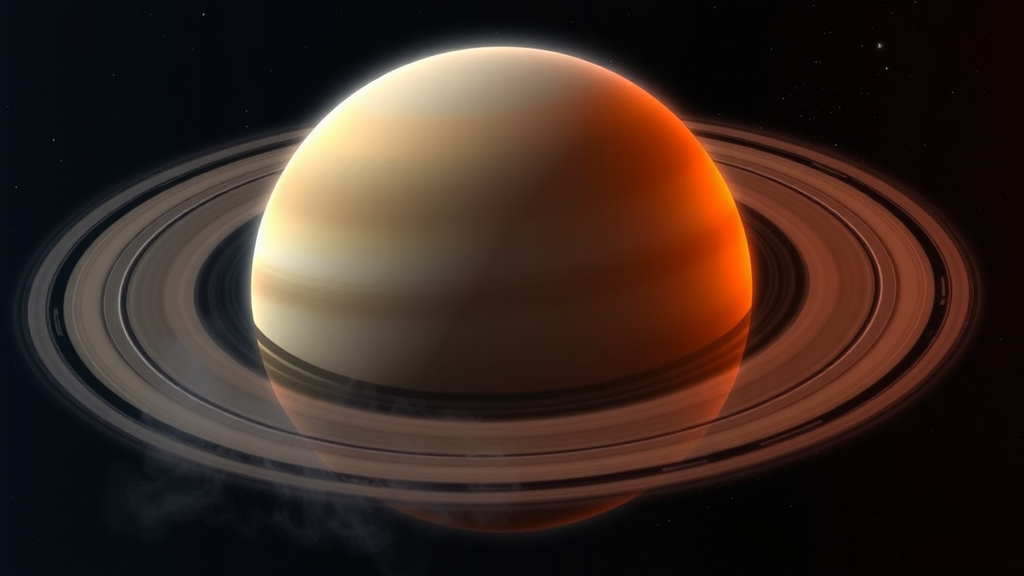
Deep in the space between the orbits of two of Saturn’s icy moons, Dione and Rhea, an invisible drama may be unfolding. Charged dust grains drifting through the planet’s middle magnetosphere could be supporting slow-moving, self-sustaining electrostatic waves that ripple through the plasma at ultra-low frequencies. A new theoretical study by Tanushree Bezbaruah and Pralay Kumar Karmakar of Tezpur University, published in Astrophysics and Space Science, provides the most detailed picture yet of how such nonlinear coherent structures might form in this exotic, dust-laden environment, and the results offer a fresh window into the hidden electrodynamics of the ringed giant.
Saturn’s magnetosphere is not the clean, empty vacuum that early space-age scientists might have imagined. It is a crowded arena of electrons, ions, and microscopic dust particles, many of them shed from the planet’s vast E ring and from the geysers of Enceladus. What makes this environment truly remarkable is that the dust grains themselves can carry electric charges of either sign. Depending on their size, composition, and exposure to sunlight and plasma currents, some grains accumulate negative charge while others can become positively charged. This bipolar dust population, coexisting with ordinary plasma species, creates a medium whose wave behavior is far richer than that of a conventional electron-ion plasma.
The new model focuses specifically on the region between Dione and Rhea, a stretch of the middle magnetosphere where Cassini-era measurements have documented complex plasma populations. The authors construct a five-component fluid description: two distinct dust fluids representing positively and negatively charged grains, cold Maxwellian electrons and ions, and a population of hot suprathermal electrons. The suprathermal electrons are particularly important because spacecraft observations have repeatedly shown that Saturn’s magnetospheric electron distributions deviate from thermal equilibrium, possessing energetic tails that a simple Maxwellian cannot capture. By treating these hot electrons with a kappa distribution, the model stays faithful to what instruments such as Cassini’s Radio and Plasma Wave Science experiment actually measured.
The mathematical heart of the study is the reductive perturbation method, a classical technique in nonlinear plasma physics that has been used since the 1970s to tame the full complexity of fluid equations. The idea is elegant: rather than solving the entire nonlinear system at once, one assumes that the wave amplitude is small and stretches the space and time coordinates in a carefully chosen way. The original equations are then expanded order by order in a small parameter, and at the lowest significant order one recovers a linear wave mode, in this case the dust-acoustic wave, a compressive oscillation in which the massive, charged dust grains move collectively while the much lighter electrons and ions simply respond to restore charge balance.
Carrying the expansion to the next order yields a Korteweg-de Vries equation, one of the most celebrated equations in all of nonlinear science. The KdV equation famously describes systems in which nonlinearity, which steepens waves, and dispersion, which spreads them out, strike an exact balance. When these two effects cancel each other, the result is a solitary wave: a localized pulse that propagates without changing shape, behaving almost like a particle. First observed as a shallow water canal wave in the nineteenth century, solitons have since been identified in optical fibers, ocean currents, and, as this work shows, potentially in the dusty plasma surrounding Saturn.
One of the study’s most striking findings is the character of the solitary solutions. Unlike many laboratory dusty plasma experiments, which typically produce compressive solitons, the Saturnian configuration analyzed here supports only rarefactive solitary waves, localized depletions in the electrostatic potential rather than humps. The authors show that this behavior is governed decisively by the equilibrium negative dust charge. Because the negatively charged grains dominate the charge balance in this region, their abundance and charge state control the sign and magnitude of the nonlinearity coefficient in the KdV equation, and therefore determine both the polarity and the amplitude of the resulting solitary structures. Small changes in the dust charge parameter translate into significant changes in the wave profile, making the equilibrium dust charge a powerful diagnostic knob for the entire system.
The numerical analysis of the stationary solutions yields concrete, testable predictions. The electrostatic potential amplitudes of these solitary structures reach the order of a few millivolts, a small but physically meaningful value in the tenuous magnetospheric plasma. More intriguingly, the associated electric field exhibits a bipolar signature, swinging positive and negative in sequence, with a magnitude in the millivolt-per-meter range and a characteristic period of a few hundred seconds. This places the structures firmly in the ultra-low-frequency band, a regime where planetary magnetospheres are known to host a variety of wave phenomena but where dusty plasma effects have been difficult to isolate.
The bipolar electric field signature is particularly significant for observational purposes. Spacecraft such as Cassini, which spent thirteen years orbiting Saturn, routinely detected electrostatic solitary waves and broadband wave bursts in the planet’s inner magnetosphere. Previous studies documented such structures inside ten Saturn radii and near Enceladus, but the middle magnetosphere between Dione and Rhea remained comparatively underexplored from a theoretical standpoint. The new predictions give mission scientists and future data analysts a concrete template: if ultra-low-frequency, bipolar electric field pulses with periods of hundreds of seconds and amplitudes in the millivolt-per-meter range appear in archived or future data from this region, they could be the fingerprint of dust-acoustic solitons shaped by bipolar dust populations.
Beyond its immediate application to Saturn, the work speaks to a broader question in space plasma physics: how do charged dust grains reshape wave dynamics in planetary environments generally? Dusty plasmas are now recognized as ubiquitous, appearing in cometary comas, planetary rings, the lunar plasma environment, and interstellar clouds. The presence of dust introduces new low-frequency modes, modifies existing dispersion relations, and, as this study demonstrates, can even determine the polarity of nonlinear structures. The finding that a single parameter, the equilibrium dust charge, exerts decisive control over the nonlinear behavior suggests that similar diagnostics could be applied to other dusty magnetospheres, including those of Jupiter and the dusty plasmas near Mars and comets.
The authors are careful to ground their model in realistic Saturnian conditions, drawing on decades of spacecraft measurements of plasma densities, electron temperatures, and dust properties compiled from the Voyager era through the Cassini mission. Their order-by-order perturbation analysis, presented in full mathematical detail, shows that the secondary electron emission current, while physically present, remains roughly an order of magnitude smaller than the photoemission current and three orders of magnitude smaller than the dominant electron and ion collection currents under the considered conditions, justifying its neglect without altering the main conclusions. This kind of careful bookkeeping strengthens the case that the predicted rarefactive solitons are not mathematical artifacts but genuine features of the Saturnian middle magnetosphere. As planetary scientists continue to mine the Cassini archive and contemplate future missions to the outer solar system, this theoretical framework provides a ready-made lens for recognizing the subtle, slow, and silent waves that charged dust may be sending through the realm of the ringed planet.
Subject of Research: Nonlinear dust-acoustic solitary waves in the bipolar dusty plasma of Saturn's middle magnetosphere
Article Title: A perturbative approach to investigate nonlinear coherent structures in complex bipolar Saturnian plasmas
Article References: Bezbaruah, T., & Karmakar, P. K. (2026). A perturbative approach to investigate nonlinear coherent structures in complex bipolar Saturnian plasmas. Astrophysics and Space Science, 371(9), Article 106. https://doi.org/10.1007/s10509-026-04637-6
Image Credits: AI Generated
DOI: 10.1007/s10509-026-04637-6
Keywords: Saturn, dusty plasma, dust-acoustic waves, solitary waves, Korteweg-de Vries equation, magnetosphere, suprathermal electrons, nonlinear waves, Dione, Rhea, planetary rings, plasma physics
Cite Scienmag News
Katie Riggs. (September 22, 2026). Saturn’s Dusty Middle Magnetosphere May Hide Ultra-Low-Frequency Solitary Waves. Scienmag. https://scienmag.com/saturns-dusty-middle-magnetosphere-may-hide-ultra-low-frequency-solitary-waves/
Katie Riggs. "Saturn’s Dusty Middle Magnetosphere May Hide Ultra-Low-Frequency Solitary Waves." Scienmag, 22 September 2026, https://scienmag.com/saturns-dusty-middle-magnetosphere-may-hide-ultra-low-frequency-solitary-waves/. Accessed 4 October 2026.
Katie Riggs. "Saturn’s Dusty Middle Magnetosphere May Hide Ultra-Low-Frequency Solitary Waves." Scienmag. September 22, 2026. https://scienmag.com/saturns-dusty-middle-magnetosphere-may-hide-ultra-low-frequency-solitary-waves/


