


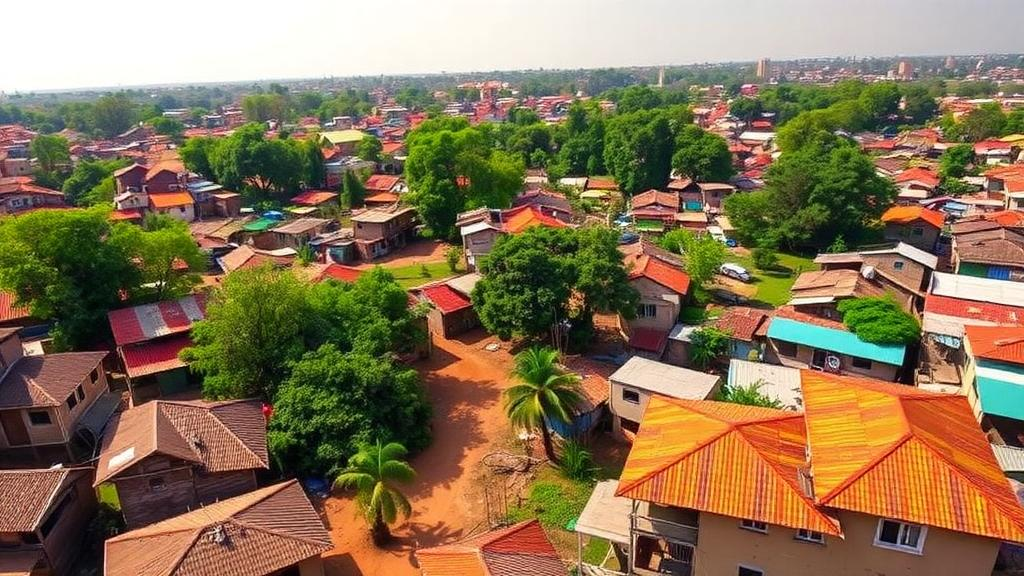
For most of the twentieth century, Kumasi in south-central Ghana carried a title few African cities could claim: the Garden City of West Africa. Planned in 1945 by architects Maxwell Fry and Jane Drew around Ebenezer Howard’s garden city principles, the metropolis was designed with green belts, urban parks and orderly residential layouts that kept development in harmony with nature. A new study published in Discover Cities now documents, in unsparing quantitative detail, how that identity is slipping away, and why the people who live there know it.
Researchers from the Department of Planning at Kwame Nkrumah University of Science and Technology combined a survey of 183 residents across high, middle and low-income communities with interviews of officials from the Environmental Protection Authority and the Physical Planning Department. Crucially, they paired this social data with a decade of satellite evidence. Using Landsat 8 imagery from 2015 and Landsat 9 imagery from 2025, processed in ArcMap 10.8.2 with a Maximum Likelihood Classifier, they divided the metropolis into just two classes: natural areas dominated by vegetation and wetlands, and developed land occupied by buildings, roads and infrastructure.
The numbers are stark. In 2015, natural areas covered 50.7 square kilometers, or 21.5 percent of the study area. By 2025, that figure had fallen to 34.8 square kilometers, or 14.8 percent, a 31.1 percent decline in the city’s living green infrastructure over a single decade. Built-up areas expanded by 8.5 percent in the same period. The classification relied on false color composites in which vegetation appears in red shades because of its strong near-infrared reflectance, allowing analysts to distinguish surviving green space from encroaching concrete with considerable confidence.
Residents have noticed. In the survey, 70.7 percent of respondents described the city as not very sustainable, 26.8 percent were neutral, and only 2.5 percent considered it sustainable. Yet awareness of environmental programs was remarkably high: 74.2 percent of residents knew of sustainability initiatives in the city, with waste reduction and recycling dominating recognition at 64.3 percent, followed by urban forestry at 21.3 percent and the national Green Ghana tree-planting project at 12.5 percent.
That gap between awareness and environmental outcomes is the study’s central paradox. People know the programs exist, and they overwhelmingly believe the city is failing. The researchers frame this through Urban Resilience Theory, which holds that a city’s capacity to withstand environmental pressure depends on ecological, social and institutional strengths working together. The shrinking wetlands and green spaces of Greater Kumasi are buffers against heat, flooding and pollution; their loss erodes the city’s ecological resilience even as its citizens grow more environmentally literate.
The institutional interviews explain why awareness has not translated into protection. When asked to identify the main barriers to restoring the Garden City, 40.3 percent of responses pointed to weak enforcement of environmental laws. Respondents noted that the Land Use and Spatial Planning Act, Act 925, is not strictly applied, allowing construction in areas zoned for green space and wetlands, which blocks natural drainage paths and drives up flood risk. Planners interviewed for the study emphasized that the problem is not the absence of regulations but their inconsistent application, particularly where development has already occurred.
Other barriers clustered around familiar governance failures. Inadequate funding for restoration projects accounted for 17.2 percent of responses, limited public awareness and engagement for 32.1 percent, and uncontrolled urbanization and land-use change for 10.4 percent. Officials described chieftaincy and political interference as obstacles to enforcing land-use regulations, and noted that although approved development plans must indicate green areas, compliance in practice is weak, with elite interference cited as a recurring problem. Inter-agency coordination, staff capacity and financial resources all emerged as constraints in the interviews with the Environmental Protection Authority and the Physical Planning Department.
The study’s authors argue the remedy lies in enforcement technology and accountability as much as in new policy. They recommend regular site inspections, GIS-based monitoring of development, and meaningful sanctions for construction without permits, coordinated among the Metropolitan and Municipal Assemblies, the Land Use and Spatial Planning Authority and the Environmental Protection Authority. They also propose a dedicated environmental restoration fund to finance the protection and recovery of green spaces and wetlands, and stronger community-level tree planting, wetland conservation and cleanup programs to convert resident awareness into action.
One of the more striking recommendations reaches into the classroom. The authors suggest that the Ministry of Education and the Ghana Education Service make tree planting, with follow-up maintenance, a compulsory component of environmental education, requiring each student to plant at least one tree before completing their studies. The idea treats environmental restoration as a skill to be practiced rather than a subject to be memorized, and reflects the study’s broader conclusion that the Garden City can only return through a combination of education, financing, institutional reform and sustained public participation.
The researchers acknowledge limitations: the findings are specific to Greater Kumasi, perceptions were captured at a single point in time, and only a small number of institutional representatives were interviewed. Still, the decade-long loss of nearly a third of the city’s natural cover, measured independently by satellite and mirrored by residents’ pessimism, offers a sobering case study for rapidly urbanizing cities across Africa. Whether Kumasi regains its Garden City title will depend less on whether people know about sustainability programs, the study suggests, than on whether institutions finally enforce the rules that already exist.
Subject of Research: Environmental change, public awareness and urban sustainability in Greater Kumasi, Ghana
Article Title: The fading Garden City: environmental change, public awareness and the quest for urban sustainability in Greater Kumasi
Article References: Antwi, Y. N. B., Takyi, S. A., Nartey, C. D., & Amponsah, O. (2026). The fading Garden City: environmental change, public awareness and the quest for urban sustainability in Greater Kumasi. Discover Cities, 3(1), Article 194. https://doi.org/10.1007/s44327-026-00370-5
Image Credits: AI Generated
DOI: 10.1007/s44327-026-00370-5
Keywords: Kumasi, Garden City, Ghana, urban sustainability, green spaces, wetlands, Landsat, GIS, urbanization, environmental enforcement, urban planning, environmental awareness
Cite Scienmag News
Courtney Benton. (September 30, 2026). Satellite images reveal Ghana’s Garden City is losing its green soul. Scienmag. https://scienmag.com/satellite-images-reveal-ghanas-garden-city-is-losing-its-green-soul/
Courtney Benton. "Satellite images reveal Ghana’s Garden City is losing its green soul." Scienmag, 30 September 2026, https://scienmag.com/satellite-images-reveal-ghanas-garden-city-is-losing-its-green-soul/. Accessed 4 October 2026.
Courtney Benton. "Satellite images reveal Ghana’s Garden City is losing its green soul." Scienmag. September 30, 2026. https://scienmag.com/satellite-images-reveal-ghanas-garden-city-is-losing-its-green-soul/


