A comparative field study of 34 Slovak Water Framework Directive monitoring sites found that DNA metabarcoding of traditional bulk samples, water environmental DNA and sediment environmental DNA produced different macrozoobenthos taxonomic profiles and ecological status classifications. Bulk samples detected the broadest taxonomic spectrum and generally yielded higher ecological quality ratio values, while sediment samples most often produced poorer classifications. Only three sites retained the same status across all three sample types.
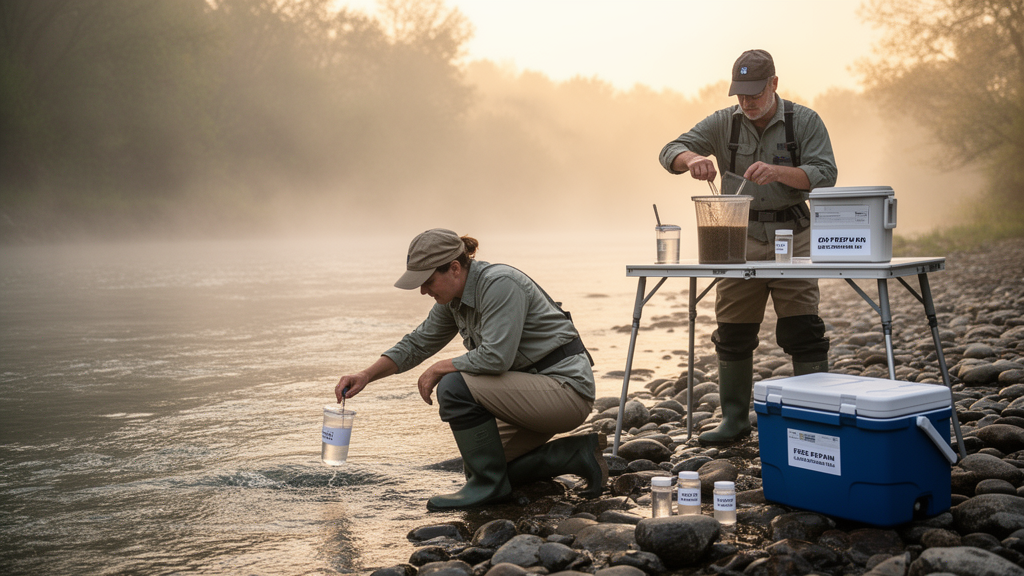
The study sampled 10 stream types between 130 and 905 metres above sea level in the Western Carpathians during spring in 2022 or 2023. At each site, investigators collected approximately 15 minutes of kick-sampled bulk material, two replicate one-litre water samples and two 25-millilitre sediment samples from riffle and pool habitats. All materials were preserved in 96% ethanol and stored at minus 25 degrees Celsius. The observational comparison assessed how sampling method affected taxon detection, individual ecological metrics, ecological quality ratios and resulting ecological quality classes.
Laboratory processing targeted an approximately 420-base-pair fragment of the standard cytochrome c oxidase I barcode region. DNA underwent two-step PCR, and libraries were sequenced on an Illumina MiSeq. Bioinformatic processing included read merging, denoising, length filtering, chimera removal, clustering into operational taxonomic units at 97% identity and taxonomic assignment through BOLD. Negative controls were assessed for each sequencing run, and read counts from control detections were subtracted from corresponding samples. Sequencing produced more than 32.1 million reads; after quality filtering, more than 16 million remained and were clustered into 24,529 operational taxonomic units.
Following the removal of low-similarity and non-target operational taxonomic units, 1,205 remained, of which 702 could be assigned to species, representing 558 named species. Insects dominated the dataset, with 544 operational taxonomic units representing 463 species, followed by Clitellata with 115 operational taxonomic units representing 66 species. The researchers described 235 operational taxonomic units assigned to 94 named species as potential cryptic diversity, using that term because the sequence patterns had not been independently validated as species boundaries. Chironomidae and Naididae showed particularly high numbers of such assignments.
Bulk samples contained 895 operational taxonomic units, including 610 identified to species, compared with 680 units and 414 species in water samples and 430 units and 234 species in sediment samples. After collapsing multiple operational taxonomic units assigned to the same named species, the corresponding totals were 599, 417 and 233 taxa. The data subset accepted by the ASTERICS ecological-assessment software was smaller: 576 taxa for bulk samples, 404 for water and 222 for sediment. This filtering reflected the taxa for which the software contained suitable autecological information, illustrating that molecular detection at high taxonomic resolution cannot be transferred directly into every existing ecological index.
Read counts were used as abundance proxies, and the final ecological quality ratio for each site and sample type was the arithmetic mean of partial ratios calculated from 12 metrics selected according to stream type. Bulk samples assigned 22 sites to the highest class, very good ecological status. Water and sediment data sometimes lowered a site’s classification by two or three classes. Sediment results were generally least favourable, with 24 sites placed in the moderate or poor classes. When all three sample types were pooled, 82% of sites received the highest ecological quality class.
The overall multimetric ecological quality ratio differed significantly among sample types. In the direct comparison of bulk, water and sediment samples, all three pairs differed significantly in post-hoc tests. Paired analyses also found significant differences for every pair, with bulk samples generally producing higher values. Three of the 12 individual metrics—percentage of oligosaprobic taxa, Aka plus Lit plus Psa taxa and the Rheoindex—did not differ significantly across all three methods. The EPT-taxa count, BMWP score and number-of-families metric were particularly sensitive to sampling method. Bulk samples detected 62 unique Ephemeroptera, Plecoptera and Trichoptera taxa, whereas water and sediment samples together detected six. Bulk samples also yielded 18 BMWP families, compared with three in water and two in sediment.
Recalculation after removing EPT taxa, BMWP score and number of families substantially reduced differences among methods. The bulk-versus-water difference in the comparison of the three sample types was no longer statistically significant, while differences involving sediment remained present but were less pronounced. The findings therefore show that the sample-type effect in the Slovak assessment was driven mainly by presence/absence metrics that reward detection of additional taxa, rather than by consistently large differences in abundance-dependent metrics.
The results are bounded by the study design and methods. Only 34 sites were sampled, all during the spring season, and one litre of water was filtered per replicate; the BF3/BR2 primer pair targets a relatively long amplicon and is not considered optimal for environmental DNA. Reference-database gaps, amplification bias, false positives, variable laboratory procedures and the use of read counts as abundance proxies also limit interpretation. Water DNA may be transported from upstream, whereas sediment DNA may persist and reflect historical rather than only contemporary communities. The authors therefore consider bulk sampling the most comprehensive approach in this comparison, while noting that non-invasive environmental sampling may still be useful if filtered volumes, replicate numbers, primers, PCR replication and metric-specific treatment are optimized and standardized.
Subject of Research: Comparison of bulk, water eDNA and sediment eDNA metabarcoding for macrozoobenthos ecological status assessment in Slovakia
Article Title: Bulk, water, and sediment eDNA metabarcoding reveal metric-driven differences in WFD macrozoobenthos ecological status classification in Slovakia
Article References: Šamulková, M., Beracko, P., Macko, P., Tuhrinová, K., Čiamporová-Zaťovičová, Z., & Čiampor Jr, F. (2026). Bulk, water, and sediment eDNA metabarcoding reveal metric-driven differences in WFD macrozoobenthos ecological status classification in Slovakia. Metabarcoding and Metagenomics, 10, Article e185694. https://doi.org/10.3897/mbmg.10.185694
Image Credits: AI Generated
Keywords: DNA metabarcoding, environmental DNA, macrozoobenthos, Water Framework Directive, ecological quality ratio, biomonitoring, Slovakia, freshwater streams, taxonomic richness, Bulk, water, sediment
Cite Scienmag News
Violet Maxwell. (October 20, 2026). Sample choice alters DNA-based ecological status classifications at 34 Slovak monitoring sites. Scienmag. https://scienmag.com/sample-choice-alters-dna-based-ecological-status-classifications-at-34-slovak-monitoring-sites/
Violet Maxwell. "Sample choice alters DNA-based ecological status classifications at 34 Slovak monitoring sites." Scienmag, 20 October 2026, https://scienmag.com/sample-choice-alters-dna-based-ecological-status-classifications-at-34-slovak-monitoring-sites/. Accessed 20 October 2026.
Violet Maxwell. "Sample choice alters DNA-based ecological status classifications at 34 Slovak monitoring sites." Scienmag. October 20, 2026. https://scienmag.com/sample-choice-alters-dna-based-ecological-status-classifications-at-34-slovak-monitoring-sites/