


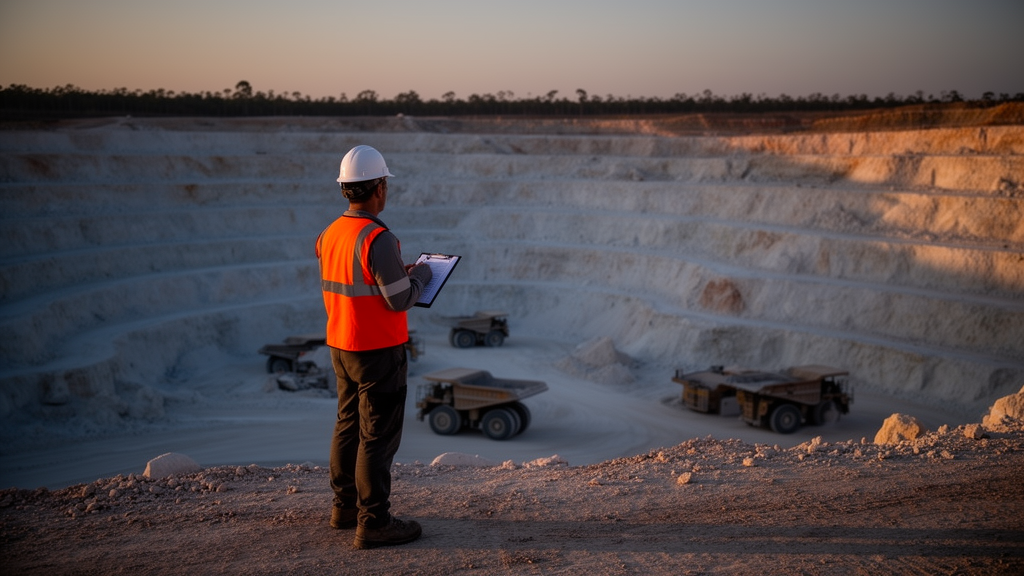
Workers at a medium-sized phosphate mine showed elevated rates of anxiety and depression on standard screening questionnaires, and — counterintuitively — the miners themselves were not the worst off. According to a peer-reviewed study published in BMC Psychology, safety officers reported the poorest mental health among the positions surveyed, a finding that points to the psychological weight of carrying responsibility for other people's safety rather than to direct exposure to underground hazards. The research team selected a single enterprise, referred to as Mine L, as the study site.
After approval from an institutional ethics review committee and permission from the mine, the investigators worked in two phases. First, they conducted in-depth interviews with 30 employees to explore how workers themselves described their psychological strain. Second, they administered two widely used self-report instruments — the Self-Rating Anxiety Scale (SAS) and the Self-Rating Depression Scale (SDS) — to all employees, ultimately collecting 147 valid questionnaires.
The screening results were substantial. 25.85 percent of respondents scored at or above the cutoff on the anxiety scale, while 38.78 percent scored at or above the cutoff on the depression scale. Mean scores on both measures were significantly higher than the national norms, indicating that the surveyed workforce as a whole carried a heavier psychological burden than the general reference population.
The most consequential result emerged when the researchers compared scores across job positions. A one-way ANOVA showed an overall statistically significant difference in both SAS and SDS scores among personnel in different roles. Tukey HSD post-hoc comparisons then pinpointed where those differences lay: miners' anxiety scores were significantly lower than those of both safety officers and managers, and miners' depression scores were significantly lower than those of safety officers.
In other words, the employees closest to the physical hazards — the miners — were not the ones reporting the most distress. The authors interpret this pattern through the lens of job responsibility. The study's conclusion states that direct exposure to job responsibility is an important perspective for understanding differences in mental health status across positions within mining enterprises, and it offers a possible direction for targeted psychological interventions in mining companies.
The thematic analysis of the interview data reinforced the questionnaire findings. Three self-reported sources of anxiety and depression emerged from the 30 interviews: pressure arising from safety management, problems with enterprise management, and economic and livelihood pressures. The workers' accounts located psychological strain not only in the mine's physical environment but also in organizational and financial domains.
The study's framing rests on a documented premise. Mining work is conducted in complex and hazardous environments, and personnel are exposed over the long term to multiple occupational stressors, including physical hazards, high-risk accidents, shift work, and heavy workloads. This combination has made mining personnel a high-risk group for occupational mental health problems.
Yet the authors note that existing research has offered relatively limited fine-grained comparison of mental health status across different positions within mining enterprises — a gap this study was designed to address. Important caveats apply. The study was conducted at a single medium-sized phosphate mine, with 147 valid questionnaires and self-report screening scales rather than clinical diagnoses, so the results may not generalize to other mines, other commodities, or larger workforces.
The authors themselves present the conclusion as relatively low overall mental health status at Mine L and as a possible direction for intervention, not as a definitive portrait of the mining sector. Within those limits, the study adds a specific observation to occupational mental health research: in this workforce, the position defined by responsibility for safety — rather than the position defined by proximity to physical danger — showed the poorest measured mental health. The authors suggest this distinction could guide where targeted psychological interventions are directed in mining enterprises.
Subject of Research: Occupational mental health of mining personnel at a phosphate mine
Article Title: Anxiety and depression in mineshafts: a study on the mental health status of mining personnel
Article References: Ma, Y., Ma, H., Xu, S., Zhang, Y., Wang, B., & Xu, Q. (2026). Anxiety and depression in mineshafts: a study on the mental health status of mining personnel. BMC Psychology. https://doi.org/10.1186/s40359-026-05394-5
Image Credits: AI Generated
DOI: 10.1186/s40359-026-05394-5
Keywords: anxiety, depression, mining, occupational mental health, phosphate mine, safety officers, screening, SAS, SDS, job responsibility, BMC Psychology, China
Cite Scienmag News
Glenn Wilkins. (October 25, 2026). Safety Officers Bear the Heaviest Mental Health Burden in Phosphate Mine Study. Scienmag. https://scienmag.com/safety-officers-bear-the-heaviest-mental-health-burden-in-phosphate-mine-study/
Glenn Wilkins. "Safety Officers Bear the Heaviest Mental Health Burden in Phosphate Mine Study." Scienmag, 25 October 2026, https://scienmag.com/safety-officers-bear-the-heaviest-mental-health-burden-in-phosphate-mine-study/. Accessed 25 October 2026.
Glenn Wilkins. "Safety Officers Bear the Heaviest Mental Health Burden in Phosphate Mine Study." Scienmag. October 25, 2026. https://scienmag.com/safety-officers-bear-the-heaviest-mental-health-burden-in-phosphate-mine-study/


