


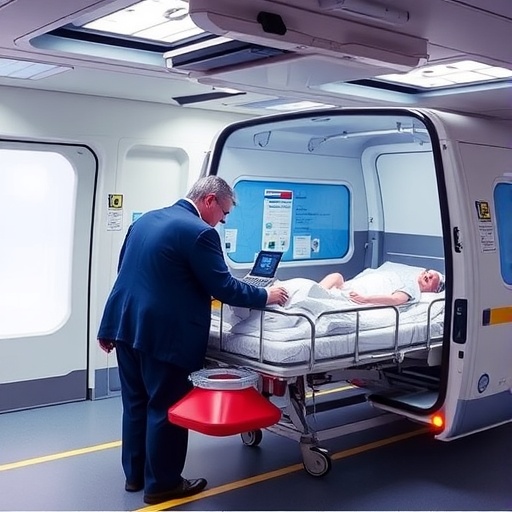
In a groundbreaking study published in the Journal of Perinatology, researchers have unveiled an innovative and comprehensive systems-based approach to managing mass intrahospital transport of neonatal intensive care units (NICUs). This pioneering strategy focuses on enhancing safety protocols, streamlining operational efficiency, and prioritizing family-centered care during transfers within hospital settings. The implications of this work resonate deeply with neonatal healthcare providers striving to maintain the highest level of care during what is often a precarious and stressful period for neonates and their families.
The study, led by Sakhuja, Durrani, Anand, and colleagues, addresses a critical yet often underexplored aspect of neonatal care—how to safely and efficiently move entire NICU units within hospital confines without compromising patient stability or quality of care. This topic has gained urgency due to frequent and sometimes necessary transports occasioned by hospital renovations, emergencies, or strategic relocations. Until now, the absence of cohesive transport protocols has posed significant risks and logistical challenges, making this research especially timely.
Intrahospital transport involves transferring neonates who are often critically ill and technologically dependent on various life-support machines and monitoring devices. Traditionally, these transfers are complex endeavors contingent on meticulous coordination among medical staff, transport teams, and ancillary departments. The new framework proposed within this study integrates a systems-based perspective that holistically evaluates the interplay of human factors, technology, and process workflows, seeking to reduce incidences of adverse events associated with transport.
Enhancing safety during neonatal transport emerges as the cornerstone of the authors’ methodology. The research explores how redundancies in monitoring and communication systems can mitigate the risk of clinical deterioration. Emphasis is placed on adaptive protocols that dynamically respond to the condition of each neonate, ensuring that vital parameters are continuously tracked with minimal interruption. Specialized transport incubators and ventilators, alongside real-time communication channels, form an integral part of this safety matrix.
Efficiency, often a secondary consideration in clinical settings, is elevated to paramount importance in this system. By leveraging Lean management principles and employing detailed process mapping, the research team identified bottlenecks and delays typical in conventional transfers. The proposed model advocates for a synchronized workflow, where roles are clearly delineated, and time-sensitive interventions are pre-planned. This not only shortens transport durations but also frees up critical care resources to focus on ongoing patient management.
Arguably the most innovative aspect of this study is the nuanced incorporation of family-centered care principles into mass NICU transport. Recognizing that parental involvement significantly influences neonatal outcomes and emotional well-being, the authors devised approaches to maintain family engagement despite the physical relocation of care spaces. Communication strategies, real-time updates, and ensuring parents’ access to their infants during and after transport form essential pillars of this compassionate strategy.
The study presents a detailed case analysis of a hospital that underwent a mass intrahospital NICU transfer using this systems-based approach. Results demonstrated zero incidences of adverse clinical events attributable to transport, a striking improvement compared to historical data from the same institution. Moreover, staff feedback highlighted reduced stress levels and increased confidence in handling transport logistics, underscoring the operational benefits beyond patient safety.
Technological integration is thoroughly analyzed. The authors describe how advanced telemetry systems within transport incubators provide continuous vital sign transmission to stationary monitors, enabling clinicians to retain situational awareness without physically escorting every neonate. Additionally, the deployment of mobile point-of-care testing units enhances immediate diagnostic capabilities during transit, reducing delays in therapeutic decision-making.
Another critical dimension discussed is the training and simulation of multidisciplinary teams involved in intrahospital transport. The paper details how repetitive simulation exercises foster familiarity with equipment, refine communication protocols across departments, and prepare teams for unforeseen complications. This continual learning approach is instrumental in maintaining high performance levels and responsiveness during actual transports.
The infrastructural adaptations recommended include dedicated transport routes within hospital buildings designed to minimize travel time and environmental disruptions such as noise and vibration that could stress neonates. The physical layout optimization ensures smooth coordination between the departure and arrival points, decreases transfer time, and limits exposure to potentially harmful external conditions.
From an administrative perspective, the authors argue for the establishment of a designated transport coordination unit responsible for overseeing every aspect of NICU moves—from logistical planning to real-time monitoring and post-transport debriefings. Centralized command structures, they argue, reduce errors born from fragmented communication and enhance accountability.
Moreover, the study delves into the psychological benefits this approach brings to families, demonstrating that transparent communication channels and active involvement in the transfer process reduce parental anxiety. Families reported higher satisfaction scores when they felt adequately informed and supported, a critical factor considering the extended hospital stays and emotional toll of neonatal critical care.
In summation, the research offers an unprecedented, multilayered framework that hospitals worldwide can adopt to enhance the safety, efficiency, and humaneness of mass NICU intrahospital transports. The convergence of technology, process improvement, and family engagement practices exemplifies modern neonatal care’s direction, promising improved outcomes for the most vulnerable patients.
As hospitals evolve and face increasing logistical demands, this study underscores that mass intrahospital transport need not be a perilous or disruptive event. Instead, with meticulous systems engineering and compassionate care models, it can become an orchestrated transition that upholds clinical excellence and nurtures family bonds.
Future research, the authors suggest, will focus on scaling these protocols across diverse hospital settings, including resource-limited environments. Emphasis on telemedicine support during transport and refining artificial intelligence-driven predictive models for patient monitoring could further revolutionize neonatal intrahospital transportation.
Ultimately, this systems-based approach reshapes the paradigm of neonatal care delivery amid physical relocations, situating patient safety and family-centered values at the epicenter of hospital operations. The healthcare community awaits further validation and adaptation of these protocols to embed them universally as standards for NICU transports.
Cite Scienmag News
Harold Sullivan. (May 27, 2026). Safe, Efficient Neonatal ICU Transport: A Systems Approach. Scienmag. https://scienmag.com/safe-efficient-neonatal-icu-transport-a-systems-approach/
Harold Sullivan. "Safe, Efficient Neonatal ICU Transport: A Systems Approach." Scienmag, 27 May 2026, https://scienmag.com/safe-efficient-neonatal-icu-transport-a-systems-approach/. Accessed 4 September 2026.
Harold Sullivan. "Safe, Efficient Neonatal ICU Transport: A Systems Approach." Scienmag. May 27, 2026. https://scienmag.com/safe-efficient-neonatal-icu-transport-a-systems-approach/


