


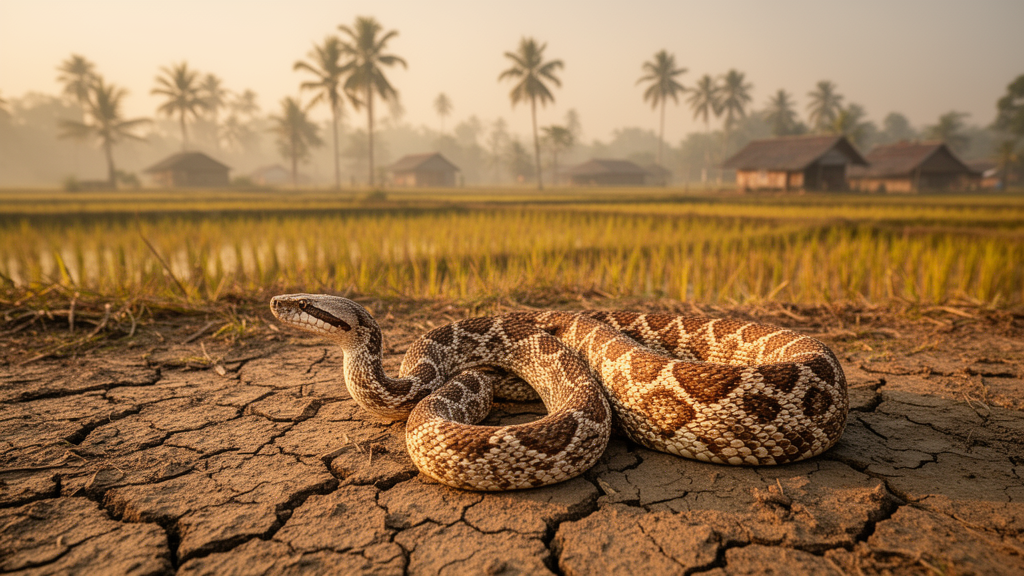
Bangladesh is witnessing one of the most dramatic range expansions ever documented for a venomous snake. Russell’s viper (Daboia russelii), one of the world’s most medically significant vipers, has surged from just six administrative districts in 2015 to 27 of the country’s 64 districts, and new research suggests the spread is being driven by a powerful combination of warming winters, shifting rainfall, expanding farmland, and collapsing populations of the snake’s predators and competitors. The study, published in the journal Herpetozoa, used species distribution modelling to reconstruct the ecological story behind a public health emergency.
The findings are striking. The team estimates that the climatically suitable area for Russell’s viper in Bangladesh now spans approximately 76,716 square kilometres, roughly five times larger than the species’ observed area of occupancy of 14,344 square kilometres recorded in 2015. This means vast stretches of western Bangladesh already offer the right climatic conditions for the viper, even where the snake has not yet been formally documented. The suitable zones cluster along the banks and char lands of the Padma, Meghna, and Jamuna Rivers, covering floodplains, low tidal plains, and diverse forest types including tropical deciduous, mangrove, and village forests.
To build these predictions, the researchers compiled 231 occurrence records from active fieldwork, research-grade biodiversity databases such as GBIF and iNaturalist, and authenticated print and electronic media reports. Between 2019 and 2022, 69 specimens were collected under permit from the Bangladesh Forest Department and documented with detailed morphological and geographic data. The team then combined 12 bioclimatic variables from WorldClim 2.0 at one-kilometre resolution with seven spatial variables covering elevation, bio-ecological zones, climatic sub-regions, floodplains, forest types, land use, and river zones. Highly correlated variables were excluded to avoid multicollinearity, and all raster layers were resampled to a standard one-square-kilometre grid.
Two modelling algorithms were deployed: the non-parametric Bioclim approach and the machine-learning Maximum Entropy (Maxent) algorithm. Both performed exceptionally under current conditions, with the Bioclim model achieving an area under the curve (AUC) of 0.9851 and Maxent reaching 0.9730, alongside near-perfect sensitivity and high specificity. For future projections under the shared socioeconomic pathway 370 (ssp370) scenario for 2080, based on 23 climate projections, Maxent proved far more resilient, maintaining an AUC of 0.9718 while Bioclim dropped to 0.6512. The researchers therefore weighted Maxent at 0.7 and Bioclim at 0.3 in their ensemble predictions, producing a robust map of present and future climatic suitability.
Principal Component Analysis revealed the climatic fingerprints behind the expansion. Three components collectively explained over 79% of the variance in the viper’s occurrence. The strongest positive contributors were the minimum temperature of the coldest month, precipitation of the driest month, precipitation of the driest quarter, and annual precipitation. Conversely, mean diurnal range, temperature seasonality, temperature annual range, and elevation exerted negative influences. In plain terms, warmer winters and more reliable dry-season rainfall open the door for this cold-sensitive reptile, while extreme seasonal temperature swings and reduced precipitation close it. As poikilothermic animals, snakes depend entirely on ambient temperature for metabolism and reproduction, making these variables decisive.
But climate alone does not explain the speed of the colonisation. Field observations documented two distinct dispersal pathways. From 2019 to 2021, vipers moved along the riverine channels of the Padma and upper Meghna Rivers toward the lower Meghna, potentially reaching tidal floodplains and coastal islands in the Bay of Bengal. By 2022, sightings in previously unoccupied districts such as Meherpur, Jhenaidah, and Chuadanga indicated terrestrial dispersal independent of rivers, and by 2023 the species had reached the coastal district of Satkhira through overland corridors crossing Jashore. Russell’s viper is a proficient swimmer capable of riding river currents and floating debris, and Bangladesh’s frequent floods, which impacted 38% to 42% of the country’s area in major events in 2004, 2007, 2017, and 2020, create temporary aquatic corridors that connect isolated water bodies and ease movement across inundated landscapes.
Demographic and ecological data add further momentum. Among 61 vipers sexed between 2019 and 2021, the population showed a pronounced female bias: balanced at 1:1 in 2019, shifting to 1:1.3 by 2020, and reaching 1:2 by 2021, with females comprising 66.7% of collected specimens. Combined with the species’ ovoviviparous reproduction and large clutch sizes of 6 to 63 live offspring, a female-dominant structure could accelerate population growth dramatically. The researchers speculate that rising temperatures might even favour female offspring through temperature-dependent sex determination, a phenomenon documented in reptiles, though they stress this hypothesis requires further investigation.
Meanwhile, the viper’s natural enemies are vanishing. Analysis of potential predators and competitors using IUCN Bangladesh Red List data revealed that predator populations have declined by 29% and competitor populations by 46%. Only 4% of predators and 1% of competitors show increasing trends, while roughly a third of species in each group have unknown status. At the same time, rice cultivation has intensified across Bangladesh, with gross production surging by 2.32% between fiscal years 2001-02 and 2021-22 and a strong correlation (R² = 0.93) between time and production. Multiple planting and harvest cycles per year sustain larger rodent populations, which in turn feed more vipers. Paddy fields offer abundant prey, concealment in undergrowth, and ideal conditions for daily activity, making agrarian Bangladesh a viper paradise.
The public health implications are severe. Russell’s viper envenoming causes complex syndromes that are difficult to treat, resulting in severe morbidity, high mortality, and permanent disability. Snakebite incidents and deaths attributable to this species have surged in Bangladesh as the range has expanded, and rural clinicians face mounting challenges in managing cases. Farmers and field workers in newly colonised districts are at particular risk, often encountering the viper while tending crops. The researchers recommend that health policymakers use the directional trends identified in this study to allocate healthcare resources, implement preventive measures, and inform at-risk communities about the viper’s likely presence, while promoting protective gear during agricultural work and encouraging victims to seek modern healthcare facilities promptly.
Yet the story is not one of unchecked expansion. Projections for 2080 indicate a slight contraction of suitable climate space, with 21% of the country remaining suitable compared to 23% today, and about 4% of currently suitable areas expected to become unsuitable. Northwestern and central regions face the greatest losses as seasonal temperature variability increases and precipitation declines. The viper also confronts anthropogenic threats, including fearful anti-snake attitudes and targeted killings that may cause unnoticed population declines. The authors argue that effective snakebite management plans and conservation strategies must proceed in parallel, safeguarding public health while ensuring the survival of this ecologically and economically important rodent predator. As Bangladesh continues to experience rapid ecological and climatic shifts, the lessons from this viper’s expansion carry weight far beyond its borders, offering a template for understanding how venomous species respond to environmental change across South Asia and the tropics.
Subject of Research: Ecology and Conservation
Article Title: Expanding habitat suitability under changing climate and land use may drive rapid expansion of Russell’s viper ( Daboia russelii ) in Bangladesh
Article References: Hasan, N., Dutta, J., Noman, M., Rahman, M. M., Rudra, S., Auawal, A., Islam, M. R., Uddin, M. A., Uddin, H., Hasan, M. T., Ahsan, M. F., Kuch, U., Ghose, A., Haidar, I. K. A., & Chowdhury, M. A. W. (2025). Expanding habitat suitability under changing climate and land use may drive rapid expansion of Russell’s viper (Daboia russelii) in Bangladesh. Herpetozoa, 38, 137-153. https://doi.org/10.3897/herpetozoa.38.e143411
Image Credits: AI Generated
DOI: 10.3897/herpetozoa.38.e143411
Keywords: Russell's viper, Bangladesh, species distribution modelling, climate change, snakebite, range expansion, Herpetozoa, public health, Expanding, habitat, suitability, under
Cite Scienmag News
Drew Townsend. (October 18, 2026). Russell’s viper may rapidly expand across Bangladesh as climate and land use shift. Scienmag. https://scienmag.com/russells-viper-may-rapidly-expand-across-bangladesh-as-climate-and-land-use-shift/
Drew Townsend. "Russell’s viper may rapidly expand across Bangladesh as climate and land use shift." Scienmag, 18 October 2026, https://scienmag.com/russells-viper-may-rapidly-expand-across-bangladesh-as-climate-and-land-use-shift/. Accessed 18 October 2026.
Drew Townsend. "Russell’s viper may rapidly expand across Bangladesh as climate and land use shift." Scienmag. October 18, 2026. https://scienmag.com/russells-viper-may-rapidly-expand-across-bangladesh-as-climate-and-land-use-shift/


