

Monday, October 26, 2026
Science
No Result
View All Result
  • Login
  • HOME
  • SCIENCE NEWS
  • CONTACT US
  • HOME
  • SCIENCE NEWS
  • CONTACT US
No Result
View All Result
Scienmag
No Result
View All Result
Home Science News Agriculture

Rubber Tree Genome Links Wood Traits to 33 Genetic Associations

October 26, 2026
in Agriculture
Juliet Wilcox
By Juliet Wilcox Scienmag Editorial Profile - Human Genetics
Reading Time: 2 mins read
0
Rubber Tree Genome Links Wood Traits to 33 Genetic Associations

Rubber Tree Genome Links Wood Traits to 33 Genetic Associations

65
SHARES
587
VIEWS
Share on FacebookShare on Twitter
ADVERTISEMENT

A genome-wide association study has identified 33 genetic marker–trait associations linked to the mechanical properties, chemical composition, and biomass-energy characteristics of rubberwood. The findings provide a genomic framework for improving the value of trees used in plantation replanting, while also supporting the longer-term goal of breeding rubber clones that combine latex production with useful wood quality. The researchers described the results as the first integrated genomic analysis of these wood traits in Hevea brasiliensis .

The study combined phenotypic evaluation, quantitative genetic analysis, and genome-wide association mapping in a panel of 100 rubber tree genotypes that included commercial clones and controlled-cross progenies. A total of 300 sampled trees were evaluated in a 10 × 10 triple-lattice design. Researchers measured wood density, moisture content, modulus of rupture, modulus of elasticity, compressive strength, lignocellulosic composition, proximate characteristics, and elemental composition, then analyzed these traits alongside 24,242 high-quality DArTSeq single-nucleotide polymorphism markers.

Rubberwood obtained when plantations are replanted is an increasingly important renewable resource for timber, furniture, and biomass-based industries in Southeast Asia, but the genetic architecture underlying its quality has largely remained unresolved. Substantial phenotypic variation was detected for most of the traits, particularly the mechanical properties and cell-wall components. Broad-sense heritability estimates ranged from 0 to 0.51, showing that the estimated genetic contribution varied markedly among characteristics.

Hemicellulose content, hydrogen content, and compressive strength parallel to the grain displayed moderate heritability, which the study identified as promising for association mapping and genetic improvement. Correlation analysis found biologically meaningful relationships among wood density, strength-related traits, and lignocellulosic composition. Using five complementary GWAS models—the generalized linear model, mixed linear model, constrained mixed linear model, FarmCPU, and BLINK—the researchers detected 33 SNP–trait associations across 11 chromosomes.

Eleven associations exceeded the Bonferroni-corrected threshold for genome-wide significance, and 22 were classified as suggestive. Several loci co-localized with genes involved in secondary cell-wall biosynthesis, transcriptional regulation, and cellular metabolism, making them candidates for further investigation. The analysis identifies statistical associations rather than demonstrating that individual markers directly cause the measured wood characteristics.

Nevertheless, the study establishes specific genomic targets that could support molecular breeding aimed at improving the mechanical, chemical, and energy-related value of dual-purpose rubberwood without overlooking latex productivity.

Subject of Research: Genetic associations with rubberwood mechanical, chemical, and energy-related traits

Article Title: Genome-wide association study reveals genetic loci controlling wood mechanical properties, lignocellulosic composition, and biomass energy traits in rubber tree (Hevea brasiliensis)

Article References: Phumichai, C., Rattanawong, R., Tonusin, T., Chotchutima, S., & Phumichai, T. (2026). Genome-wide association study reveals genetic loci controlling wood mechanical properties, lignocellulosic composition, and biomass energy traits in rubber tree (Hevea brasiliensis). BMC Plant Biology. https://doi.org/10.1186/s12870-026-09846-3

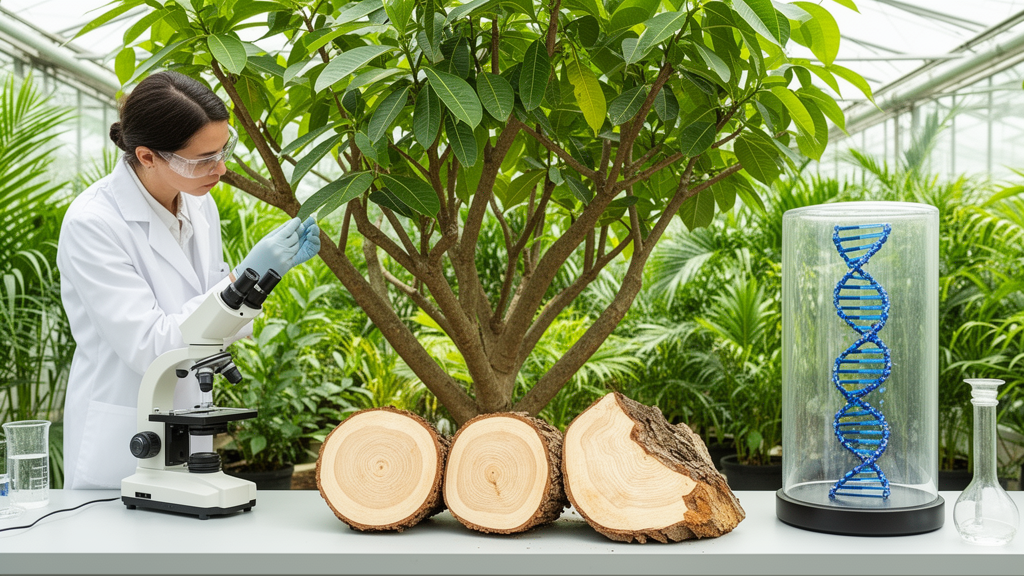
Image Credits: AI Generated

DOI: 10.1186/s12870-026-09846-3

Keywords: rubber tree, rubberwood, genome-wide association study, SNP markers, wood mechanics, lignocellulosic composition, biomass energy, heritability, genomic breeding, Hevea brasiliensis, Genome-wide, association

Cite Scienmag News

Juliet Wilcox. (October 26, 2026). Rubber Tree Genome Links Wood Traits to 33 Genetic Associations. Scienmag. https://scienmag.com/rubber-tree-genome-links-wood-traits-to-33-genetic-associations/

Juliet Wilcox. "Rubber Tree Genome Links Wood Traits to 33 Genetic Associations." Scienmag, 26 October 2026, https://scienmag.com/rubber-tree-genome-links-wood-traits-to-33-genetic-associations/. Accessed 26 October 2026.

Juliet Wilcox. "Rubber Tree Genome Links Wood Traits to 33 Genetic Associations." Scienmag. October 26, 2026. https://scienmag.com/rubber-tree-genome-links-wood-traits-to-33-genetic-associations/


Tags: associationbiomass energybiomass-energy characteristicsgenetic architecture of rubberwood traitsgenetic basis of rubberwood qualitygenetic markers for wood traitsgenome-widegenome-wide association studygenome-wide association study in Hevea brasiliensisgenomic breedinggenomic tools for rubber tree breedingheritabilityHevea brasiliensisimprovement of plantation rubberwoodlignocellulosic compositionphenotypic and genotypic analysis of rubber treesrubber clone breeding for wood and latexrubber treerubber tree genomerubberwoodrubberwood chemical compositionrubberwood mechanical propertiesSNP markerswood mechanics
Share26Tweet16
Previous Post

Qualitative study maps three paths to sexual recovery after breast cancer

Next Post

Sports team participation accounts for part of students’ physical activity association

Related Posts

Induced cassava mutations link more starch with less lignin
Agriculture

Induced cassava mutations link more starch with less lignin

October 26, 2026
Genome study reveals north–south genetic divergence in coastal halophyte
Agriculture

Genome study reveals north–south genetic divergence in coastal halophyte

October 26, 2026
Machine learning assesses lemon balm responses to drought, fungi and TiO₂ nanoparticles
Agriculture

Machine learning assesses lemon balm responses to drought, fungi and TiO₂ nanoparticles

October 26, 2026
Treated oilfield wastewater supports Eucalyptus rooting in nursery trial
Agriculture

Treated oilfield wastewater supports Eucalyptus rooting in nursery trial

October 26, 2026
Oat drought study identifies predicted miR156-centered RNA network
Agriculture

Oat drought study identifies predicted miR156-centered RNA network

October 26, 2026
Genome analysis maps 540 GST genes across four legumes
Agriculture

Genome analysis maps 540 GST genes across four legumes

October 26, 2026
Next Post
Sports team participation accounts for part of students’ physical activity association

Sports team participation accounts for part of students’ physical activity association

  • Mothers who receive childcare support from maternal grandparents show more optimized

    Mothers who receive childcare support from maternal grandparents show more parental warmth, finds NTU Singapore study

    27656 shares
    Share 11059 Tweet 6912
  • University of Seville Breaks 120-Year-Old Mystery, Revises a Key Einstein Concept

    1061 shares
    Share 424 Tweet 265
  • Bee body mass, pathogens and local climate influence heat tolerance

    682 shares
    Share 273 Tweet 171
  • Researchers record first-ever images and data of a shark experiencing a boat strike

    546 shares
    Share 218 Tweet 137
  • Groundbreaking Clinical Trial Reveals Lubiprostone Enhances Kidney Function

    531 shares
    Share 212 Tweet 133
Science

Embark on a thrilling journey of discovery with Scienmag.com—your ultimate source for cutting-edge breakthroughs. Immerse yourself in a world where curiosity knows no limits and tomorrow’s possibilities become today’s reality!

RECENT NEWS

  • Attacks on Water Systems Threaten Health and Peace, Experts Warn
  • Vapor-treated PbS quantum-dot inks retain efficiency after 60 days
  • International observational study tests PANXEON for early pancreatic cancer
  • Induced cassava mutations link more starch with less lignin

Categories

  • Agriculture
  • Anthropology
  • Archaeology
  • Athmospheric
  • Biology
  • Biotechnology
  • Blog
  • Bussines
  • Cancer
  • Chemistry
  • Climate
  • Earth Science
  • Editorial Policy
  • Marine
  • Mathematics
  • Medicine
  • Pediatry
  • Policy
  • Psychology & Psychiatry
  • Science Education
  • Science News
  • Social Science
  • Space
  • Technology and Engineering

Subscribe to Blog via Email

Enter your email address to subscribe to this blog and receive notifications of new posts by email.

Join 5,151 other subscribers

© 2025 Scienmag - Science Magazine

Welcome Back!

Login to your account below

Forgotten Password?

Retrieve your password

Please enter your username or email address to reset your password.

Log In
No Result
View All Result
  • HOME
  • SCIENCE NEWS
  • CONTACT US

© 2025 Scienmag - Science Magazine

Discover more from Science

Subscribe now to keep reading and get access to the full archive.

Continue reading