


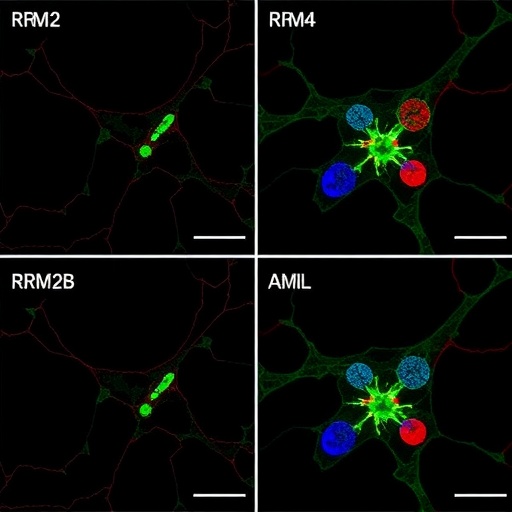
In a groundbreaking study published in 2026, researchers have unveiled critical insights into the molecular mechanisms governing acute myeloid leukemia (AML), focusing on the dynamic roles of ribonucleotide reductase subunits RRM2 and RRM2B. This investigation sheds light on how these proteins orchestrate pyrimidine metabolism under stress conditions and influence the differentiation trajectory of AML cells, revealing potential therapeutic avenues for a malignancy notorious for its poor prognosis and resistance to conventional treatments.
Acute myeloid leukemia is a form of cancer characterized by the rapid proliferation of undifferentiated myeloid cells in the bone marrow and blood, leading to impaired hematopoiesis and immune dysfunction. The quest to understand the intracellular processes that regulate leukemic cell survival and differentiation is vital to developing targeted therapies. Central to this is the control of deoxyribonucleotide (dNTP) pools, necessary for DNA synthesis and repair, which is tightly regulated by ribonucleotide reductase (RNR). The holoenzyme RNR is composed of distinct subunits, with RRM2 and RRM2B playing pivotal roles, especially during cellular stress and DNA damage responses.
The study emphasizes the distinct yet interconnected functions of RRM2 and RRM2B within AML cells subjected to pyrimidine stress—conditions in which the cells face a scarcity of essential pyrimidine nucleotides. RRM2 is typically associated with the baseline proliferative processes in dividing cells, facilitating dNTP supply during the S phase of the cell cycle. In contrast, RRM2B, often induced by p53 and associated with DNA repair, is implicated in survival mechanisms during cellular insults.
Advanced molecular biology techniques were employed to delineate the expression patterns and functional contributions of these subunits in AML. The researchers utilized AML cell lines subjected to pyrimidine deprivation, simulating metabolic stress situations. They discovered that RRM2 expression was downregulated under these conditions, which corresponded with a halt in proliferation and induction of differentiation markers. Conversely, RRM2B expression was upregulated, suggesting a compensatory mechanism aimed at DNA repair and cell survival.
This reciprocal regulation underscores a sophisticated cellular adaptation strategy whereby AML cells attempt to balance proliferation with survival under adverse metabolic conditions. The modulation of RRM2 and RRM2B was found to be tightly linked with the differentiation status of leukemia cells, implicating these proteins as critical nodes not only in metabolic control but also in the leukemic cell fate decisions.
Mechanistic dissection of RRM2B’s role revealed its function in enabling AML cells to cope with pyrimidine shortage by maintaining dNTP pools necessary for DNA repair synthesis. Knockdown experiments of RRM2B resulted in heightened DNA damage accumulation and increased apoptosis, confirming its protective role. Interestingly, this loss also impeded differentiation, indicating that RRM2B supports both survival and maturation in leukemic cells under stress.
The findings have profound implications for therapy design. Targeting RRM2 has been a strategy to curb proliferating cancer cells. However, this study suggests that RRM2B might serve as a molecular escape route, enabling leukemic cells to persist despite RRM2 inhibition. Therefore, concomitant targeting of RRM2B could potentially overcome resistance mechanisms, pushing AML cells towards apoptosis and terminal differentiation.
Therapeutic resistance remains a significant barrier in AML management, with many patients exhibiting minimal response to standard chemotherapy protocols. By illuminating the pyrimidine stress response pathway, this research opens the possibility of developing pharmacologic agents that selectively inhibit RRM2B or disrupt its regulatory network. Such intervention could sensitize AML cells to existing treatments, reduce relapse rates, and improve patient outcomes.
Moreover, the study highlights the intricate crosstalk between metabolic stress responses and differentiation pathways in cancer cells. This dual regulation is a vital axis in maintaining leukemic cell plasticity, which underpins the disease’s heterogeneity and treatment evasion. Understanding how RRM2 and RRM2B influence this axis adds a new dimension to cancer biology and the interplay between metabolism and epigenetic control mechanisms.
The researchers also explored signaling pathways upstream of RRM2B induction, identifying key transcriptional regulators responsive to DNA damage and metabolic cues. This points to a larger network of enzymes and signaling molecules that coordinate to restore nucleotide balance, maintain genomic integrity, and dictate cell fate under stress, all of which could be exploited therapeutically.
The compelling evidence that differentiation-promoting therapies could be enhanced by manipulating nucleotide metabolism offers a new paradigm. Agents that mimic pyrimidine stress or selectively dampen RRM2 function while inhibiting compensatory RRM2B support may tip the balance towards leukemic cell maturation and death, a strategy aligned with recent trends in differentiation therapy.
This research not only advances our understanding of the cellular responses to metabolic challenges in AML but also provides a valuable framework for exploring similar mechanisms in other malignancies reliant on aberrant nucleotide metabolism. The generalizability of RNR subunit modulation underscores the broad relevance of these findings across oncology.
Future directions proposed by the authors include preclinical evaluation of dual RRM2 and RRM2B inhibitors in AML models and assessment of their synergy with DNA-damaging agents. There is also interest in investigating biomarkers that predict responsiveness to such combined therapeutic approaches, potentially enabling precision medicine strategies in AML treatment.
In conclusion, the elucidation of RRM2 and RRM2B’s roles in pyrimidine stress response and differentiation in acute myeloid leukemia represents a significant advance in cancer biology. It not only enhances our molecular understanding of AML pathophysiology but also paves the way for innovative therapeutic interventions aimed at tackling treatment resistance by exploiting metabolic vulnerabilities intrinsic to leukemic cells.
This study was conducted by Brcic, Lalic, Smoljo, and colleagues, whose findings have been published in Cell Death Discovery, offering an invaluable resource for researchers and clinicians seeking to transform AML therapy through detailed molecular targeting.
Cite Scienmag News
Nathaniel Bowman. (April 24, 2026). RRM2 and RRM2B in AML Stress Response, Differentiation. Scienmag. https://scienmag.com/rrm2-and-rrm2b-in-aml-stress-response-differentiation/
Nathaniel Bowman. "RRM2 and RRM2B in AML Stress Response, Differentiation." Scienmag, 24 April 2026, https://scienmag.com/rrm2-and-rrm2b-in-aml-stress-response-differentiation/. Accessed 4 September 2026.
Nathaniel Bowman. "RRM2 and RRM2B in AML Stress Response, Differentiation." Scienmag. April 24, 2026. https://scienmag.com/rrm2-and-rrm2b-in-aml-stress-response-differentiation/


