


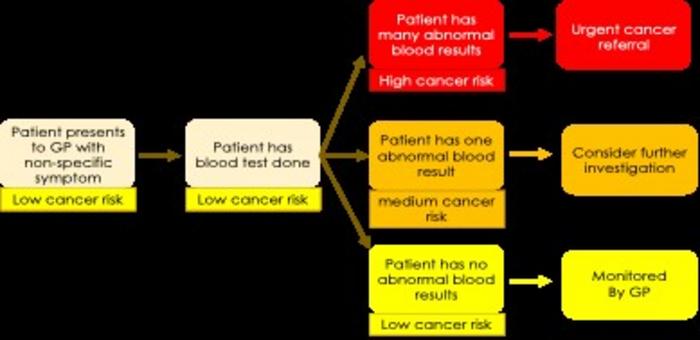
Incorporating information from common blood tests can enhance cancer risk assessment in patients with abdominal symptoms, according to a study publishing July 30th in the open-access journal PLOS Medicine by Meena Rafiq from University College London, UK, and colleagues.

Credit: Meena Rafiq (CC-BY 4.0,
Incorporating information from common blood tests can enhance cancer risk assessment in patients with abdominal symptoms, according to a study publishing July 30th in the open-access journal PLOS Medicine by Meena Rafiq from University College London, UK, and colleagues.
Early cancer detection is key to successful treatment. However, many undiagnosed cancer patients present to their primary care provider with non-specific symptoms that can be a result of several other benign causes, making it difficult to determine who warrants additional diagnostic testing or referral. Most guidelines focus on “alarm” symptoms specific to a given type of cancer to guide referrals. There is limited guidance on non-specific symptoms to guide cancer assessment and referral decisions across different cancer types.
In this study, researchers used data from the UK Clinical Practice Research Datalink to identify more than 470,000 patients aged 30 years or older who had visited a general practitioner due to abdominal pain or bloating. Within a year of that visit, approximately 9,000 patients with abdominal pain and 1,000 patients with bloating were diagnosed with cancer. The researchers looked at 19 abnormal blood test results collected during the initial primary care visit to see if they could predict who was more likely to be diagnosed with cancer.
Several blood abnormalities were predictive of cancer risk across sex and age groups. For example, in patients aged 30–59 years with abdominal symptoms, anemia, low albumin, raised platelets, abnormal ferritin, and increased inflammatory markers strongly predicted a risk of undiagnosed cancer. Among older patients (aged 60 years and above), the presence of abdominal pain or bloating alone was enough to warrant a cancer referral.
The study also showed which types of cancer were most common based on age, sex, and blood test abnormality. For example, among women aged 50–59 years with anemia and abdominal bloating, the most common types of cancer were bowel and ovarian cancer. This level of granularity can help guide providers on which diagnostic strategies to prioritize.
The study shows that common, routine blood test results can provide additional context in patients with non-specific abdominal symptoms to improve cancer risk assessment and identify patients who warrant additional testing and/or referral to a specialist.
The authors add, “Using existing blood tests can be an effective and affordable way to improve early diagnosis of cancer in people who see their GP with vague symptoms. Our study identified several commonly used GP blood tests where abnormal results increase a patient’s risk of having cancer and these can be used to diagnose cancer earlier.”
#####
In your coverage, please use this URL to provide access to the freely available paper in PLOS Medicine:
Citation: Rafiq M, Renzi C, White B, Zakkak N, Nicholson B, Lyratzopoulos G, et al. (2024) Predictive value of abnormal blood tests for detecting cancer in primary care patients with nonspecific abdominal symptoms: A population-based cohort study of 477,870 patients in England. PLoS Med 21(7): e1004426.
Author Countries: United Kingdom, Australia, Italy
Funding: see manuscript
Journal
PLoS Medicine
Method of Research
Observational study
Subject of Research
People
COI Statement
Competing Interests: see manuscript
Cite Scienmag News
Nathaniel Bowman. (July 30, 2024). Routine blood test results can improve cancer risk assessment in patients with abdominal symptoms. Scienmag. https://scienmag.com/routine-blood-test-results-can-improve-cancer-risk-assessment-in-patients-with-abdominal-symptoms/
Nathaniel Bowman. "Routine blood test results can improve cancer risk assessment in patients with abdominal symptoms." Scienmag, 30 July 2024, https://scienmag.com/routine-blood-test-results-can-improve-cancer-risk-assessment-in-patients-with-abdominal-symptoms/. Accessed 4 September 2026.
Nathaniel Bowman. "Routine blood test results can improve cancer risk assessment in patients with abdominal symptoms." Scienmag. July 30, 2024. https://scienmag.com/routine-blood-test-results-can-improve-cancer-risk-assessment-in-patients-with-abdominal-symptoms/

