

Monday, July 13, 2026
Science
No Result
View All Result
  • Login
  • HOME
  • SCIENCE NEWS
  • CONTACT US
  • HOME
  • SCIENCE NEWS
  • CONTACT US
No Result
View All Result
Scienmag
No Result
View All Result
Home Science News Technology and Engineering

Room-Temperature Direct Electrochemical Splitting of Liquid Ammonia Enables Onsite Hydrogen Production

March 31, 2026
in Technology and Engineering
Reading Time: 3 mins read
0
Room-Temperature Direct Electrochemical Splitting of Liquid Ammonia Enables Onsite Hydrogen Production
66
SHARES
600
VIEWS
Share on FacebookShare on Twitter
ADVERTISEMENT
Figure Abstract
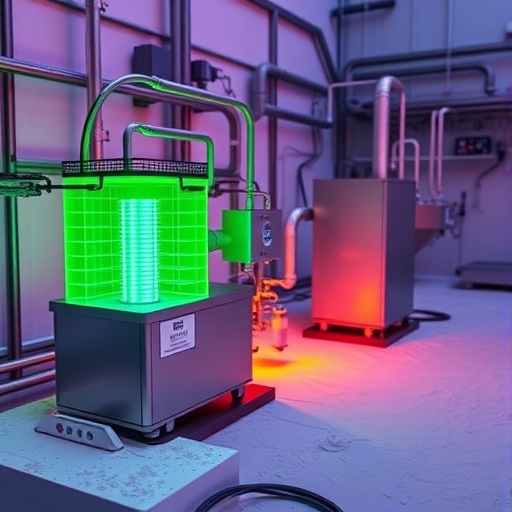
image: Direct electrochemical liquid ammonia splitting enables efficient onsite hydrogen generation at room temperature and low pressure (<1 MPa) using Ru nanoparticles on nitrogen-doped carbon. This breakthrough overcomes high-temperature barriers in traditional ammonia decomposition, offering a sustainable pathway for hydrogen production with superior activity and 100-hour stability, surpassing Pt/C catalysts.
view more 

Credit: Chinese Journal of Catalysis

The pursuit of safe and efficient hydrogen storage and transportation is crucial for a sustainable hydrogen economy. Ammonia, with its high hydrogen density and ease of liquefaction, is a promising carrier, but its decomposition into hydrogen typically requires high temperatures (400–700 °C). Electrochemical liquid ammonia decomposition (ELADH) offers a promising route for room-temperature, on-site hydrogen release with a low theoretical voltage. However, its development has been hampered by sluggish kinetics, poor catalyst stability, and corrosive reaction environments.

Recently, a research team led by Prof. Jun-Min Yan from Jilin University and Prof. Hai-Xia Zhong from the Changchun Institute of Applied Chemistry, Chinese Academy of Sciences, demonstrated a highly efficient and stable ELADH system. Through density functional theory calculations, they identified Ru as a superior catalyst compared to Pt, Rh, and Ir, with the Ru (101) facet exhibiting a low energy barrier for N–H bond cleavage and optimal hydrogen adsorption. Guided by this, they synthesized nitrogen-doped carbon-supported Ru nanoparticle catalysts (Ru NPs-CN) via a two-step pyrolysis method.

The Ru NPs-CN catalyst, featuring predominantly exposed (101) facets and a porous structure, achieved outstanding performance in an optimized electrochemical system using a graphite plate anode and NH4PF6 electrolyte in liquid ammonia. It delivered a high current density of -910 mA cm-2 at –1.47 V and a low overpotential of –1.01 V at -10 mA cm-2, significantly outperforming Ru single-atom and commercial Pt/C catalysts. Crucially, the system maintained stable hydrogen evolution for over 100 hours in a two-electrode configuration, showcasing remarkable durability. This work provides a feasible strategy for mild-condition hydrogen production from ammonia and deepens the understanding of the electrochemical ammonia splitting process. The results were published in Chinese Journal of Catalysis (DOI: 10.1016/S1872-2067(25)64915-1).


About the journal

Chinese Journal of Catalysis is co-sponsored by Dalian Institute of Chemical Physics, Chinese Academy of Sciences and Chinese Chemical Society, and it is currently published by Elsevier group. This monthly journal publishes in English timely contributions of original and rigorously reviewed manuscripts covering all areas of catalysis. The journal publishes Reviews, Accounts, Communications, Articles, Highlights, Perspectives, and Viewpoints of highly scientific values that help understanding and defining of new concepts in both fundamental issues and practical applications of catalysis. Chinese Journal of Catalysis ranks among the top six journals in Applied Chemistry with a current SCI impact factor of 17.7.

At Elsevier

Manuscript submission


Journal

Chinese Journal of Catalysis

DOI

10.1016/S1872-2067(25)64915-1

Article Title

Direct electrochemical liquid ammonia splitting for onsite hydrogen generation under room temperature

Article Publication Date

3-Feb-2026

Media Contact

Yan Zhang

Dalian Institute of Chemical Physics, Chinese Academy Sciences

cjcatal@dicp.ac.cn

Journal
Chinese Journal of Catalysis
DOI
10.1016/S1872-2067(25)64915-1

Journal

Chinese Journal of Catalysis

DOI

10.1016/S1872-2067(25)64915-1

Article Title

Direct electrochemical liquid ammonia splitting for onsite hydrogen generation under room temperature

Article Publication Date

3-Feb-2026

Tags


  • /Applied sciences and engineering
Tags: ambient condition hydrogen generationammonia as hydrogen carrierammonia electrolysis for energyefficient hydrogen splitting techniqueselectrochemical ammonia splitting technologygreen hydrogen from ammonialiquid ammonia hydrogen productionlow pressure hydrogen productiononsite hydrogen generationrenewable hydrogen production methodsroom temperature electrochemical ammonia splittingsustainable hydrogen fuel production
Share26Tweet17
Previous Post

Measuring Blue-Green Space Cooling in Subtropical Cities

Next Post

O-GlcNAcylation Controls Microglial Inflammation in Parkinson’s

Related Posts

Advancing Polyamide Desalination Membranes with Interfacial Rheology Techniques
Technology and Engineering

Advancing Polyamide Desalination Membranes with Interfacial Rheology Techniques

July 13, 2026
Early Chemistry Boosts 847 mV Voltage in Wide-Bandgap CZTS Solar Cells
Technology and Engineering

Early Chemistry Boosts 847 mV Voltage in Wide-Bandgap CZTS Solar Cells

July 13, 2026
Scaling Language Models Enhances Protein Fitness Predictions
Technology and Engineering

Scaling Language Models Enhances Protein Fitness Predictions

July 13, 2026
A Call for Advancing Sustainability in Robotics Technology
Technology and Engineering

A Call for Advancing Sustainability in Robotics Technology

July 13, 2026
Advancing Humanoid Robots with Human-Aware ErgoCub Intelligence Optimization
Technology and Engineering

Advancing Humanoid Robots with Human-Aware ErgoCub Intelligence Optimization

July 13, 2026
Advances and Challenges in Genomic Newborn Screening Research
Technology and Engineering

Advances and Challenges in Genomic Newborn Screening Research

July 13, 2026
Next Post
O-GlcNAcylation Controls Microglial Inflammation in Parkinson’s

O-GlcNAcylation Controls Microglial Inflammation in Parkinson’s

  • Mothers who receive childcare support from maternal grandparents show more

    Mothers who receive childcare support from maternal grandparents show more parental warmth, finds NTU Singapore study

    27656 shares
    Share 11059 Tweet 6912
  • University of Seville Breaks 120-Year-Old Mystery, Revises a Key Einstein Concept

    1061 shares
    Share 424 Tweet 265
  • Bee body mass, pathogens and local climate influence heat tolerance

    682 shares
    Share 273 Tweet 171
  • Researchers record first-ever images and data of a shark experiencing a boat strike

    546 shares
    Share 218 Tweet 137
  • Groundbreaking Clinical Trial Reveals Lubiprostone Enhances Kidney Function

    531 shares
    Share 212 Tweet 133
Science

Embark on a thrilling journey of discovery with Scienmag.com—your ultimate source for cutting-edge breakthroughs. Immerse yourself in a world where curiosity knows no limits and tomorrow’s possibilities become today’s reality!

RECENT NEWS

  • Tropical Variability Drives Cold Surge Movement Across Hemispheres
  • SHEA urges confirmed, evidence-based leadership at CDC for strong guidance
  • Context-Aware Landmark Recognition Boosts Cultural Heritage in Augmented Reality
  • Walking and Healthy Diet Linked to Reduced Central Obesity Over Time

Categories

  • Agriculture
  • Anthropology
  • Archaeology
  • Athmospheric
  • Biology
  • Biotechnology
  • Blog
  • Bussines
  • Cancer
  • Chemistry
  • Climate
  • Earth Science
  • Editorial Policy
  • Marine
  • Mathematics
  • Medicine
  • Pediatry
  • Policy
  • Psychology & Psychiatry
  • Science Education
  • Social Science
  • Space
  • Technology and Engineering

Subscribe to Blog via Email

Enter your email address to subscribe to this blog and receive notifications of new posts by email.

Join 5,146 other subscribers

© 2025 Scienmag - Science Magazine

Welcome Back!

Login to your account below

Forgotten Password?

Retrieve your password

Please enter your username or email address to reset your password.

Log In
No Result
View All Result
  • HOME
  • SCIENCE NEWS
  • CONTACT US

© 2025 Scienmag - Science Magazine

Discover more from Science

Subscribe now to keep reading and get access to the full archive.

Continue reading
