

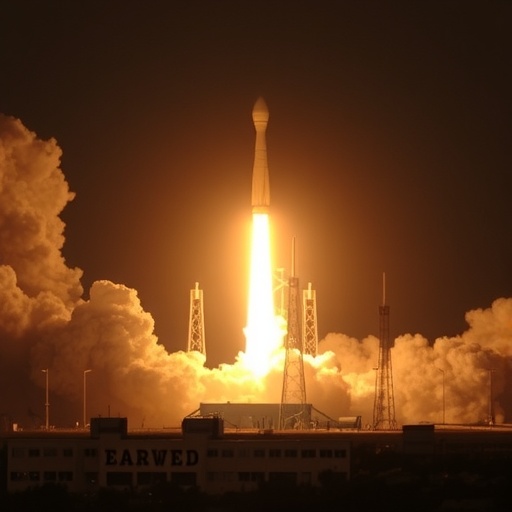
In a groundbreaking study published recently, scientists have identified a distinctive plume of lithium atoms in the upper atmosphere, marking the first direct detection of pollution caused by space debris re-entering Earth’s atmosphere. This discovery emerged from observations conducted in February 2025 and provides unprecedented insight into the atmospheric impact of disintegrating rocket stages, a subject previously shrouded in uncertainty.
The study focused on the mesosphere and the lower thermosphere, which together span approximately 50 to 120 kilometers above Earth’s surface. These regions have largely been overlooked in terms of pollution monitoring related to space debris, despite their critical role in atmospheric chemistry and dynamics. When satellites and rocket stages reach the end of their operational lives, they are engineered to disintegrate during re-entry to minimize ground impact risk. However, the atmospheric consequences of their fragmentation and vaporization have remained poorly understood until now.
Utilizing lidar technology—a sophisticated laser-based remote sensing method—researchers were able to detect and quantify the concentration of lithium atoms within the lower thermosphere. Lithium is a common element in spacecraft components but exists only in trace amounts naturally at these altitudes. The team, led by Robin Wing, observed an abrupt and significant elevation in lithium concentration nearly tenfold the normal background levels starting shortly after 00:20 UTC on February 20, 2025. This lithium-rich plume extended from an altitude of 97 kilometers down to 94 kilometers above sea level.
Unlike previous studies that inferred space debris pollution from indirect data or ground-level contamination, this research provided real-time atmospheric measurements. The plume was tracked for 27 minutes until the lidar system ceased recording, offering a detailed temporal picture of the phenomenon and confirming its existence as a coherent atmospheric event rather than random noise or sampling error.
To trace the origin of the lithium plume, atmospheric wind models were employed, taking into account prevailing mesospheric and thermospheric wind patterns. These models revealed that the plume’s source most plausibly corresponded to the uncontrolled re-entry of a Falcon 9 upper stage over the Atlantic Ocean near Ireland, occurring approximately 20 hours prior to the plume detection. This correlation strongly implicates the rocket stage as the source of the observed lithium pollution.
Further chemical analyses ruled out natural atmospheric processes as a significant contributor to this sudden surge in lithium concentration. The lack of known natural mechanisms capable of producing such a localized and intense lithium signature strengthens the case for anthropogenic origin related to spacecraft debris. This finding challenges prevailing assumptions and opens new avenues for understanding human impacts on high-altitude atmospheric chemistry.
This study serves as a pivotal case demonstrating how modern atmospheric monitoring technologies can directly observe and characterize pollution from space activities. The detection technique detailed by Wing and colleagues offers a template for future investigations into other metallic pollutants introduced during the re-entry of various types of space debris, including other rockets and defunct satellites.
The authors caution, however, that the chemical transformations occurring during the descent of debris materials can alter the detectability of pollutants like lithium. Not all re-entry events will produce plumes measurable by lidar due to these complex interactions. Hence, a comprehensive assessment of atmospheric pollution from space debris will necessitate combined observation strategies and advanced atmospheric chemistry modeling.
Considering the rapid escalation in orbital launches over the past decade, including burgeoning commercial spaceflight and satellite megaconstellations, the study highlights an urgent need to monitor and assess long-term atmospheric implications. Repeated deposition of metallic elements like lithium at high altitudes could have unknown effects on mesospheric and thermospheric chemistry, radiative balance, and possibly even climate dynamics.
This research not only illuminates an underexplored dimension of space environmental impact but also underscores the importance of responsible consumption and production practices within the aerospace industry. As humanity’s presence in space expands, so too does our footprint, making it imperative to integrate atmospheric health considerations into space debris mitigation strategies.
The implications of these findings extend beyond the atmospheric sciences community, reaching policymakers, space agencies, and environmental advocates who must now grapple with the subtle yet tangible environmental consequences of space operations. This milestone sets a precedent for more rigorous monitoring protocols that could inform international regulations and sustainability frameworks for space activities.
In conclusion, the detection of a lithium plume generated by the Falcon 9 rocket’s uncontrolled re-entry marks a paradigm shift in how scientists understand and monitor the impact of space debris on Earth’s atmosphere. It opens a new frontier in atmospheric research, demonstrating the power of remote sensing technology to uncover the hidden pollution pathways from mankind’s expanding footprint beyond the planet’s surface.
Subject of Research: Not applicable
Article Title: Measurement of a lithium plume from the uncontrolled re-entry of a Falcon 9 rocket
News Publication Date: 19-Feb-2026
Web References: http://dx.doi.org/10.1038/s43247-025-03154-8
Keywords: lithium plume, space debris re-entry, Falcon 9, upper atmosphere pollution, lidar measurement, mesosphere, lower thermosphere, atmospheric chemistry, space environmental impact, rocket stage re-entry, atmospheric remote sensing, aerospace pollution


