


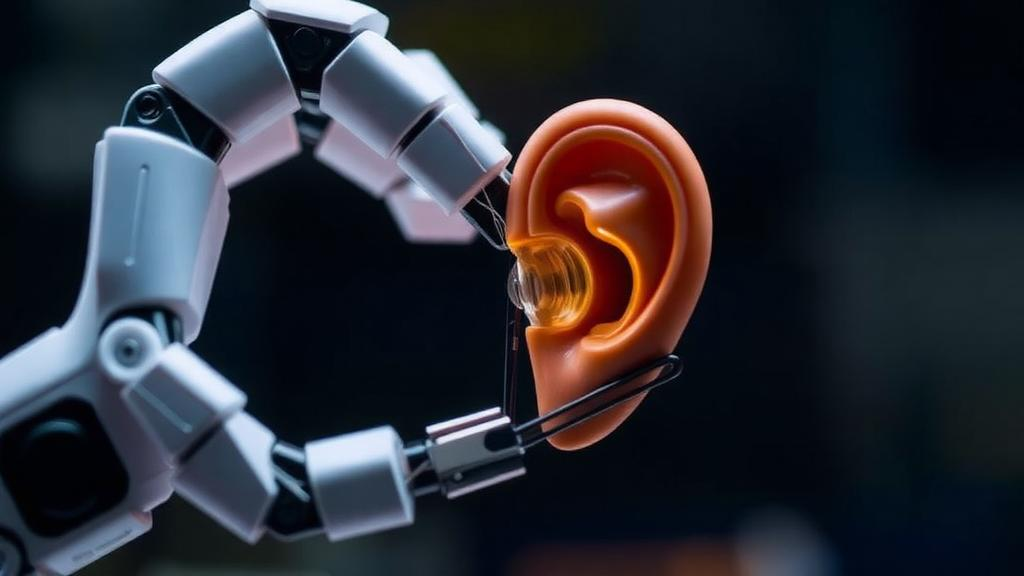
The cochlear implant is one of medicine’s most remarkable devices, restoring a sense of sound to people whose inner ears no longer work. Yet paradoxically, the act of implanting it can destroy exactly what surgeons are trying to save. Many recipients still have a flicker of natural, residual hearing when they enter the operating room, and a substantial share of that hearing is lost during or after the surgery itself. A comprehensive review published in Frontiers in Audiology and Otology examines why that loss happens and whether robots can succeed where even the most experienced human hands fall short, surveying more than four decades of experimental, histopathological and clinical literature on atraumatic and robot-assisted electrode insertion.
The stakes are not merely symbolic. When residual hearing survives implantation, patients can combine the implant’s electrical stimulation with their own natural acoustic perception, a hybrid approach known as electro-acoustic stimulation. This combination consistently outperforms electrical stimulation alone for speech understanding, music appreciation and hearing in noisy environments. The difference can be striking: an ear that retains low-frequency hearing lets its owner distinguish voices in a crowded room in a way that pure electrical hearing often cannot. Preserving that fragile biological resource has therefore become a central objective of modern cochlear implantation, and the review makes clear that success or failure hinges on a single, deceptively simple moment: the insertion of the electrode array into the spiraling, fluid-filled cochlea.
Inside the cochlea, the electrode must thread through one of three fluid-filled chambers, ideally the scala tympani, which runs closest to the auditory nerve fibers without crossing the delicate basilar membrane that separates the chambers. When the electrode strays, the consequences cascade. The review catalogs the classic injury patterns: scalar translocation, in which the electrode buckles out of its intended chamber; tip fold-over, where the leading end doubles back on itself; and basilar membrane rupture, the direct tearing of the membrane that carries frequency information to the brain. Each of these events triggers inflammation inside the cochlea, followed by fibrosis, the formation of scar-like tissue, and neo-osteogenesis, the growth of new bone in a space that must remain open and fluid-filled. That remodeling does not only erase residual hearing; it can compromise the long-term survival of the auditory neurons themselves, degrading the implant’s effectiveness even for patients who never had hearing to lose.
What makes these injuries so difficult to prevent is that they are largely invisible during surgery. The cochlea is encased in bone a few centimeters behind the ear, and the forces generated at the electrode tip occur inside fluid and tissue that a surgeon cannot see or directly feel. The review identifies insertion speed and trajectory stability as the key modulators of intracochlear force and pressure generation. Insert too quickly and pressure waves surge through the perilymph; deviate slightly from the ideal path and the stiff electrode begins to press against walls it should never touch. Human hands, however steady, are subject to motor variability, tremor and fatigue, and even identical electrodes placed by the same surgeon can follow meaningfully different paths on different days. That variability, the authors argue, is the fundamental obstacle to making atraumatic insertion a reliable routine rather than an aspiration.
Surgical technique and hardware design have responded on multiple fronts. Soft, flexible electrode arrays with tapered tips, lubricious coatings and optimized stiffness profiles are engineered to hug the scala tympani wall and slide past the structures they must protect. Surgeons use specially shaped insertion tools and controlled drilling approaches to create a path that aligns naturally with the cochlea’s spiral. Pharmacological strategies, most prominently perioperative corticosteroids, aim to blunt the inflammatory cascade when trauma does occur, reducing fibrosis and protecting the sensitive neural elements. The review synthesizes these strategies with an important methodological discipline, reporting preclinical data separately from clinical data so that the strength of evidence for each intervention remains clear.
Into this landscape have come the robots. The review evaluates three robotic insertion systems in detail: RobOtol, a robotically assisted surgical platform developed for ear procedures; OTODRIVE, a system designed specifically for controlled, constant-speed electrode insertion; and iotaSOFT, an automated insertion tool that advances the electrode at programmable, sub-millimeter-per-second velocities far slower than any hand can sustain. The principle they share is kinematic discipline. By constraining insertion to a predefined trajectory and a controlled speed profile, robotic systems eliminate the jerks, hesitations and speed fluctuations of manual technique, and the cadaveric and in vitro experiments reviewed show that they deliver on that promise.
The measured advantages are concrete. Across experimental models, robotic systems achieve significantly lower and more reproducible insertion angular errors and force profiles than manual insertion. They place the electrode fully within the scala tympani more often and score lower on histological trauma scales. These are exactly the metrics that matter, because every degree of angular deviation and every spike in tip force is a chance for the electrode to snag the basilar membrane or fold at the apex of the cochlea. The clinical translation, while still maturing, is encouraging. A non-randomized comparative study cited in the review reported hearing preservation in up to 85 percent of robot-assisted recipients compared with 71 percent following manual insertion. Meta-analytic data on robot-assisted cochlear implantation surgery, abbreviated RACIS by the authors, show an overall procedural success rate of 97.2 percent and a complication profile comparable to conventional surgery. Postoperative electrode impedance measurements, a window into the inflammatory environment around the electrode, trend more stably after robotic insertion, suggesting attenuated fibro-inflammatory remodeling around the array.
The review is careful, however, not to oversell what the evidence shows. The pooled hearing preservation estimates across studies carry very high statistical heterogeneity, with an I-squared value of 98.41 percent, meaning that the results of individual studies vary so wildly that a single summary number is close to meaningless. Differences in electrode designs, surgical approaches, hearing preservation definitions and patient populations make direct comparisons treacherous. The authors conclude that at present the technical superiority of robotic insertion, its precision, reproducibility and consistency of electrode placement, is better established than its long-term functional benefit. A smoother insertion seen on imaging and force traces has not yet been proven, in randomized trials, to preserve more hearing for more patients over the years that follow.
The most exciting frontier, according to the review, is the marriage of robotics with real-time intraoperative sensing, above all electrocochleography. By recording the electrical responses of the cochlea while the electrode advances, surgeons can in principle detect the moment of danger, a rising force, a physiological distress signal, and adapt the insertion on the fly, slowing down, reversing slightly or altering the trajectory before injury occurs. That vision of adaptive, personalized insertion, in which the robot responds to the living cochlea rather than blindly following a precomputed path, represents a genuine paradigm shift from static technique to feedback-guided surgery. Combined with anatomical imaging that maps each patient’s individual cochlear geometry before the operation, it points toward insertions planned and executed around the anatomy of a single ear.
For now, the review’s verdict is measured but optimistic: robot-assisted cochlear implantation is a maturing, reproducible approach that reduces inter-operator variability and improves the consistency of electrode placement, with a safety record already indistinguishable from conventional surgery. What remains is the hard work of proof. The authors call for randomized controlled studies incorporating long-term functional outcomes, cost-effectiveness analysis and anatomical imaging to establish the true clinical benefit of RACIS. If those trials confirm what the laboratory data suggest, the field could move decisively beyond the era in which hearing preservation depends on the steadiness of a particular pair of hands on a particular day. Millions of people with hearing loss stand to gain from an operation that no longer trades the hearing they have left for the hearing technology provides, and the robot in the operating room may soon be the reason they do not have to choose.
Subject of Research: Hearing preservation through atraumatic and robot-assisted electrode insertion in cochlear implantation surgery
Article Title: Hearing preservation in cochlear implantation: a comprehensive review with emphasis on atraumatic and robot-assisted electrode insertion
Article References: Hearing preservation in cochlear implantation: a comprehensive review with emphasis on atraumatic and robot-assisted electrode insertion. (n.d.). https://doi.org/10.3389/fauot.2026.1939453
Image Credits: AI Generated
DOI: 10.3389/fauot.2026.1939453
Keywords: cochlear implants, hearing preservation, robot-assisted surgery, electrode insertion, scala tympani, basilar membrane, electro-acoustic stimulation, corticosteroids, electrocochleography, RACIS, cochlear trauma, fibrosis
Cite Scienmag News
Denise Maddox. (October 15, 2026). Robots Are Learning to Thread Cochlear Implants Without Destroying Hearing. Scienmag. https://scienmag.com/robots-are-learning-to-thread-cochlear-implants-without-destroying-hearing/
Denise Maddox. "Robots Are Learning to Thread Cochlear Implants Without Destroying Hearing." Scienmag, 15 October 2026, https://scienmag.com/robots-are-learning-to-thread-cochlear-implants-without-destroying-hearing/. Accessed 15 October 2026.
Denise Maddox. "Robots Are Learning to Thread Cochlear Implants Without Destroying Hearing." Scienmag. October 15, 2026. https://scienmag.com/robots-are-learning-to-thread-cochlear-implants-without-destroying-hearing/


