


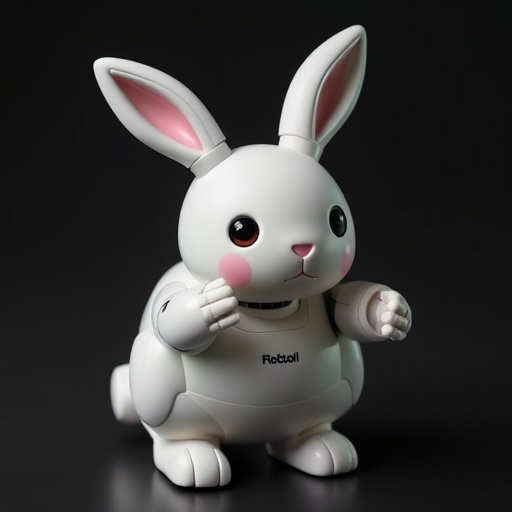
In the rapidly evolving domain of social robotics, a groundbreaking development emerges from the forefront of artificial intelligence research at the Universidad Carlos III de Madrid (UC3M). The Social Robotics Group within UC3M’s Robotics Lab has ingeniously crafted an innovative system empowering an assistive, pet-like robot to discern the identities of individuals it encounters through voice recognition alone. This pioneering technology has been embodied in Mía, a compact robotic rabbit prototype designed to serve elderly individuals experiencing cognitive decline, currently undergoing practical trials within day centers managed by Madrid City Council.
Mía, measuring a modest 30 by 30 by 50 centimeters and weighing approximately three kilograms, represents a fusion of robotics engineering and affective computing. Unlike conventional social robots that depend heavily on camera-based image processing—which can demand substantial computational resources and raise privacy concerns—Mía’s design incorporates a streamlined yet sophisticated onboard voice recognition system. This system processes audio signals locally using the robot’s integrated microphone, an approach that enhances privacy by ensuring voice data never leaves the physical device.
The core innovation lies in the system’s incremental learning capability. When Mía encounters a new voice, it instantly generates a unique profile without the need for a preliminary setup or enrollment phase. This dynamic user recognition mechanism continuously adapts as interactions proceed, distinguishing known users from newcomers by analyzing complex acoustic patterns and nuances. By employing an improved open-source clustering algorithm, the system organizes these “voice signatures” into discrete user groups, enabling the robot to personalize its behavior according to the recognized individual.
This trajectory towards personalized interaction represents a significant leap forward in assistive robotics. As José Carlos Castillo Montoya, a principal investigator in the project, elucidates, the ability for Mía to recognize and adapt to users’ distinct voices paves the way for more effective affective stimulation—particularly vital for elderly individuals facing cognitive challenges. The robot’s interactions are thus tailored to individual needs, facilitating a more natural, empathetic interface that nurtures emotional well-being.
Mía’s design philosophy is rooted in the emerging field of animal robotics, which seeks to replicate the therapeutic benefits traditionally provided by real animals in settings where live animal therapy is impractical or inadvisable. Animal robotics harnesses the calming influence, anxiety reduction, and social engagement prompted by animal interactions, but within a fully controlled and safe technological environment. This paradigm is especially promising for vulnerable populations such as the elderly with cognitive impairment, who may gain considerable mood and social benefits.
Empirical pilot studies conducted in collaboration with Madrid’s municipal day centers serve as a testament to Mía’s potential. These trials reveal not only notable improvements in the emotional states of elderly users but also underscore the robot’s role as a social catalyst. By triggering caregiving instincts and encouraging communication among participants, Mía effectively mitigates loneliness and isolation, fostering a more interactive and supportive social atmosphere.
The underlying AI voice recognition algorithm mimics aspects of human auditory learning, transforming each spoken interaction into a distinctive acoustic “fingerprint.” This voice biometrics approach captures intricate vocal characteristics—such as pitch, cadence, and timbre—that collectively define an individual’s speech signature. The system constructs an internal multidimensional map of these audio features, dynamically classifying and reclassifying data clusters as new inputs arrive.
Given the constrained computational hardware onboard Mía, the algorithm’s efficiency is paramount. The developers have optimized resource consumption through intelligent clustering methods that organize voice signatures with minimal processing overhead. This enables real-time adaptation and the swift creation of new user profiles, ensuring that the robot can function independently in everyday home environments without reliance on cloud computing or external servers.
Beyond technical sophistication, this voice recognition technology foreshadows a new breed of socially aware assistive robots with customizable responses. Once a user is identified, the robot can tailor its conduct—for example, deploying specific soothing behaviors for individuals prone to restlessness. Such adaptability enhances user comfort and safety, signifying a step toward genuinely interactive companion robots that integrate seamlessly into personalized care routines.
UC3M’s ongoing work with Mía includes multiple fully operational prototypes engaged in active clinical settings, underscoring their commitment to rigorous validation and refinement. These experiments aim to demonstrate efficacy and robustness in real-world scenarios, while the research team pursues strategic partnerships with commercial entities interested in bridging the gap between laboratory innovation and market-ready assistive technology products.
The implications of this voice biometrics and dynamic clustering approach extend far beyond eldercare applications. This decentralized, privacy-conscious user recognition methodology could transform diverse fields—ranging from domestic service robots to adaptive user interfaces—that demand secure, context-aware human-robot interaction without compromising user data security.
This breakthrough, documented in a recent publication within the journal Applied Sciences, heralds a new horizon where assistive robots autonomously learn and personalize interactions simply by “listening” to the first greeting uttered by household members. As artificial intelligence continues to merge with socially sensitive robotics, solutions like Mía exemplify how technology can profoundly enhance quality of life while respecting individual privacy and dignity.
By realistically emulating the subtle human ability to recognize voice identity in an embedded and incremental fashion, Mía bridges the gap between functional robotics and emotionally engaging companionship. This advances the ultimate goal of fostering autonomous yet empathetic machines capable of responding flexibly to multifaceted human needs, thus marking a transformative milestone in the field of social robotics and AI-assisted care.
News Publication Date: 5-May-2026
Web References: DOI:10.3390/app16094548
Cite Scienmag News
Denise Maddox. (June 15, 2026). Robotic Pet Rabbit Developed to Identify Huggers by Their Voice. Scienmag. https://scienmag.com/robotic-pet-rabbit-developed-to-identify-huggers-by-their-voice/
Denise Maddox. "Robotic Pet Rabbit Developed to Identify Huggers by Their Voice." Scienmag, 15 June 2026, https://scienmag.com/robotic-pet-rabbit-developed-to-identify-huggers-by-their-voice/. Accessed 4 September 2026.
Denise Maddox. "Robotic Pet Rabbit Developed to Identify Huggers by Their Voice." Scienmag. June 15, 2026. https://scienmag.com/robotic-pet-rabbit-developed-to-identify-huggers-by-their-voice/


