


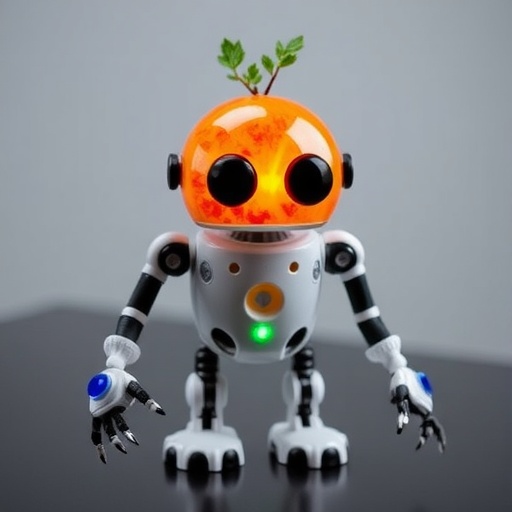
A groundbreaking study led by Associate Professor Yoshihiro Nakata of The University of Electro-Communications, Japan, in collaboration with teams from Doshisha University and Otemon Gakuin University, introduces an innovative concept in the realm of human-food interaction. They have developed a novel “edible agent” — a consumable, bio-compatible object engineered not merely for nutritional purposes but as an interactive entity capable of social engagement through synchronized vocalizations and movements. This pioneering research, recently published in the prestigious journal PLOS ONE, opens up unprecedented avenues for exploring psychological responses to food beyond traditional paradigms.
The core innovation lies in the fabrication of an edible construct designed to exhibit discernible signs of “mind perception,” a psychological dimension that attributes agency and experiential qualities to objects or beings. Typically, mind perception has been investigated through real animals or humanoid robots; however, this study circumvents ethical and experimental limitations by employing edible materials, thereby eliminating welfare concerns while maintaining control over behavioral variables. The edible agent, comprising gelatin, sugar, calcium carbonate, and pure apple juice, materializes as a soft, pliable form with anthropomorphic features including eyes and articulated arms to foster a sense of social presence.
Technically, the agent’s movements are actuated pneumatically via compressed air, causing rhythmic side-to-side swaying synchronous with externally generated audio signals. These audio signals—and the vocalizations embedded within—were crafted to mimic different communicative styles. In the experimental design, two distinct behavioral modes were featured: one where the agent responded with rational, context-appropriate vocalizations to an interlocutor’s statements in Japanese, and another where it emitted emotive, infant-like sounds conveying basic affective states such as joy, fear, anger, and sadness. This dual modality aimed to elicit varied psychological attributions from human observers regarding the edible agent’s perceived mind.
To empirically assess human perception, the researchers conducted an online survey involving 1,094 participants. Methodologically, the participants first viewed a video emphasizing the construct’s edible composition and production process, affirming the agent’s consumability. Subsequently, they observed two separate interaction sequences showcasing the edible agent’s distinct vocal and movement behaviors in response to social stimuli. Participants evaluated the agent across 18 mind-perception items, measuring dimensions related to both cognitive capabilities and emotional experience. Additionally, they anticipated their own reluctance and guilt related to the hypothetical act of consuming the agent, thereby probing the ethical and affective implications of eating entities with apparent minds.
A comprehensive factor analysis distilled mind perception into two principal dimensions: Agency and Experience. Agency encapsulates cognitive faculties such as self-control, moral reasoning, planning, and thought, while Experience comprises sensations and emotions like joy, fear, pain, and rage. Results revealed that the edible agent demonstrating rational vocal responses scored higher on Agency, signifying recognition of intentional and thoughtful capacities. Conversely, the agent exhibiting infantile vocalizations was attributed higher Experience, indicating perceived emotional richness. These findings reveal that subtle differences in vocal expression and behavioral cues can markedly sway the psychological representation of mind in non-living, edible agents.
Intriguingly, despite these modulations in mind perception, the study found no clear correlation between higher mind attribution and participants’ reluctance to eat or feelings of guilt. This suggests a complex dissociation between cognitive-emotional appraisals of mind-like qualities and moral or affective barriers toward food consumption. The authors posit that while vocalizations and behavioral complexity foster mind attribution, other psychological or cultural factors might mediate ethical concerns tied to eating entities ascribed mental states. This nuanced insight challenges simplistic assumptions around anthropomorphism and ethical food choices, highlighting the multifaceted nature of human-food interactions.
Beyond the theoretical contributions, the experimental framework introduced constitutes a versatile tool for dissecting human psychological and ethical responses toward food and food-like entities. Edible agents, by virtue of their controllability in appearance, behavior, and vocal expression, create unprecedented opportunities to simulate and study social interactions within the context of eating. Unlike traditional animal models, these agents bypass ethical dilemmas and experimental variability, enabling rigorous investigation into mind perception, moral considerations, and possibly other cognitive factors influencing dietary acceptance.
Notably, this research also underscores the potential for edible agents to inform the development of alternative food sources and novel food products that intersect with emerging ethical concerns and cultural contexts. As food technology advances toward inclusivity, sustainability, and innovation, understanding how consumers psychologically engage with food items incarnating social properties could inform design strategies that enhance acceptance and reduce cognitive dissonance. This is particularly relevant in the rising landscape of lab-grown meat, insect-based protein, and hybrid food-robot hybrids.
Looking ahead, the research team advocates for future studies incorporating more immersive and ecologically valid conditions, including direct consumption scenarios and autonomous agent behaviors during eating episodes. Such extensions would refine understanding of real-time interactions and emotional dynamics as humans negotiate the boundary between food and social agent. Integrating sensory feedback beyond visual and auditory cues, such as texture and taste, may further enrich the experiential authenticity and affective modulation of edible agents.
The interdisciplinary collaboration among engineers, psychologists, and food scientists reflects the emergent convergence necessary to address complex phenomena at the nexus of technology, cognition, and culture. Key contributors include doctoral student Takuma Shimoyama and former master’s candidate Yuya Kume from The University of Electro-Communications, Assistant Professor Mei Yamagata of Doshisha University, and Associate Professor Hideyuki Takahashi from Otemon Gakuin University. Collectively, their work exemplifies the innovative potential of synthetic biology and interactive robotics in transforming the landscape of food research.
This pioneering work is not only a milestone in understanding mind perception in non-traditional contexts but also paves the way for a new scientific domain dedicated to human perception in human-food interactions. By strategically employing edible materials capable of mimicking behaviors traditionally ascribed to living beings, the study blurs conventional boundaries, challenging both scientific paradigms and societal norms about what it means to “consume” with awareness and ethical reflection. The ramifications extend to multiple fields, including artificial intelligence, human-computer interaction, sensory science, and ethics.
In summary, this landmark study illustrates how innovative material science and psychological inquiry converge to reshape our understanding of food as a dynamic, interactive phenomenon. The concept of edible agents with perceptible minds offers a novel experimental platform for dissecting the cognitive and ethical dimensions that underpin everyday decisions about what we choose to eat. As science and technology continue to evolve, such interdisciplinary endeavors are crucial for anticipating and navigating the future of food, culture, and consciousness.
News Publication Date: 22-Jun-2026
Web References: 10.1371/journal.pone.0350612
Cite Scienmag News
Courtney Benton. (June 24, 2026). Robotic Edible Agents with Perceptible Minds: A New Tool for Exploring Human-Food Interactions. Scienmag. https://scienmag.com/robotic-edible-agents-with-perceptible-minds-a-new-tool-for-exploring-human-food-interactions/
Courtney Benton. "Robotic Edible Agents with Perceptible Minds: A New Tool for Exploring Human-Food Interactions." Scienmag, 24 June 2026, https://scienmag.com/robotic-edible-agents-with-perceptible-minds-a-new-tool-for-exploring-human-food-interactions/. Accessed 5 September 2026.
Courtney Benton. "Robotic Edible Agents with Perceptible Minds: A New Tool for Exploring Human-Food Interactions." Scienmag. June 24, 2026. https://scienmag.com/robotic-edible-agents-with-perceptible-minds-a-new-tool-for-exploring-human-food-interactions/


