


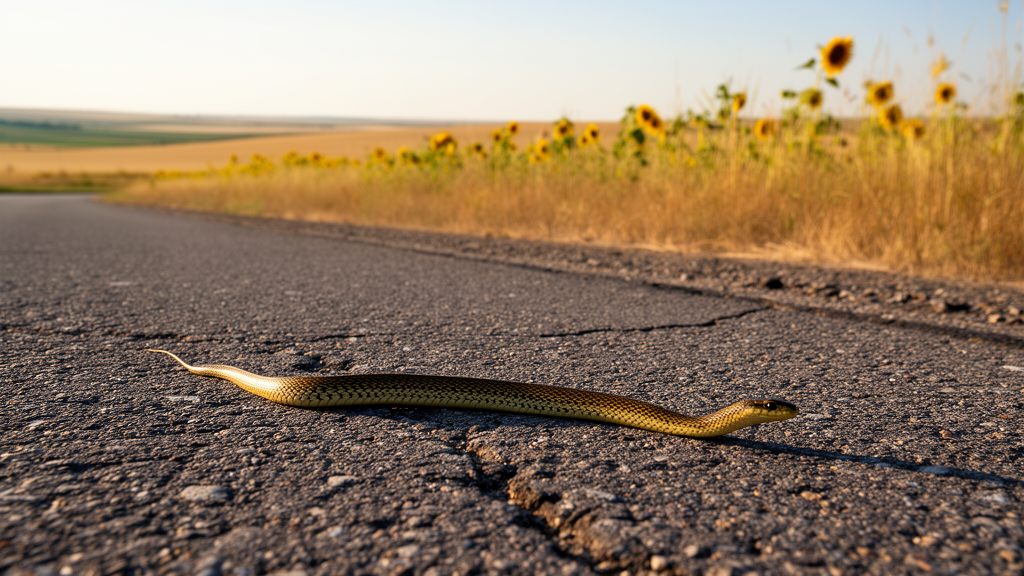
In a striking reversal of long-held assumptions about snake mortality, a new study reveals that juvenile Caspian whipsnakes are the primary victims of road traffic in the lower Olt River valley of southern Romania. Published in the journal Herpetozoa, the research documents 66 road-killed individuals of Dolichophis caspius over just eight days of fieldwork conducted in 2021 and 2024. The findings challenge previous data from Romania, which had predominantly recorded adult fatalities, suggesting that earlier surveys may have suffered from significant detection biases. This shift in understanding highlights the critical importance of age-specific monitoring in conservation biology, particularly for species at the edges of their distribution ranges.
The study focused on a 53-kilometer stretch of county road DJ 456, which winds through the Boian Plain and follows the course of the Olt River. This region is characterized by flat agricultural lands interspersed with steep loess walls, a habitat type that is particularly favorable for the Caspian whipsnake. The road itself is notable for its low speed limit of 50 km/h, enforced by numerous curves and speed cameras, and it passes through more than 90% of small villages. These specific road features appear to have played a crucial role in the high detection rate of small, juvenile snakes, which might otherwise be overlooked or destroyed on higher-speed highways.
Of the 66 road-killed snakes identified, 41 were juveniles, representing 62.12% of the total, while 25 were adults. This juvenile dominance stands in stark contrast to historical Romanian data, where only 11 juveniles were recorded among 150 adults over the previous two decades. The researchers suggest that the low speed of the road allowed observers to spot the smaller carcasses, which average only 21.92 cm in length at hatching. On faster roads, these small bodies are easily missed by drivers and researchers alike, leading to a skewed perception of the species’ vulnerability to vehicular traffic.
The temporal distribution of road mortality also provided valuable insights into the species’ behavior. The highest number of victims was recorded in late August 2024, with 20 snakes found dead in a single day. This peak coincides with the period when juvenile snakes are most active and likely to disperse from their hatching sites. However, the study also found a high percentage of juveniles in spring, indicating that road mortality is not limited to the autumn season. The variability in mortality rates across different days, even within the same month, underscores the influence of local microclimate conditions on snake activity and, consequently, their exposure to road traffic.
The spatial analysis revealed distinct hotspots of road mortality, particularly in the northern sectors of the studied road near the localities of Sprâncenata and Zănoaga. These areas are characterized by the presence of small forest fragments on the loess walls, providing a diverse habitat that attracts high densities of snakes. The proximity of these habitats to the road creates a dangerous corridor where snakes are forced to cross the asphalt to move between suitable microhabitats. This spatial clustering of fatalities suggests that targeted conservation efforts in these specific areas could significantly reduce the impact of road traffic on the local population.
The high number of juvenile casualties also indicates the presence of large, breeding populations in the region. The Caspian whipsnake is known to benefit from climate warming, which has allowed it to expand its range northward in recent decades. The lower Olt River valley, one of the warmest regions in Romania, provides ideal conditions for the species’ survival and reproduction. The abundance of juveniles on the road serves as a proxy for the health and size of the local population, suggesting that the species is thriving in this area despite the ongoing threat from vehicular traffic.
However, the study also highlights the limitations of current conservation strategies. While barrier fences and ecopassages have been successful in reducing road mortality for some snake species, they may not be effective for the Caspian whipsnake, which is a fast and agile climber. The impracticality of installing such structures along a 53-kilometer road that passes through numerous villages further complicates mitigation efforts. The researchers suggest that simpler measures, such as wildlife warning signs, might be more feasible, although their effectiveness is debated. In some cases, warning signs have been found to be ineffective or even counterproductive, as drivers may intentionally run over snakes they see.
The findings of this study emphasize the need for more comprehensive and age-specific monitoring of road mortality in snake populations. Previous data, often collected from high-speed roads or by amateur naturalists, may have underestimated the impact of traffic on juvenile snakes. By focusing on a low-speed road with specific habitat features, the researchers were able to capture a more accurate picture of the species’ vulnerability. This approach could be applied to other regions and species to better understand the true extent of road mortality and its implications for population dynamics.
As climate change continues to alter habitats and species distributions, the intersection of roads and wildlife will become an increasingly important issue in conservation biology. The Caspian whipsnake in the lower Olt River valley serves as a compelling case study of how local conditions, road features, and species behavior interact to shape mortality rates. The study calls for a nuanced approach to conservation, one that considers the specific needs of different age classes and the unique characteristics of each landscape. By addressing the root causes of road mortality, such as habitat fragmentation and high traffic volumes, it may be possible to mitigate the impact of roads on this and other vulnerable species.
Subject of Research: Dolichophis caspius road mortality at its northern distribution range limit: the lower Olt River valley, southern Romania
Article Title: Dolichophis caspius road mortality at its northern distribution range limit: the lower Olt River valley, southern Romania
Article References: Covaciu-Marcov, S.-D., Lazăr, A.-M., Mușet, A.-F., Pop, D.-R., Cicort-Lucaciu, A.-Ș., & Ferenți, S. (2025). Dolichophis caspius road mortality at its northern distribution range limit: the lower Olt River valley, southern Romania. Herpetozoa, 38, 61-69. https://doi.org/10.3897/herpetozoa.38.e145691
Image Credits: AI Generated
DOI: 10.3897/herpetozoa.38.e145691
Keywords: Dolichophis, caspius, road, mortality, northern, distribution, range, limit, lower, River, valley, southern
Cite Scienmag News
Margaret Porter. (October 18, 2026). Roads Kill Juvenile Caspian Whipsnakes in Southern Romania. Scienmag. https://scienmag.com/roads-kill-juvenile-caspian-whipsnakes-in-southern-romania/
Margaret Porter. "Roads Kill Juvenile Caspian Whipsnakes in Southern Romania." Scienmag, 18 October 2026, https://scienmag.com/roads-kill-juvenile-caspian-whipsnakes-in-southern-romania/. Accessed 18 October 2026.
Margaret Porter. "Roads Kill Juvenile Caspian Whipsnakes in Southern Romania." Scienmag. October 18, 2026. https://scienmag.com/roads-kill-juvenile-caspian-whipsnakes-in-southern-romania/


