


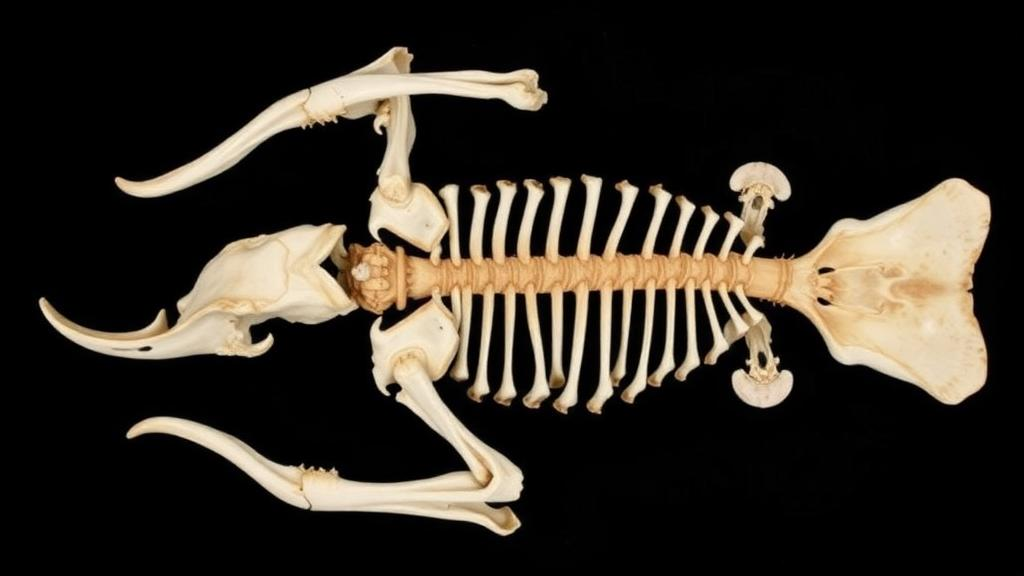
On the sun-baked roads of Rio Grande do Norte, in the Brazilian semi-arid, a team of researchers spent four years patrolling highways at dawn, collecting the fresh corpses of wild animals struck by vehicles. What they did with those bodies — necropsy, dissection, and quantitative computed tomography — has produced one of the most detailed forensic portraits yet of what a collision with a car actually does to the skeleton of a wild vertebrate. The study, published in Neotropical Biology and Conservation, examined 24 roadkilled animals — four birds, eight reptiles, and twelve mammals — collected between 2018 and 2021 on roads surrounding three Federal Conservation Units: the Furna Feia National Park, the Açu National Forest, and the Seridó Ecological Station. The results reveal a grim arithmetic: on average, each animal carried roughly three to four bone lesions, and the pattern of those injuries was anything but random.
The sampling protocol was unusually strict for opportunistic roadkill research. Animals had to be found within the first hours after sunrise, before livor mortis set in — judged by the still-wet appearance of open lesions, the absence of gas bloating, and the lack of putrid odor. Specimens that were severely crushed or flattened were discarded, as were any showing cadaveric alterations that could interfere with necropsy. The researchers reasoned that much of the Caatinga fauna is nocturnal or crepuscular, so most collisions occur at night or in the early morning when drivers have limited visibility. By collecting quickly, they prevented bodies from being preyed upon by scavengers and protected fragile specimens, such as birds, from the rising heat. Many animals found on road shoulders are apparently thrown off the road after impact and are generally in better condition than those found in the middle of the lane — a detail that shaped which specimens made it to the laboratory.
The species list reads like a who’s who of semi-arid roadkill: one yellow-headed vulture (Cathartes burrovianus), one crested caracara (Caracara plancus), two roadside hawks (Rupornis magnirostris), one green iguana (Iguana iguana), seven black and white tegus (Salvator merianae), and twelve crab-eating foxes (Cerdocyon thous). All were adults. In the laboratory, each animal was weighed on a 0.1 g precision scale, inspected externally, and sexed where possible by gonad visualization. Bone lesions were classified into four types — multiple (more than one fracture line), transverse (perpendicular to the bone’s long axis), open (with bone fragments penetrating skin, from small tissue damage to limb amputation), and luxation (abnormal joint dislocation) — and mapped across five regions and thirteen bones, from skull to caudal vertebrae.
The numbers are stark. A total of 88 bone lesions were observed across the 24 specimens. Birds averaged 3.25 injuries per individual; reptiles and mammals averaged 3.75 each, with no statistically significant difference between the means (p = 0.93). Four animals — one bird, one reptile, and two mammals — showed no bone lesions at all, only internal organ damage, a reminder that vehicle collisions do not always fracture bone but can rupture organs and cause internal hemorrhage leading to immediate death. The type of injury varied by class: birds showed all four lesion types, with transverse fractures dominating (61.5%); reptiles and mammals were overwhelmingly affected by multiple fractures (73.3% and 60%, respectively). Regionally, the pattern diverged sharply: birds suffered 76.9% of their lesions in the appendicular skeleton, while reptiles and mammals bore the brunt in the head — 43.3% and 57.8% of their lesions, respectively, were skull injuries.
The skull dominance in mammals is particularly striking when compared with international literature. Studies of domestic dogs and raccoon dogs in South Korea found appendicular skeleton lesions to be the most frequent, and research on red foxes in Italy reported mostly simple fractures. Yet the crab-eating foxes in this study were mainly affected in the skull, with 82.2% of their lesions in the anterior portion of the body. The researchers suggest that medium-to-large carnivores may turn their backs upon an approaching vehicle — a behavior that would explain the higher incidence of posterior injuries seen in other studies of wild carnivores, where pelvic limb lesions dominated. In this study, however, forelimb injuries outnumbered hindlimb ones among the foxes, a contrast with Pastor et al.’s earlier work on the same species in Espírito Santo, Brazil, which found equal amounts of lesions on humerus, femur, and tibia.
Birds tell a different story. Their skeletons are adapted for flight — bones are lost or fused, cortical bone is thinned, and medullary cavities are pneumatized — making them more fragile and prone to comminuted or open fractures. Yet in this study, transverse fractures were the most common type, and the wings and hind limbs were affected by an equivalent number of lesions. This contrasts with previous studies of birds of prey in veterinary hospitals and rehabilitation centers worldwide, where wing bones — particularly the humerus, ulna, and radius — dominated fracture records. The high incidence of tibial fractures observed here was unprecedented in the literature the researchers reviewed. For reptiles, the study found that only they suffered lesions in the pelvic girdle and caudal vertebrae — a statistically significant difference (p = 0.03 for both). Four of the seven tegus were collected with tail autotomy, two with additional lesions along the tail, suggestive of being run over. Lizards’ crawling posture, slower displacement speed, and long tails make them easy targets for oncoming vehicles, and tail autotomy — the self-amputation of the tail at fragile fracture planes between caudal vertebrae — may occur at the moment of impact or in the final minutes of life under severe physiological stress.
Beyond lesion mapping, the study measured bone mineral density (BMD) using quantitative computed tomography — a technique that distinguishes trabecular from medullary bone and measures density in volumetric units (mg/cm³), an advantage over dual-energy X-ray absorptiometry. Animals were scanned on a GE HiSpeed FXI device with calcium hydroxyapatite phantoms (0, 100, and 200 mg/cm³) placed parallel to the axial skeleton. Attenuation values in Hounsfield units were converted to mg/cm³ using a calibration equation. BMD was measured in the trabecular bone of the tibia for birds, the first lumbar vertebra for reptiles, and the fifth lumbar vertebra for mammals. The results showed a statistically significant difference between vertebrate classes (p = 0.01): reptiles (mean 689.61 mg/cm³) and mammals (mean 611.56 mg/cm³) had higher BMD than birds (mean 339.60 mg/cm³). The crab-eating fox value was nearly double that of domestic dogs with hyperadrenocorticism described in a Korean study, and tegu values were comparable to those of boa constrictors.
Crucially, the statistical analyses found no significant relationship between BMD, the number of lesions, and body condition score. The researchers infer that the amount of calcium in bones and the nutritional status of individuals have minimal influence on the number of injuries suffered after a collision. Instead, anatomical and behavioral particularities are the determining factors of the amount, type, and location of injuries across vertebrate classes. This finding has direct implications for conservation: mitigation measures should be tailored to specific taxonomic or functional groups rather than applied uniformly. Vehicle speed is one variant that future studies should explore — a Tasmanian survey found that 50% of roadkill resulted from vehicles moving faster than 80 km/h, and that a reduction of about 20% in speed would decrease roadkill by about 50%. A Southern Ontario study found the speed limit was the best predictor of roadkill rates.
The study’s authors acknowledge limitations — low sample size, sometimes compromised samples, and extrapolation from dead specimens to live animals. Yet the database on main injuries found in frequently roadkilled wild animals serves as an aid to wildlife rescue and rehabilitation professionals. International data suggest rehabilitation outcomes vary: in Ontario, Canada, approximately 17% of birds, 33% of reptiles, and 5% of mammals admitted after vehicle collisions could be rehabilitated and released; in Australia, 31.2% of birds, 32.6% of reptiles, and 12.2% of mammal victims survived. Skull lesions, particularly multiple-type ones, are the most severe and potentially fatal — but not always deleterious: a study in Italy reported a 25% survival rate in red foxes with head injuries, and in South Korea, 25% of wild mammals with fractures underwent surgery, recovered, and were released. The BMD averages obtained here — particularly by the QCT method — describe species whose values had not yet been documented. With more studies, larger samples, and more species, the researchers argue, rehabilitation and release numbers can increase, since professionals will have more information about the main injuries suffered by collision victims. The efforts and resources invested in a single wild specimen make a big difference, particularly for endangered species — and the conservation of species is essential for balancing ecosystems.
Subject of Research: Characterization of bone lesions and bone mineral density of roadkilled wild animals in the Brazilian semi-arid
Article Title: Characterization of bone lesions and bone mineral density of roadkilled wild animals in the Brazilian semi-arid
Article References: Taili, I., Séllos Costa, F., Azevedo de Paula Antunes, J. M., Shimabukuro, A., dos Santos, R., de Oliveira Cabral, S., & Calabuig, C. (2024). Characterization of bone lesions and bone mineral density of roadkilled wild animals in the Brazilian semi-arid. Neotropical Biology and Conservation, 19(4), 427-448. https://doi.org/10.3897/neotropical.19.e132703
Image Credits: AI Generated
DOI: 10.3897/neotropical.19.e132703
Keywords: Characterization, bone, lesions, mineral, density, roadkilled, wild, animals, Brazilian, semi-arid, scientific research
Cite Scienmag News
Margaret Porter. (October 18, 2026). Roadkill forensics: CT scans reveal bone secrets of semi-arid wildlife. Scienmag. https://scienmag.com/roadkill-forensics-ct-scans-reveal-bone-secrets-of-semi-arid-wildlife/
Margaret Porter. "Roadkill forensics: CT scans reveal bone secrets of semi-arid wildlife." Scienmag, 18 October 2026, https://scienmag.com/roadkill-forensics-ct-scans-reveal-bone-secrets-of-semi-arid-wildlife/. Accessed 18 October 2026.
Margaret Porter. "Roadkill forensics: CT scans reveal bone secrets of semi-arid wildlife." Scienmag. October 18, 2026. https://scienmag.com/roadkill-forensics-ct-scans-reveal-bone-secrets-of-semi-arid-wildlife/


