


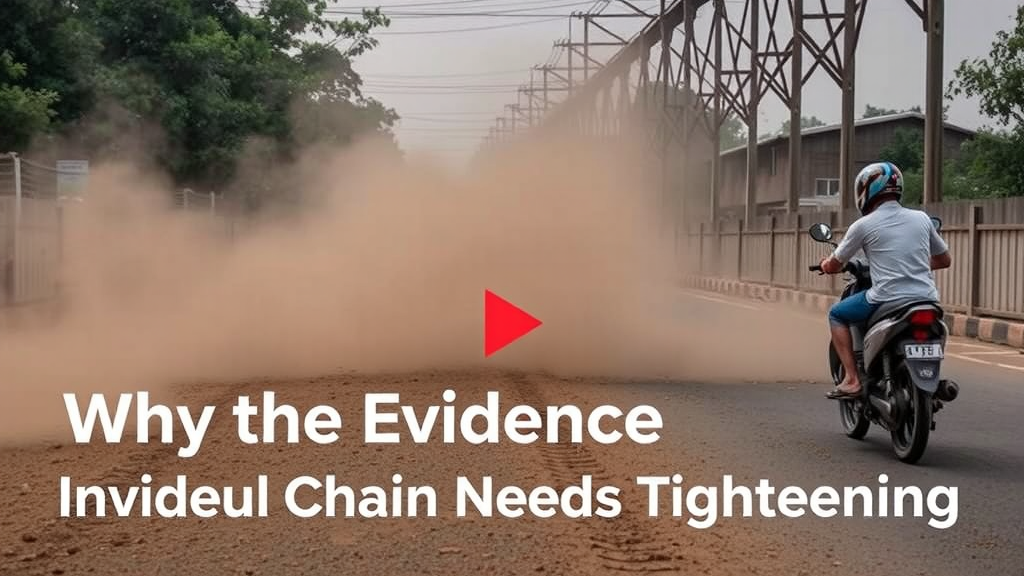
Roadside dust in industrial corridors is one of the most direct pathways by which potentially toxic elements enter the human body, yet the science connecting a dust sample to a health-risk number is longer and more fragile than most readers realize. A new Correspondence published in Environmental Geochemistry and Health by Luis F. O. Silva of Universidad de la Costa in Barranquilla, Colombia, scrutinizes that evidential chain for a recent study of road dust along National Highway 19 in the Durgapur Industrial Area of eastern India. The original study, led by Koley and colleagues, combined an impressive battery of techniques, but Silva argues that several links in the reasoning need explicit clarification before the study’s strongest conclusions can be reproduced and interpreted with confidence.
The Durgapur study examined potentially toxic elements, often abbreviated PTEs, in roadside dust collected along a heavily trafficked industrial corridor. The researchers measured elemental concentrations using inductively coupled plasma optical emission spectrometry, examined particle morphology with scanning electron microscopy, and computed a suite of geochemical indices to gauge contamination levels. They then mapped spatial patterns through interpolation, explored statistical associations among elements using Pearson correlation, principal component analysis, and hierarchical cluster analysis, and finally translated the concentration data into human-health risk estimates for adults and children. This kind of integrated workflow has become the standard template in urban and industrial dust research, which is precisely why questions about its internal consistency matter far beyond a single highway in West Bengal.
The first and most concrete issue raised in the Correspondence concerns numerical discrepancies between different parts of the published paper. According to Silva, the abstract of the Durgapur study reports mean concentrations of iron, manganese, zinc, and chromium that differ substantially from the means listed for the fourteen composite samples in the study’s Table 3. The abstract also reports hazard-index values for children that do not match those presented in Table 8, where the health-risk results are displayed. Because abstracts are what most readers, journalists, and policy analysts actually read, inconsistencies between an abstract and the underlying tables can propagate misleading numbers through secondary sources, decision documents, and meta-analyses long after the original paper is published.
A related ambiguity involves the sampling design itself. The study describes fourteen composite samples, each collected in triplicate, yet the abstract refers to a sample size of n equals 42. Silva points out that the statistical unit used in the multivariate analyses, whether each composite sample or each individual replicate, is never explicitly identified. This distinction is not pedantic. Principal component analysis and hierarchical cluster analysis are sensitive to the number and independence of observations, and a data matrix built from forty-two entries that are not statistically independent can produce artificially tight clusters and misleadingly confident factor loadings. Readers attempting to reproduce the source-attribution step would need to know exactly which rows entered the analysis.
The Correspondence then turns to what may be the most common overinterpretation in the entire field of dust source apportionment: treating statistical associations as quantitative source contributions. Principal component analysis and hierarchical cluster analysis are exploratory tools. They can reveal that certain elements tend to co-occur, which is consistent with a shared origin such as coal combustion, vehicle brake wear, or industrial smelting. What they cannot do, on their own, is say what percentage of the zinc in a dust sample comes from traffic rather than from soil or industry. Quantitative apportionment requires receptor models such as positive matrix factorization, constrained with source profiles and uncertainty estimates. Silva notes that the Durgapur study’s multivariate results should be read as source associations, supporting hypotheses about origins rather than delivering apportioned masses.
A second methodological warning concerns particle size. The laboratory analysis in the Durgapur study was performed on the fraction of dust smaller than 63 micrometers, a conventional sieve cut in street-dust geochemistry. Silva cautions that this size fraction should not be equated with an inhalable particulate fraction as defined in aerosol science. Inhalable and respirable fractions are governed by aerodynamic diameter and by how particles become airborne through resuspension, not by sieve opening. Dust finer than 63 micrometers contains plenty of particles far too large to reach the deep lung, and the particles most relevant to inhalation exposure may behave quite differently in the environment. Conflating the two fractions inflates apparent inhalation doses and misaligns the chemistry with the exposure pathway.
The third major clarification involves the distinction between total concentration and effective dose. The Durgapur study, like most dust studies, measured total elemental concentrations after acid digestion and used those totals in the health-risk equations. Silva emphasizes that total concentrations provide screening-level rather than true exposure-dose estimates when bioaccessibility and chemical speciation have not been measured. Bioaccessibility refers to the fraction of an element that actually dissolves in the physiological environment of the lung or gut and can be absorbed; speciation determines whether an element such as chromium is present in a relatively benign or a highly toxic oxidation state. Only a subset of the total metal load in a swallowed or inhaled dust particle is biologically available, and ignoring that gap means the calculated risk numbers are conservative upper bounds rather than realistic doses.
Finally, the Correspondence flags a disconnect in the carcinogenic-risk assessment. The text describing the cancer-risk calculations, Silva writes, does not appear to correspond to the elements for which total carcinogenic risk values are actually displayed in the study’s Table 8. Because cancer-risk estimates depend on element-specific slope factors and exposure assumptions, a mismatch between the narrative description and the tabulated results makes it difficult for readers to know which pollutants drive the reported risk. In environmental-health literature, where carcinogenic-risk figures are frequently quoted in policy discussions and media coverage, such a mismatch is more than a formatting issue; it touches the credibility of the central safety conclusion.
None of these points, Silva stresses, negates the value of the integrated approach that the Durgapur team adopted. Combining electron microscopy, geochemical indices, spatial mapping, multivariate statistics, and risk calculation reflects the field’s best ambition: to move from raw concentration patterns all the way to statements about who is exposed and how much. The Correspondence is offered as a constructive audit of the chain of inference, arguing that each link, from the identity of the statistical unit to the interpretation of a sieve fraction to the assumptions behind a dose equation, must be stated explicitly and applied consistently. When one link is loose, every downstream conclusion inherits that looseness, even if each individual technique was executed flawlessly.
The broader lesson for environmental science is that transparency and reproducibility are built through exactly this kind of open methodological critique. Studies of road dust in industrial corridors from Chhattisgarh to Hubei increasingly rely on the same toolkit, and their results feed into urban planning, traffic regulation, and child-protection policy. Silva’s Correspondence, published in Environmental Geochemistry and Health as volume 48, article 607, and drawing on no new primary data, models the practice of clarifying the evidential chain in print. For readers tracking pollution in their own cities, the takeaway is simple: a hazard-index number in an abstract is the end of a long argument, and every step of that argument deserves to be checked.
Subject of Research: Methodological evaluation of source attribution and health-risk assessment for potentially toxic elements in road dust from the Durgapur Industrial Area, India
Article Title: From concentration patterns to source attribution and health risk: clarifying the evidential chain in Durgapur road dust
Article References: From concentration patterns to source attribution and health risk: clarifying the evidential chain in Durgapur road dust. (n.d.). https://doi.org/10.1007/s10653-026-03512-1
Image Credits: AI Generated
DOI: 10.1007/s10653-026-03512-1
Keywords: road dust, potentially toxic elements, Durgapur, source apportionment, principal component analysis, health risk assessment, bioaccessibility, heavy metals, Environmental Geochemistry and Health, industrial pollution, particulate matter, NH-19
Cite Scienmag News
Russell Cooper. (September 25, 2026). Road Dust Study Under Scrutiny: Why the Evidence Chain in Durgapur Needs Tightening. Scienmag. https://scienmag.com/road-dust-study-under-scrutiny-why-the-evidence-chain-in-durgapur-needs-tightening/
Russell Cooper. "Road Dust Study Under Scrutiny: Why the Evidence Chain in Durgapur Needs Tightening." Scienmag, 25 September 2026, https://scienmag.com/road-dust-study-under-scrutiny-why-the-evidence-chain-in-durgapur-needs-tightening/. Accessed 4 October 2026.
Russell Cooper. "Road Dust Study Under Scrutiny: Why the Evidence Chain in Durgapur Needs Tightening." Scienmag. September 25, 2026. https://scienmag.com/road-dust-study-under-scrutiny-why-the-evidence-chain-in-durgapur-needs-tightening/


