


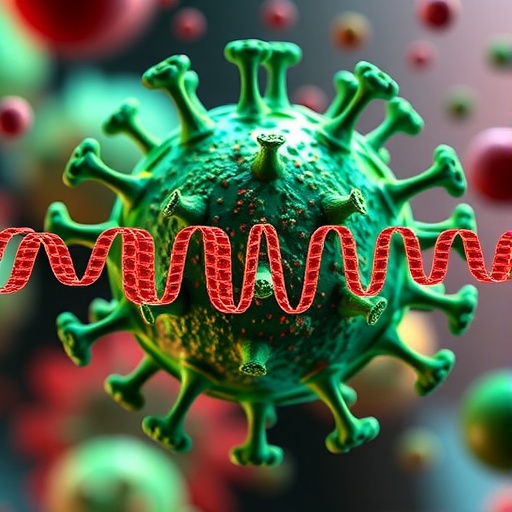
In a groundbreaking advance for microbiome science and viral ecology, researchers at Rice University have unveiled a revolutionary RNA barcoding system that reveals intricate interactions between bacteriophages—viruses that infect bacteria—and their bacterial hosts within complex microbial communities. This novel technique, recently described in the prestigious journal Nature Communications, offers an unprecedented lens through which scientists can decode the vast and hidden landscape of phage-host dynamics, potentially transforming microbiome engineering and therapeutic interventions.
Bacteriophages, the most abundant biological entities on our planet, orchestrate microbial ecosystems by infecting bacteria, altering their metabolic functions, and facilitating horizontal gene transfer—a natural mechanism for distributing genetic material across bacterial populations. Despite their ubiquity and ecological importance, unraveling which specific phages interact with which bacterial hosts in natural and engineered environments has remained an elusive challenge, primarily due to limitations in traditional culture-based methods and the complexity of microbial consortia.
The team, led by Lauren Stadler, Associate Professor of Civil and Environmental Engineering at Rice University, has pioneered a synthetic biology platform leveraging RNA-addressable modification, originally designed to monitor gene transfer via bacterial conjugation. Central to this approach is an engineered ribozyme that inserts unique molecular barcodes directly into the 16S ribosomal RNA of bacterial recipients following successful DNA transfer from a phage. This molecular tagging allows precise identification of host organisms through RNA sequencing, bypassing the need for labor-intensive bacterial culturing and enabling high-throughput analysis directly within environmental samples.
Applied to the well-characterized bacteriophage P1—known for its DNA transfer capabilities among enteric bacteria—the system revealed not only anticipated host range patterns but also uncovered a surprising new group of hosts in environmental wastewater samples: members of the order Aeromonadales, including Aeromonas hydrophila. This finding is particularly striking given that Aeromonas hydrophila had not previously been identified as a P1 host, underscoring the technology’s capability to unmask previously hidden phage-bacterial relationships within complex ecosystems.
The ability to detect these cross-order interactions is more than a mere academic curiosity; it offers critical insights into gene flow mechanisms that may fuel the spread of antibiotic resistance and influence microbial community stability. Traditional methodologies often confuse surface attachment of phages with genuine infection and DNA transfer. However, the RNA barcoding approach distinctly traces successful transduction events, allowing researchers to discriminate true host interactions from transient viral contacts.
Moreover, the Rice research team demonstrated that subtle genetic variations in phage tail fibers—protein structures critical for host recognition and binding—can drastically redefine a phage’s host range. By engineering phage particles with different tail fiber compositions and deploying their barcoding system within wastewater microbial consortia, they mapped how each fiber variant targeted a unique subset of bacteria. These insights provide an invaluable blueprint for designer phages with tailored host specificity, potentially catalyzing advancements in phage therapy and targeted microbiome modulation.
The implications of this technology extend far beyond wastewater treatment plants. As microbiome research continues to gain momentum in medicine, agriculture, and environmental science, the ability to efficiently monitor and understand viral gene exchange pathways promises to accelerate the development of phage-based alternatives to antibiotics, precision microbiota editing, and enhanced bioremediation strategies. Because the system is compatible with standard amplicon sequencing techniques, it lends itself to scalable deployment for large environmental surveys and clinical studies alike.
This innovative research was carried out through an interdisciplinary collaboration spanning Rice University’s civil and environmental engineering, biosciences, bioengineering, and chemical and biomolecular engineering departments, as well as the Systems, Synthetic and Physical Biology Graduate Program. The team included notable contributors such as James Chappell, associate professor of biosciences, and Jonathan Silberg, Stewart Memorial Professor of BioSciences, alongside doctoral graduate Zachary LaTurner—now a postdoctoral researcher at UC Berkeley’s Innovative Genomics Institute—and Rice graduate students Matthew Dysart, Samuel Schwartz, and Elizabeth Zeng.
In a broader context, this study spotlights the transformative potential of synthetic biology tools to decode biological complexity, enabling researchers to untangle the dense web of microbial interactions that govern health and disease in humans, animals, and natural environments. By providing a scalable, sensitive, and accurate method to chart phage-host relationships, the RNA barcoding system represents a major leap forward—a new frontier in the quest to harness viruses as precision instruments in biotechnology and medicine.
As bacteriophages gain recognition as powerful alternatives to traditional antimicrobial therapies amidst rising antibiotic resistance, tools like this RNA-based system will be crucial for understanding and safely deploying phage interventions. The meticulously engineered approach that allows direct observation of viral gene transfer events opens avenues for designing phages that deliver beneficial genes or selectively eliminate harmful microbial species with surgical precision, revolutionizing future therapeutic and environmental applications.
Rice University’s pioneering work injects fresh momentum into the fast-evolving field of microbiome science, providing a versatile, high-throughput technique to explore viral influences on bacterial populations in situ. This innovation promises to inspire a wave of research initiatives aimed at mapping the viral “dark matter” within microbiomes—complex microbial ecosystems influencing global biogeochemical cycles, human health, and industrial processes.
As scientists embrace this RNA barcoding platform, the microbial world’s hidden dialogues—encoded in viral gene transfers—may soon be decoded with clarity and scale that were previously unimaginable. Unlocking these intricate viral-bacterial conversations not only enriches our fundamental understanding of microbial ecology but also propels the design of next-generation biotechnologies, setting the stage for a paradigm shift in how we interact with the microbiome and its viral inhabitants.
News Publication Date: 23-Mar-2026
Web References: https://www.nature.com/articles/s41467-026-70995-y
References: DOI 10.1038/s41467-026-70995-y
Keywords
Bacteriophages, RNA barcoding, microbial communities, bacteriophage host range, synthetic biology, horizontal gene transfer, phage therapy, wastewater microbiology, microbial ecology, viral-host interactions, microbiome engineering, DNA transduction
Cite Scienmag News
Kristina Jarvis. (June 16, 2026). RNA Barcoding Uncovers Hidden Virus-Host Connections. Scienmag. https://scienmag.com/rna-barcoding-uncovers-hidden-virus-host-connections/
Kristina Jarvis. "RNA Barcoding Uncovers Hidden Virus-Host Connections." Scienmag, 16 June 2026, https://scienmag.com/rna-barcoding-uncovers-hidden-virus-host-connections/. Accessed 4 September 2026.
Kristina Jarvis. "RNA Barcoding Uncovers Hidden Virus-Host Connections." Scienmag. June 16, 2026. https://scienmag.com/rna-barcoding-uncovers-hidden-virus-host-connections/


