


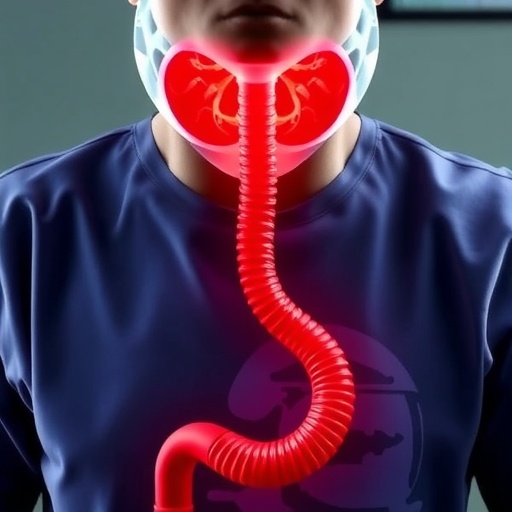
Esophageal cancer surgery has entered an era of smaller incisions, robotic instruments and faster recovery—but a long-standing question has remained unresolved: should surgeons routinely create a temporary feeding opening into the digestive tract during minimally invasive esophagectomy? A large Japanese analysis suggests that the answer is more complicated than either “yes” or “no.” Feeding enterostomy did not significantly change the risk of postoperative bowel obstruction, the study’s primary outcome, but it was associated with more reoperations and several other complications. At the same time, patients with an enterostomy experienced lower rates of delayed gastric emptying and deep-vein thrombosis. The findings indicate that the feeding access can be useful in carefully selected patients, but that placing one automatically in every minimally invasive esophagectomy may expose some patients to avoidable harm.
The analysis included 19,054 people who underwent minimally invasive esophagectomy for esophageal or esophagogastric junction cancer in Japan between 2019 and 2022. Of these patients, 4,599—24.1 percent—received a feeding enterostomy during their cancer operation. The procedure creates a small opening, or stoma, through the abdominal wall into part of the digestive tract. A gastrostomy connects the opening to the stomach, while a jejunostomy connects it to the jejunum, the section of small intestine beyond the stomach. Through this access, clinicians can deliver liquid nutrition when swallowing is unsafe or oral intake is insufficient after surgery. The approach was particularly important during the era of open esophagectomy, when recovery was often slower and postoperative nutritional problems were common. But minimally invasive surgery, enhanced-recovery protocols and earlier oral feeding have changed the balance between potential benefit and procedural risk.
Esophagectomy remains one of the most demanding operations in cancer care. Surgeons remove part or all of the esophagus and reconstruct the food pathway, usually by pulling the stomach upward to connect it with the remaining esophagus or throat. The operation can disrupt normal swallowing, breathing and gastrointestinal function at the same time. Even when the tumor is successfully removed, patients may experience pneumonia, leakage at the surgical connection, infection, prolonged ventilator dependence, delayed movement of food through the reconstructed stomach or an inability to consume enough calories. A feeding enterostomy is intended to provide a reliable nutritional route during this vulnerable period. Yet creating it requires an additional surgical maneuver, and any incision into the bowel or stomach can potentially lead to infection, leakage, adhesions or obstruction. The clinical challenge is therefore not simply whether enteral feeding is beneficial, but whether the access route itself improves outcomes enough to justify its risks.
To examine that trade-off, the investigators used Japan’s National Clinical Database, which captures more than 95 percent of esophagectomy cases nationwide. They restricted the study to minimally invasive procedures, including thoracoscopic and robot-assisted operations, and excluded open thoracotomy cases. Patients who had both a gastrostomy and a jejunostomy, duplicate records or incomplete key information were also excluded. Because patients selected for enterostomy may differ systematically from those who are not—for example, in illness severity, nutritional status or surgical complexity—the researchers used inverse probability of treatment weighting. This statistical technique estimates each patient’s probability of receiving an enterostomy based on measured characteristics, then weights the observations so the comparison groups more closely resemble one another. The team also used g-computation to estimate adjusted risks, average outcomes and differences between groups, reducing the chance that simple differences in patient characteristics would be mistaken for effects of the feeding procedure.
The primary endpoint was postoperative bowel obstruction, a complication that can occur when surgery, inflammation or scar tissue interferes with the passage of intestinal contents. After adjustment, the difference between patients with and without an enterostomy was only 0.2 percentage points and was not statistically significant, with a p value of 0.132. In other words, the study did not show convincing evidence that creating the feeding access either increased or reduced bowel obstruction overall. That result is important because obstruction is one of the main concerns surrounding a procedure that manipulates the gastrointestinal tract. However, the absence of a statistically significant difference does not prove that the two strategies are identical in every patient. Bowel-related events were rare, and the researchers did not perform adjusted comparisons for those uncommon outcomes. The study therefore provides reassurance against a large increase in obstruction risk, but it cannot exclude smaller effects or risks concentrated in particular high-risk subgroups.
The clearest warning signal was reoperation. After adjustment, patients who received a feeding enterostomy had a 2.5-percentage-point higher rate of reoperation within 30 days than those who did not, with a reported p value of 0.012. A difference of that size may be clinically meaningful after a major cancer operation, even though the database analysis cannot establish precisely why the additional procedures occurred in every case. Reoperations can be triggered by leaks, infections, bleeding, obstruction or other postoperative problems, and the enterostomy may be directly responsible in some patients or simply more common among patients already at elevated risk. The investigators also found a higher overall burden of postoperative complications in the enterostomy group. These results underscore a central limitation of routine preventive procedures: an intervention designed to protect against nutritional decline may introduce a new source of surgical morbidity.
The findings were not uniformly negative. Delayed gastric emptying occurred 0.9 percentage points less often among patients with an enterostomy, a difference that reached statistical significance with a p value of 0.028. Deep-vein thrombosis was also less frequent in the enterostomy group. Delayed gastric emptying can cause nausea, vomiting, abdominal distension and prolonged dependence on tubes or intravenous support after the stomach is repositioned to serve as a new esophagus. The lower rate observed with enterostomy may reflect more reliable nutritional management, altered postoperative care or differences that were not fully captured by the available data; the study cannot determine the biological mechanism. Similarly, the association with fewer thrombotic events should not automatically be interpreted as proof that the feeding tube prevents clots. Patients receiving enteral nutrition may mobilize or recover differently, but residual confounding remains possible even after statistical adjustment. The overall message is therefore one of trade-offs rather than a simple benefit-risk verdict.
The researchers also investigated which type of feeding enterostomy might be preferable when the reconstructed digestive tract was routed behind the breastbone, a technique known as retrosternal reconstruction. This subgroup was necessary because the choice between gastrostomy and jejunostomy is strongly constrained by anatomy. Jejunostomy is used almost exclusively when reconstruction passes through the posterior mediastinum, the central space in the chest, whereas both options can be considered for a retrosternal route. Among 2,723 patients with retrosternal reconstruction and an enterostomy, jejunostomy was associated with an 11.2-minute shorter operation than gastrostomy. Gastrostomy, however, was associated with a hospital stay 2.3 days shorter than jejunostomy. The investigators did not compare the two techniques across all reconstruction routes because gastrostomy was extremely uncommon in posterior mediastinal reconstruction, creating severe imbalance and making such a comparison unreliable.
The study’s conclusions are likely to resonate beyond Japan because the underlying clinical dilemma is shared by esophageal cancer centers worldwide. Modern minimally invasive esophagectomy reduces surgical trauma, but it does not eliminate the physiological stress of removing and reconstructing the esophagus. Some patients—particularly those with severe preoperative malnutrition, anticipated swallowing impairment or a high likelihood of prolonged recovery—may still benefit from dependable enteral access. Others may recover quickly enough to eat early, making a prophylactic stoma unnecessary. The national scale of the Japanese database gives the analysis considerable statistical power, but its retrospective design means that treatment was not assigned randomly. Surgeons may have chosen enterostomy for patients they judged more vulnerable, and not every factor influencing that decision can be measured in a database. The results should therefore guide individualized decision-making rather than dictate a universal rule.
Taken together, the evidence argues against routine or uniform feeding-enterostomy placement during minimally invasive esophagectomy. The procedure did not significantly alter postoperative bowel obstruction, was linked to more reoperations, and nevertheless coincided with lower rates of delayed gastric emptying and deep-vein thrombosis. In the specific setting of retrosternal reconstruction, gastrostomy may offer a shorter hospital stay, while jejunostomy may modestly reduce operative time. These differences are not large enough to replace clinical judgment, but they offer surgeons a framework for discussing options with patients before surgery. The most appropriate choice will depend on nutritional status, expected swallowing recovery, reconstruction route, institutional practice and the patient’s tolerance for additional postoperative risk. Rather than treating a feeding enterostomy as an automatic component of minimally invasive esophagectomy, the findings support a selective strategy: preserve the option for patients most likely to need it, while avoiding an extra procedure when its benefits are unlikely to outweigh its complications.
Cite Scienmag News
Ophelia Keating. (August 28, 2026). Risks and Benefits of Feeding Enterostomy During Minimally Invasive Esophagectomy. Scienmag. https://scienmag.com/risks-and-benefits-of-feeding-enterostomy-during-minimally-invasive-esophagectomy/
Ophelia Keating. "Risks and Benefits of Feeding Enterostomy During Minimally Invasive Esophagectomy." Scienmag, 28 August 2026, https://scienmag.com/risks-and-benefits-of-feeding-enterostomy-during-minimally-invasive-esophagectomy/. Accessed 3 September 2026.
Ophelia Keating. "Risks and Benefits of Feeding Enterostomy During Minimally Invasive Esophagectomy." Scienmag. August 28, 2026. https://scienmag.com/risks-and-benefits-of-feeding-enterostomy-during-minimally-invasive-esophagectomy/


