


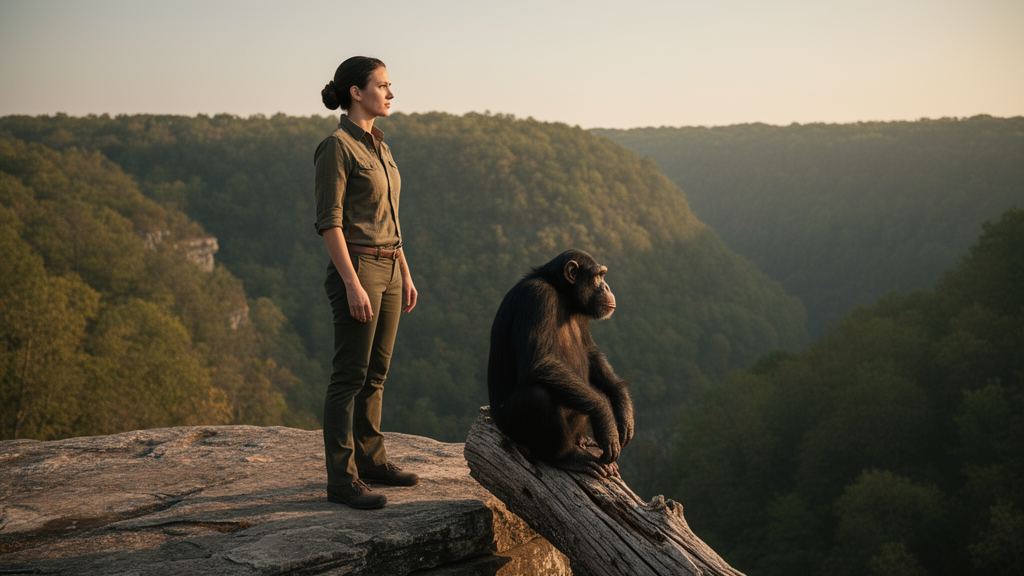
Humans and chimpanzees in leadership roles tend to be more willing to take risks, according to a new study published in The Leadership Quarterly by researchers at the Max Planck Institute for Human Development. The findings suggest an evolutionary link between leadership and risk-taking behavior, one that may stretch back to a common ancestor shared by the two species.
The human side of the study drew on data from more than 40,000 respondents in the Socio-Economic Panel (SOEP), a representative longitudinal study in Germany. The researchers compared respondents’ self-reported general risk-taking with their leadership status and income. People with leadership responsibilities reported, on average, a higher risk-taking propensity than those without leadership roles, and higher income was likewise associated with higher risk-taking. Notably, the relationship between leadership status and risk-taking did not differ across the sexes.
To test whether a similar pattern holds among our closest living relatives, the team analyzed data from 86 chimpanzees at sanctuaries in Uganda and Kenya. Long-time caregivers rated each animal’s willingness to take risks, and these ratings were compared with assessments of the chimpanzees’ social status within their groups. Higher-ranking chimpanzees were rated as more risk-taking than lower-ranking animals.
“What makes the findings compelling is that the link between leadership and risk-taking emerges in both humans and chimpanzees. As both species share a common ancestor, this relationship may have deep evolutionary roots,” the researchers note. The study thus provides new evidence that traits associated with leadership and social influence are not shaped exclusively by modern social structures but may already have played a role in early forms of social coexistence.
“The results suggest that the link between leadership and risk-taking may have deep evolutionary roots. The parallels between human and chimpanzee leaders in terms of their willingness to take risks suggest that this trait may have evolved in both species as an adaptive strategy for coping with competition in social hierarchies, as well as with the demands of uncertain and often hostile environments,” says lead author Lou Marie Haux, a postdoctoral researcher in the Center for Adaptive Rationality at the Max Planck Institute for Human Development.
Interestingly, the relationship was stronger in chimpanzees than in humans. According to the researchers, this could indicate that modern human societies have developed other routes to leadership positions—such as education, professional qualifications, and institutional frameworks—that reduce the need for aspiring leaders to take significant risks. In chimpanzee groups, where status is contested directly, a willingness to take risks may be a greater asset in climbing the hierarchy.
The authors are careful to stress that the findings establish a correlation, not a causal relationship. “We can’t be certain whether risk-taking humans are more likely to be selected into leadership positions or whether leadership roles make people more willing to take risks,” Haux explains. The longitudinal SOEP data, however, tend to support the first explanation: a higher propensity for risk-taking is often apparent even before people assume leadership roles. Whether this is indeed the case is a question for further studies.
The researchers emphasize that their findings should be seen as a starting point for further research. Future longitudinal and experimental studies could help to better understand the complex interplay between risk-taking, social status, and leadership—and shed more light on the evolutionary origins of these relationships. The team also plans to investigate whether similar patterns occur in other great ape species, such as bonobos.
At a glance, the study rests on more than 40,000 humans and 86 chimpanzees, combining data from the Socio-Economic Panel with observational data from chimpanzee sanctuaries in Uganda and Kenya. Humans in leadership positions report a higher willingness to take risks than those without leadership responsibilities, and the same holds for chimpanzees, where individuals with a higher rank in the social hierarchy are more willing to take risks. The parallels between the two species suggest that risk-taking may be a fundamental aspect of leadership and hierarchical structures—one whose origins long predate modern institutions.
Subject of Research: The relationship between leadership or social status and risk-taking behavior in humans and chimpanzees
Article Title: Human and chimpanzee leaders share a taste for risk
Article References: Human and chimpanzee leaders share a taste for risk. Original publication (Bibliographic details unavailable.)
Image Credits: AI Generated
DOI: Not provided
Keywords: risk-taking, leadership, chimpanzees, social hierarchy, evolution, Socio-Economic Panel, Max Planck Institute, behavioral science, The Leadership Quarterly, correlation, Human, chimpanzee
Cite Scienmag News
Gavin Prescott. (October 27, 2026). Risk-taking runs deep: leaders in humans and chimpanzees alike show bolder streaks. Scienmag. https://scienmag.com/risk-taking-runs-deep-leaders-in-humans-and-chimpanzees-alike-show-bolder-streaks/
Gavin Prescott. "Risk-taking runs deep: leaders in humans and chimpanzees alike show bolder streaks." Scienmag, 27 October 2026, https://scienmag.com/risk-taking-runs-deep-leaders-in-humans-and-chimpanzees-alike-show-bolder-streaks/. Accessed 27 October 2026.
Gavin Prescott. "Risk-taking runs deep: leaders in humans and chimpanzees alike show bolder streaks." Scienmag. October 27, 2026. https://scienmag.com/risk-taking-runs-deep-leaders-in-humans-and-chimpanzees-alike-show-bolder-streaks/


