

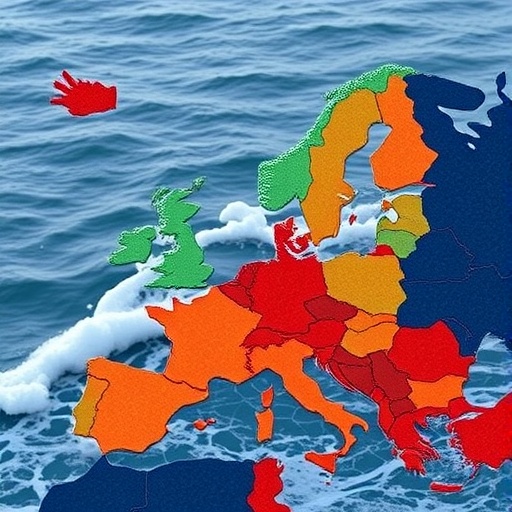
In an era defined by mounting climate uncertainties, a breakthrough study published in Nature Climate Change illuminates a critical dimension of the climate crisis: the vulnerability of Europe’s surface transport infrastructure to coastal flooding under various global warming scenarios. This comprehensive analysis provides an unprecedented understanding of how incremental temperature rises threaten to disrupt the transport networks that form the backbone of economic and social connectivity across the continent.
Coastal regions in Europe are home to dense networks of roads, railways, and bridges that facilitate the daily movement of millions of people and goods. However, these infrastructures face increasing peril from sea-level rise and the intensification of storm surges driven by climate change. This new research meticulously quantifies flood risks to these transport assets, correlating exposure with specific increments in global warming. By doing this, the authors deliver a forward-looking risk assessment that is crucial for policymakers, urban planners, and engineers aiming to safeguard these indispensable systems.
The study employs a robust methodological framework encompassing high-resolution flood modeling integrated with detailed infrastructure data to project inundation impacts under warming thresholds of 1.5°C, 2°C, and 3°C above pre-industrial levels. These benchmarks align with global climate policy targets, offering tangible reference points to evaluate potential consequences. The synthesis of climate projections and infrastructure mapping enables a granular spatial analysis, highlighting hotspots where flood risk escalates sharply with each degree of warming.
Results reveal a disconcerting pattern: even modest increases in global temperature substantially elevate flood hazards for key transport corridors. For instance, at 1.5°C warming, the risk of flooding-related disruptions to coastal roads and railways begins to rise sharply in low-lying deltaic zones, including the Netherlands, Belgium, and parts of Germany. Should warming reach 2°C or higher, extensive sections of critical infrastructure across southern and western Europe become increasingly vulnerable to frequent coastal flooding events, threatening operational continuity.
The implications extend beyond immediate physical damage. Flood-induced interruptions in transport services could cascade through economic systems, impairing supply chains, hampering commuter mobility, and exacerbating regional disparities. The researchers emphasize that routes vital for emergency services, freight movement, and international trade are disproportionately at risk, underscoring the urgency for resilience-building investments and adaptive planning.
One of the study’s key revelations is the non-linear amplification of risk with temperature rise. The jump from 1.5°C to 2°C warming significantly compounds flood exposure in densely populated coastal regions, suggesting that small changes in climate targets could have outsized impacts on infrastructural integrity. This sensitivity highlights the paramount importance of aggressive climate mitigation alongside adaptive strategies to curb the escalation of vulnerability.
Furthermore, the researchers underscore the interplay between engineered coastal defenses and climate dynamics. While existing seawalls and dikes provide some protection, their efficacy wanes as sea levels rise and storm intensities increase. Without substantial upgrades or redesigns, infrastructure behind these barriers remains precariously exposed to overtopping and breaches. The study advocates for a paradigm shift towards integrated coastal zone management that balances hard defenses with natural adaptation solutions like wetland restoration.
The analysis also delves into temporal dimensions of risk, projecting that frequency and severity of flood events disrupting transport infrastructure will intensify considerably within the coming decades. This foresight challenges conventional infrastructure design lifespans and compels reassessment of maintenance, retrofitting, and replacement cycles in light of evolving climate risks. The findings resonate as a clarion call for incorporating climate resilience into all stages of transport infrastructure lifecycle management.
Technically, the study leverages ensemble modeling approaches that incorporate uncertainty ranges from climate projections to better estimate probabilistic flood risks. This rigorous quantification adds confidence to predicted outcomes and enables stakeholders to evaluate risk tolerance and prioritize interventions systematically. The granularity of spatial and temporal projections also facilitates tailored solutions suited to local conditions rather than one-size-fits-all approaches.
Highlighting differences across European regions, the research reveals a mosaic of risk profiles shaped by geomorphology, urbanization patterns, and existing protection infrastructure. Northern European countries, while seeing elevated risks, may have greater adaptive capacity and resources. Conversely, some Mediterranean coasts face rapidly increasing vulnerabilities with fewer systemic safeguards. This variability necessitates transnational coordination to manage shared challenges and cross-border transport network dependencies.
The authors do not shy away from acknowledging limitations, noting the need for further refinement in accounting for compound flooding phenomena where coastal surge interacts with riverine flooding and pluvial events. Also, socio-economic factors such as population growth and urban expansion in coastal zones, which could exacerbate exposure and vulnerability, are recommended areas for integration in future research.
This work stands as a pivotal contribution to the evolving discourse on climate impacts, bridging the traditionally siloed fields of climate science, transport engineering, and urban resilience. By harnessing interdisciplinary approaches and cutting-edge climate data, it maps a vital pathway for safeguarding Europe’s infrastructure at a time when the stakes have never been higher.
As climate policy debates unfold globally, this research provides a scientific compass directing attention to the tangible, localized consequences of temperature thresholds on critical human systems. Its findings should galvanize public and private sectors to embed climate risks into strategic planning now, before irreversible damage challenges recovery efforts and economic stability.
In sum, the study transforms abstract climate targets into concrete predictions of flood risk exposure, delivering critical intelligence for infrastructure resilience planning. As Europe grapples with the dual imperative of decarbonization and adaptation, such granular risk assessments become indispensable tools for crafting sustainable futures where transport networks remain viable lifelines, not liabilities, amidst a warming world.
The integration of detailed geospatial analyses, climate model outputs, and infrastructure vulnerability data marks this research as a template for similar assessments worldwide. Its methodological rigor and policy relevance exemplify how science can proactively inform climate adaptation pathways, translating theory into practice with urgent implications for millions of lives and livelihoods.
In conclusion, the increasing flood risk to Europe’s coastal transport infrastructure starkly illustrates the broader challenges imposed by climate change. Unless significant mitigation efforts are paired with adaptive innovations, rising sea levels and extreme weather events will compromise the very frameworks that underpin economic integration and social cohesion. This research not only warns of looming threats but also lights the way toward resilient, future-proof infrastructure strategies essential for sustainable progress.
Subject of Research: Coastal flood risk to European surface transport infrastructure in relation to different global warming thresholds
Article Title: Coastal flood risk to European surface transport infrastructure at different global warming levels
Article References:
Nawarat, K., Reyns, J., Vousdoukas, M.I. et al. Coastal flood risk to European surface transport infrastructure at different global warming levels. Nat. Clim. Chang. (2026). https://doi.org/10.1038/s41558-025-02510-y
Image Credits: AI Generated


