

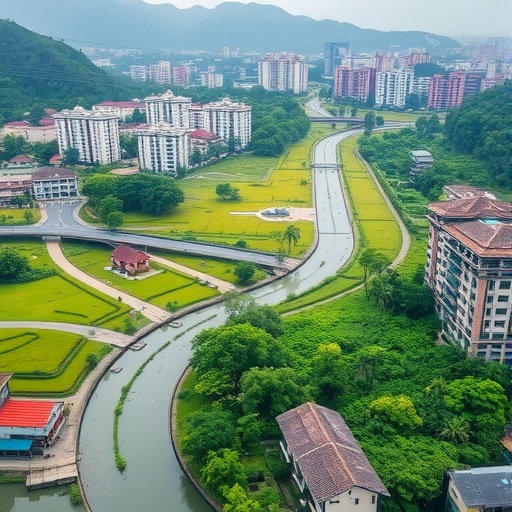
As urbanization accelerates across the globe, the delicate balance between natural ecosystems and human development faces unprecedented challenges. In China, a country experiencing some of the most rapid urban transformations in history, new research sheds light on a critical and often overlooked consequence of this growth: the growing inequality in the distribution of ecosystem services within urban–rural transition zones. This phenomenon not only threatens environmental sustainability but also poses significant risks for social equity and long-term urban resilience. The implications resonate deeply with the United Nations’ Sustainable Development Goal 11.3, which calls for inclusive, safe, resilient, and sustainable cities.
The study, conducted by Qu, Li, Yu, and colleagues, and published in npj Urban Sustain, delves into the spatial and social disparities of ecosystem service distribution amidst China’s rapidly evolving urban landscapes. Ecosystem services refer to the myriad benefits humans derive from natural environments—ranging from air and water purification, climate regulation, flood control, to recreational and cultural values. These services are essential for maintaining human health, economic vitality, and social well-being. However, as urban boundaries expand into rural territories, these services become unevenly distributed, often privileging urban centers while marginalizing peripheral and rural populations.
At the heart of this research lies a methodological innovation combining high-resolution spatial analysis with socio-economic and demographic data sets. By integrating satellite imagery, land use mapping, and socio-economic indicators, the authors constructed detailed ecosystem service distribution profiles across the urban–rural continuum of multiple Chinese metropolitan regions. This approach reveals not just the geographical distribution of ecological benefits but also the patterns of access and deprivation among diverse communities. Such granularity enables a striking understanding of how urban expansion deepens pre-existing inequalities or creates new divides in access to natural capital.
Through their analytical framework, the researchers found stark contrasts between urban cores and surrounding transition zones. While urban centers often see engineered green spaces, managed parks, and other designed ecological benefits, transition zones frequently experience habitat fragmentation, agricultural decline, and pollution. These changes drastically diminish their capacity to provide natural services such as flood mitigation and air purification. Furthermore, social groups residing in these transition zones—typically migrants, low-income farmers, and displaced communities—face compounded environmental disadvantages, exacerbating vulnerability and marginalization.
One of the more alarming revelations from the study is the temporal trend of increasing inequality. Over recent decades, while China’s urban regions have witnessed improvements in some urban ecosystem services, the benefits in peri-urban and rural fringes have stagnated or worsened. This divergence implies that rapid urban growth, if left unchecked by strategic planning, risks deepening the urban-rural divide in ecological benefits. Such disparity undermines overall sustainability goals, as ecosystems outside urban cores play crucial roles in regional climate regulation, biodiversity conservation, and food production.
Technically, the research underscores the importance of multi-dimensional indices that incorporate not only ecological parameters but also social metrics to quantify and monitor ecosystem service equity. Conventional environmental assessments have often overlooked this equity aspect, focusing instead solely on environmental quality or quantity. By introducing a composite inequality index, the authors brought a novel and quantifiable perspective on how ecosystem services are distributed across spatial and socio-economic gradients.
The findings have immediate policy relevance for urban planners, environmental managers, and policymakers striving to align urban development with Sustainable Development Goal 11.3. The goal emphasizes enhancing inclusive and sustainable urbanization and participatory urban planning. Yet, the growing inequality of ecosystem services poses a challenge to these ideals, requiring integrated solutions that bridge ecological restoration with social inclusion. The study advocates for policies promoting green infrastructure investments not just in affluent urban districts but critically in transition zones where vulnerability is highest.
Ecological restoration strategies highlighted include afforestation, wetland rehabilitation, and sustainable agricultural practices designed to enhance ecosystem functionality in peri-urban areas. Moreover, urban-rural governance frameworks must evolve to include cross-jurisdictional collaboration, ensuring transitional areas do not fall outside regulatory protections or funding mechanisms. The study stresses that ecosystem services cannot be viewed as isolated environmental commodities but as socio-ecological assets requiring equitable governance.
From a technical perspective, the research further demonstrates the effectiveness of remote sensing combined with household survey data to map disparities at fine scales. The ability to monitor ecosystem benefits continuously enables the identification of hotspots of deprivation and success, informing targeted interventions. Additionally, scenario modeling included in the study forecasts how different urban growth trajectories might exacerbate or alleviate ecosystem service inequalities, providing foresight critical for sustainable urban planning.
The implications extend beyond China, offering valuable lessons for other rapidly urbanizing nations. Many developing countries encountering similar urban-rural transitions can leverage this integrated approach to understand local ecosystem service dynamics and address emerging social inequities stemming from environmental changes. In contexts where informal settlements and peri-urban agriculture are prevalent, the balance between development and ecosystem preservation is precarious but essential for SDG 11.3 compliance.
Importantly, the research calls for a paradigm shift in how urban sustainability is conceptualized. It urges moving beyond a city-centric approach to one that embraces the urban-rural continuum as an interconnected socio-ecological system. Such a perspective recognizes that the well-being of urban residents depends heavily on the ecological integrity of surrounding landscapes, which in turn require equitable management and investment. Only with such holistic thinking can the hidden inequalities of ecosystem services be mitigated.
The study also highlights potential social consequences of neglecting urban–rural ecosystem service disparities. Environmental injustices can manifest through health impacts, loss of livelihoods, food insecurity, and displacement risks. These outcomes threaten the social fabric and economic stability of transition zone populations, potentially triggering cycles of poverty and migration that strain urban infrastructures and governance capacities further.
This research arrives at a critical juncture as China embarks on ambitious urbanization plans amidst growing concerns about ecological degradation and social equity. It acts as both a diagnostic tool and a call to action for policy reforms that integrate ecological, social, and spatial justice considerations. The authors propose that future sustainable urban development must embed ecosystem service equity metrics within planning and monitoring frameworks, ensuring progress toward SDG 11.3 is both environmentally sound and socially just.
In summary, the increasing inequality of ecosystem service distribution in China’s urban–rural transition zones reveals complex and pressing challenges confronting rapid urbanization processes. Through innovative spatial and socio-economic analyses, Qu, Li, Yu, and their team offer vital insights that redefine urban sustainability paradigms. Their work not only expands academic understanding but provides actionable pathways for ensuring that vibrant urban futures are inclusive, equitable, and ecologically balanced. As cities worldwide grapple with similar transitions, this study stands as a pioneering contribution towards harmonizing urban growth with planetary stewardship and social fairness.
Subject of Research:
Ecosystem service distribution inequality in urban–rural transition zones in China and its implications for sustainable urbanization under SDG 11.3.
Article Title:
Growing inequality of ecosystem service distribution in China’s urban–rural transition zones: implications for SDG 11.3
Article References:
Qu, S., Li, D., Yu, X. et al. Growing inequality of ecosystem service distribution in China’s urban–rural transition zones: implications for SDG 11.3. npj Urban Sustain (2026). https://doi.org/10.1038/s42949-026-00376-3
Image Credits:
AI Generated


