

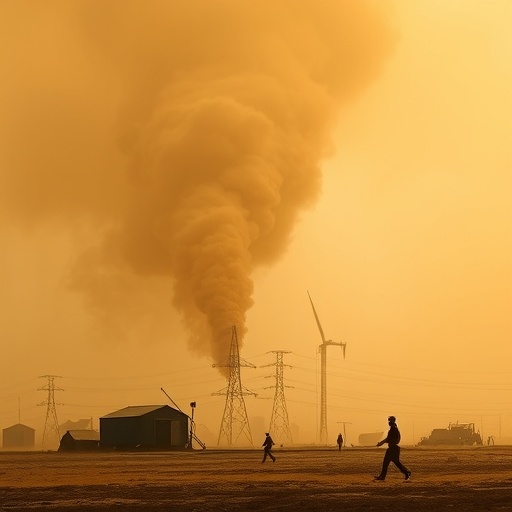
Dust Storms in Central East Asia Surge After Two Decades of Decline: Mongolia Emerges as a Key Dust Source
Central East Asia has recently witnessed a startling resurgence of dust storms following a prolonged period of decline lasting more than twenty years. A team of researchers from the Northwest Institute of Eco-Environment and Resources, affiliated with the Chinese Academy of Sciences, has uncovered compelling evidence that Mongolia has emerged as a predominant contributor to dust emissions within this region. This shift in dust source dynamics has profound implications for regional air quality, environmental management, and cross-border collaboration.
Leveraging advanced modeling techniques, the research team employed the Wind Erosion Prediction System (WEPS) to simulate and quantify hourly dust emissions resulting from 136 significant dust events between 2000 and 2023. This comprehensive analysis encompassed the principal dust-emitting landscapes of northern China and Mongolia. The model incorporated multifaceted input data including high-resolution temporal and spatial measurements of wind velocity, soil texture composition, vegetation cover, and soil moisture levels. Such integrative data assimilation allowed for robust and granular estimations of dust emission fluxes with unprecedented temporal precision.
Through this meticulous data synthesis, the study revealed a clear downward trajectory in both the frequency and intensity of dust storms from the early 2000s up through 2020. However, this favorable trend abruptly reversed in the following years. Between 2020 and 2023, total dust emissions ballooned dramatically—rising more than sevenfold from an estimated 5.7 million metric tons to over 40 million metric tons. Concurrently, the annual count of significant dust storm events surged from an average of three to approximately five. This reversal signals a new era of intensified dust activity posing renewed challenges for environmental policy and public health in the region.
A notable transformation lies in the provenance of dust emissions. The proportion attributable to Mongolia has steadily increased over the past two decades, escalating from 43% in the early 2000s to a dominant 64% during a prominent regional dust storm in April 2023. Conversely, northern China’s relative contribution has diminished, reflecting the impact of ongoing ecological restoration efforts there. The progressive enlarging of Mongolia’s dust emission role underscores a fundamental redistribution of dust source areas within Central East Asia, altering regional atmospheric dust dynamics significantly.
The study identifies three primary factors driving this resurgence in dust activity across Mongolia: escalating surface wind speeds, degradation of vegetation cover, and reductions in soil moisture content. Quantitative attribution suggests that intensified winds are the dominant influence, accounting for approximately 46% of the variance in dust emissions. Diminishing vegetation cover contributes about 19%, while declining soil moisture levels account for some 9%. Collectively, these conditions have created highly erodible landscapes vulnerable to wind erosion and dust mobilization.
Climatological phenomena such as enhanced Mongolian cyclone activity and protracted drought conditions have exacerbated these environmental changes. The Gobi Desert region, in particular, has experienced sustained soil drying and vegetation stress, facilitating large-scale particulate matter lofting into the atmosphere. These natural drivers have combined with anthropogenic land use pressures to accelerate dust storm genesis and expansion. Meanwhile, ecological restoration projects implemented in northern China—including reforestation and soil stabilization efforts—appear to have mitigated local dust emissions, contributing to the observed north-south source shift.
The ramifications of this dust source shift extend beyond environmental degradation and regional air quality deterioration. Transboundary dust transport can profoundly affect atmospheric conditions, human health outcomes, and economic activities across Central East Asia and beyond. This highlights the critical need for enhanced cross-border cooperation, shared monitoring infrastructures, and integrated early warning systems. The researchers advocate establishing coordinated observation networks between China and Mongolia to improve real-time tracking of dust plumes and better predict the timing and intensity of dust storm incursions.
Scientific advancements in remote sensing and computational modeling have enabled this new understanding of Central East Asia’s evolving dust emission landscape. Combining satellite data with ground-based measurements and predictive erosion modeling provides a multidimensional perspective on dust flux trends. Such insights are vital for formulating effective mitigation strategies aimed at reducing public exposure to harmful particulate matter and safeguarding fragile ecosystems.
The study, titled “Source shifting and contributions to Central East Asia dust events during 2000–2023,” represents a landmark contribution to the field of atmospheric science and regional environmental management. The detailed longitudinal analysis captured in this paper—published in the prestigious journal Science China Earth Sciences—underscores a complex interplay of climatic, ecological, and anthropogenic factors shaping dust storm activity. Its findings offer a refreshed perspective on dust dynamics essential for policymakers, researchers, and stakeholders engaged in Central East Asia’s environmental future.
These revelations also usher in urgent calls for sustainable land management approaches tailored to Mongolia’s unique ecological and climatic context. Restoring vegetation, improving soil conservation, and mitigating drought impacts will be pivotal to stemming the rise in dust emissions. Moreover, fostering dialogue and joint initiatives between national governments and scientific institutions is indispensable to address this transboundary environmental issue effectively.
In summary, after two decades of decline, dust storms in Central East Asia have staged a sharp comeback driven predominantly by Mongolia’s expanding contribution linked to stronger winds, vegetation loss, and soil moisture depletion. This shift underscores the necessity of coordinated monitoring, transnational cooperation, and integrated mitigation efforts to confront the mounting challenges posed by dust storms in this geopolitically sensitive and environmentally vulnerable region.
Subject of Research: Changes in dust emissions and source contributions in Central East Asia dust storms from 2000 to 2023, with emphasis on shifting dust sources between Mongolia and northern China.
Article Title: Source shifting and contributions to Central East Asia dust events during 2000–2023
News Publication Date: 2024-06 (Month and year correspond with recent publication timing)
Web References: Not explicitly provided in the summary
References: Xing Y, Liu B, Wagner L E, Qu J. 2025. Source shifting and contributions to Central East Asia dust events during 2000–2023. Science China Earth Sciences, 68(11): 3804–3816. DOI: 10.1007/s11430-024-1706-5
Image Credits: © Science China Press
Keywords: dust storm, Central East Asia, Mongolia, northern China, dust emissions, Wind Erosion Prediction System, soil erosion, vegetation degradation, soil moisture, environmental monitoring, transboundary pollution, climate impacts


